ZK vs ETH: The Battle for Scalability in the Blockchain Arena

Introduction: Investment Comparison between ZK and ETH
In the cryptocurrency market, ZK vs ETH comparison has always been a topic that investors can't avoid. The two not only have significant differences in market cap ranking, application scenarios, and price performance, but also represent different cryptocurrency asset positioning.
ZKsync (ZK): Launched as an ever-expanding verifiable blockchain network secured by math.
Ethereum (ETH): Since its launch in 2015, it has been hailed as a decentralized, open-source blockchain platform supporting smart contracts and decentralized applications (DApps), and is one of the cryptocurrencies with the highest global trading volume and market capitalization.
This article will comprehensively analyze the investment value comparison between ZK and ETH, focusing on historical price trends, supply mechanisms, institutional adoption, technological ecosystems, and future predictions, and attempt to answer the question that investors care about most:
"Which is the better buy right now?"
I. Price History Comparison and Current Market Status
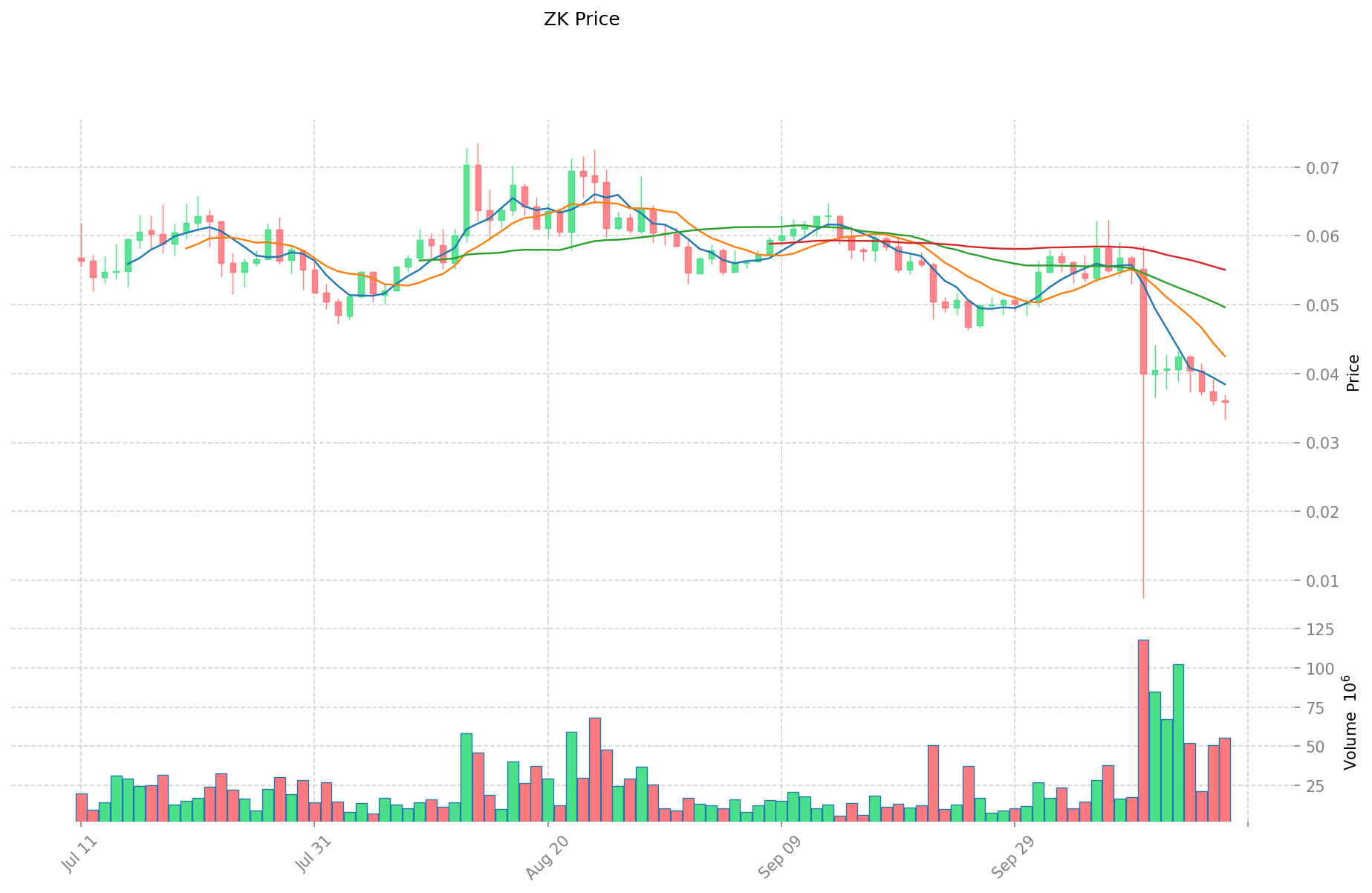
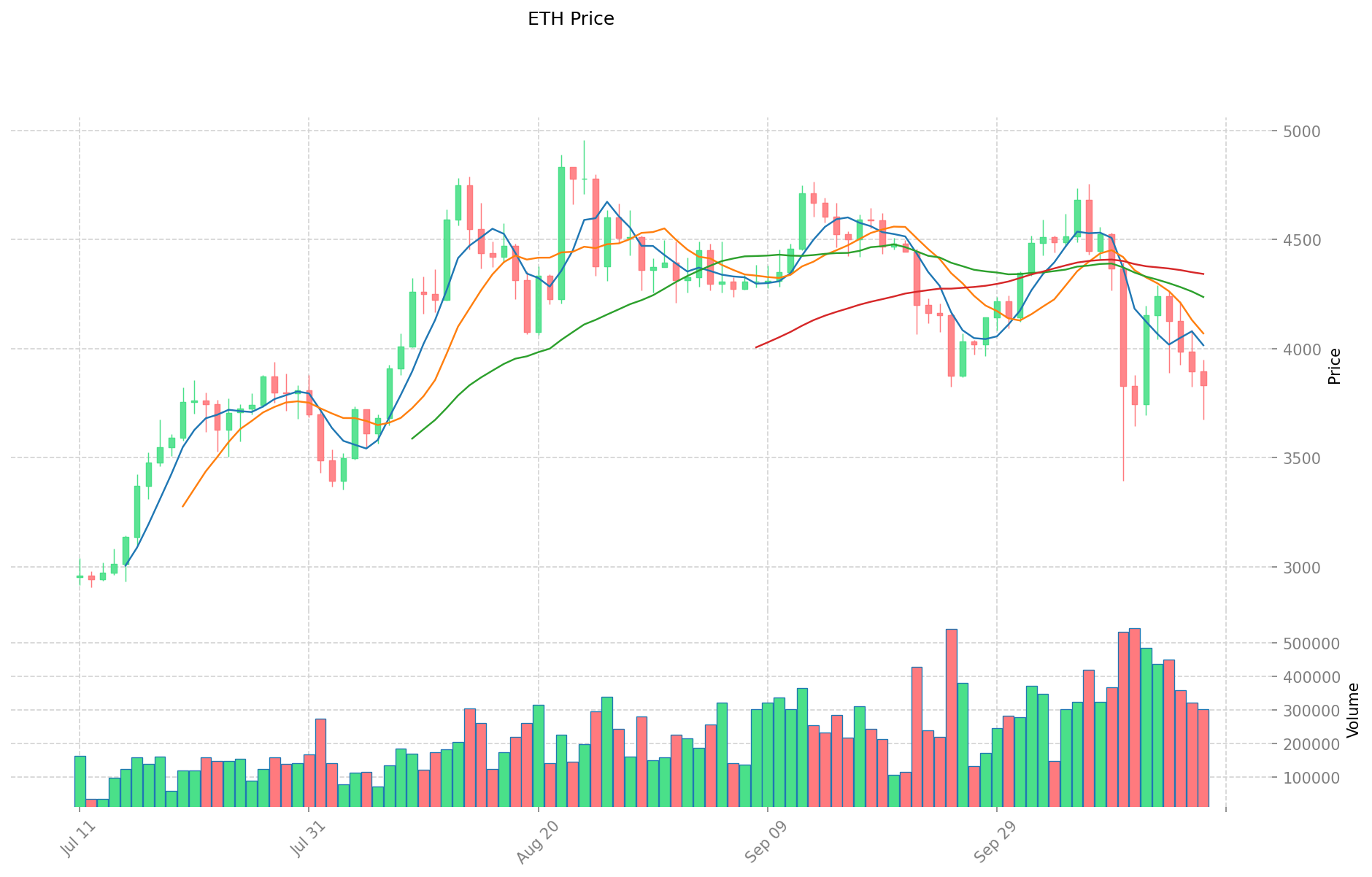
ZK (Coin A) and ETH (Coin B) Historical Price Trends
- 2024: ZK reached its all-time high of $0.367 on June 17, 2024.
- 2025: ETH hit a new all-time high of $4,946.05 on August 25, 2025.
- Comparative Analysis: In the recent market cycle, ZK dropped from its high of $0.367 to a low of $0.00736 on October 10, 2025, while ETH has shown more resilience, currently trading at $3,831.96.
Current Market Situation (2025-10-18)
- ZK current price: $0.03597
- ETH current price: $3,831.96
- 24-hour trading volume: ZK $1,941,648.25 vs ETH $1,147,092,593.11
- Market Sentiment Index (Fear & Greed Index): 22 (Extreme Fear)
Click to view real-time prices:
- View ZK current price Market Price
- View ETH current price Market Price
II. Key Factors Affecting Investment Value of ZK vs ETH
Supply Mechanism Comparison (Tokenomics)
- ETH: Ethereum transitioned to a deflationary model after EIP-1559 implementation, with token burning mechanism based on network usage
- ZK tokens: Various ZK projects have different tokenomics; some implement fixed supply models while others have inflationary mechanisms with governance features
- 📌 Historical pattern: Deflationary assets like ETH tend to gain value over time as demand increases against decreasing supply, while ZK tokens' value depends more on adoption and utility within their respective ecosystems.
Institutional Adoption and Market Applications
- Institutional holdings: ETH has significantly more institutional adoption with major funds, corporations, and ETFs integrating Ethereum
- Enterprise adoption: ETH is widely used for settlement and as a foundation for enterprise blockchain solutions; ZK solutions primarily adopted for specific use cases requiring privacy and scaling
- Regulatory attitudes: Most jurisdictions view ETH favorably as a non-security commodity; ZK projects face varying regulatory scrutiny depending on their specific functionality and governance
Technological Development and Ecosystem Building
- ETH technological upgrades: Continuing rollout of the Ethereum scaling roadmap with focus on sharding and L2 integration
- ZK technological development: Rapid innovation in zero-knowledge proof systems, with improvements in proving speed and implementation efficiency
- Ecosystem comparison: ETH has a mature ecosystem spanning DeFi, NFTs, payments and smart contracts; ZK projects are building specialized ecosystems focused on privacy-preserving applications and scaling solutions
Macroeconomic and Market Cycles
- Performance during inflation: ETH has demonstrated some store-of-value properties but remains highly volatile; ZK tokens generally correlate with broader crypto market movements
- Macroeconomic monetary policy: Both asset classes show sensitivity to interest rates and dollar strength, with risk-on environments generally favoring growth
- Geopolitical factors: Increased cross-border transaction demand and regulatory uncertainty can benefit both ETH and privacy-focused ZK solutions
III. 2025-2030 Price Prediction: ZK vs ETH
Short-term Prediction (2025)
- ZK: Conservative $0.0243 - $0.0358 | Optimistic $0.0358 - $0.0487
- ETH: Conservative $2750.51 - $3820.16 | Optimistic $3820.16 - $4736.99
Mid-term Prediction (2027)
- ZK may enter a growth phase, with estimated price range $0.0480 - $0.0747
- ETH may enter a consolidation phase, with estimated price range $3576.89 - $6125.42
- Key drivers: Institutional inflows, ETF, ecosystem development
Long-term Prediction (2030)
- ZK: Base scenario $0.0636 - $0.0815 | Optimistic scenario $0.0815 - $0.0897
- ETH: Base scenario $7524.35 - $7757.06 | Optimistic scenario $7757.06 - $9386.05
Disclaimer: This analysis is for informational purposes only and should not be considered as financial advice. Cryptocurrency markets are highly volatile and unpredictable. Always conduct your own research before making investment decisions.
ZK:
| 年份 | 预测最高价 | 预测平均价格 | 预测最低价 | 涨跌幅 |
|---|---|---|---|---|
| 2025 | 0.0487832 | 0.03587 | 0.0243916 | 0 |
| 2026 | 0.062220102 | 0.0423266 | 0.03809394 | 17 |
| 2027 | 0.07475089193 | 0.052273351 | 0.04809148292 | 45 |
| 2028 | 0.08828184883635 | 0.063512121465 | 0.04509360624015 | 76 |
| 2029 | 0.087281532923276 | 0.075896985150675 | 0.044779221238898 | 111 |
| 2030 | 0.089748184940673 | 0.081589259036975 | 0.06363962204884 | 126 |
ETH:
| 年份 | 预测最高价 | 预测平均价格 | 预测最低价 | 涨跌幅 |
|---|---|---|---|---|
| 2025 | 4736.9984 | 3820.16 | 2750.5152 | 0 |
| 2026 | 4663.651328 | 4278.5792 | 3850.72128 | 11 |
| 2027 | 6125.42791168 | 4471.115264 | 3576.8922112 | 16 |
| 2028 | 7576.5283706112 | 5298.27158784 | 4185.6345543936 | 38 |
| 2029 | 9076.733970708096 | 6437.3999792256 | 3283.073989405056 | 67 |
| 2030 | 9386.05103970988608 | 7757.066974966848 | 7524.35496571784256 | 102 |
IV. Investment Strategy Comparison: ZK vs ETH
Long-term vs Short-term Investment Strategy
- ZK: Suitable for investors focused on scaling solutions and privacy-preserving applications
- ETH: Suitable for investors seeking a more established ecosystem and potential store of value
Risk Management and Asset Allocation
- Conservative investors: ZK: 10% vs ETH: 90%
- Aggressive investors: ZK: 30% vs ETH: 70%
- Hedging tools: Stablecoin allocation, options, cross-currency portfolio
V. Potential Risk Comparison
Market Risk
- ZK: Higher volatility, less liquidity, and potential for rapid price swings
- ETH: Susceptible to broader crypto market trends and macroeconomic factors
Technical Risk
- ZK: Scalability challenges, network stability
- ETH: Mining centralization, security vulnerabilities
Regulatory Risk
- Global regulatory policies may impact both differently, with ETH generally viewed more favorably by regulators
VI. Conclusion: Which Is the Better Buy?
📌 Investment Value Summary:
- ZK advantages: Potential for high growth, focus on privacy and scalability solutions
- ETH advantages: Established ecosystem, institutional adoption, deflationary mechanism
✅ Investment Advice:
- New investors: Consider allocating a larger portion to ETH for stability
- Experienced investors: Balanced portfolio with both ETH and ZK, adjusting based on risk tolerance
- Institutional investors: Focus on ETH for liquidity and regulatory clarity, with selective exposure to ZK projects
⚠️ Risk Warning: Cryptocurrency markets are highly volatile. This article does not constitute investment advice. None
VII. FAQ
Q1: What are the main differences between ZK and ETH? A: ZK focuses on scalability and privacy solutions, while ETH is a more established ecosystem supporting smart contracts and decentralized applications. ETH has a larger market cap, higher trading volume, and more institutional adoption compared to ZK.
Q2: Which cryptocurrency has shown better price performance recently? A: ETH has shown more resilience in the recent market cycle. While ZK dropped significantly from its all-time high, ETH has maintained a higher relative price and currently trades at $3,831.96.
Q3: How do the supply mechanisms of ZK and ETH differ? A: ETH has transitioned to a deflationary model with token burning based on network usage. ZK tokens vary depending on the specific project, with some implementing fixed supply models and others using inflationary mechanisms with governance features.
Q4: What are the key factors affecting the investment value of ZK and ETH? A: Key factors include supply mechanisms, institutional adoption, technological development, ecosystem building, and macroeconomic conditions. ETH generally has an advantage in most of these areas due to its more established position in the market.
Q5: How do the long-term price predictions for ZK and ETH compare? A: By 2030, ZK is predicted to reach $0.0636 - $0.0897 in optimistic scenarios, while ETH is expected to reach $7,524.35 - $9,386.05. ETH is projected to have higher absolute growth, but ZK may offer higher percentage returns from its current lower price point.
Q6: What investment strategies are recommended for ZK and ETH? A: For conservative investors, a suggested allocation is 10% ZK and 90% ETH. For aggressive investors, the recommendation is 30% ZK and 70% ETH. New investors may want to allocate more to ETH for stability, while experienced investors might balance their portfolio between both assets.
Q7: What are the main risks associated with investing in ZK and ETH? A: Both face market risks related to crypto volatility. ZK has higher volatility and less liquidity, while ETH is more susceptible to broader market trends. Technical risks include scalability challenges for ZK and potential security vulnerabilities for ETH. Regulatory risks may impact both, with ETH generally viewed more favorably by regulators.
Share
Content
Introduction: Investment Comparison between ZK and ETH
I. Price History Comparison and Current Market Status
II. Key Factors Affecting Investment Value of ZK vs ETH
III. 2025-2030 Price Prediction: ZK vs ETH
IV. Investment Strategy Comparison: ZK vs ETH
V. Potential Risk Comparison
VI. Conclusion: Which Is the Better Buy?
VII. FAQ
How to Buy Cryptocurrency


Trending Cryptocurrencies



SCR vs STX: Analyzing the Performance and Future Potential of Two Emerging Cryptocurrencies

What is LA: A Complete Guide to Los Angeles and Its Culture, History, and Attractions
Viction's Whitepaper Logic: Driving 75.6% Growth with Zero-Gas Innovations in 2025

Aptos vs Giants: Performance Analysis & Market Share of This Rising Layer 1 Blockchain

How Prove Crypto Leverages Zero Knowledge Proofs for Blockchain Scalability

Top Layer 2 Solutions: A Comprehensive List in 2025

What is Unibase (UB) market cap and 24-hour trading volume in 2026?

What are the major security risks and regulatory challenges facing crypto exchanges like gate in 2026?
Ethereum ETF Outflows: Key Insights and What They Mean for the Crypto Market
How Do MACD, RSI, and Bollinger Bands Signal TRX Trading Opportunities in 2026?

Crypto Week: A Landmark Moment for Digital Asset Regulation in the United States