HYPE vs MANA: The Battle of Digital Assets in the Metaverse Economy

2025-10-15 03:45:25
Altcoins
Crypto Insights
DeFi
Investing In Crypto
Metaverse Crypto
Article Rating : 3
0 ratings
The article "HYPE vs MANA: The Battle of Digital Assets in the Metaverse Economy" provides an in-depth comparison between Hyperliquid (HYPE) and Decentraland (MANA), two prominent digital assets in the cryptocurrency market. It addresses investment value, historical price trends, supply mechanisms, institutional adoption, technical ecosystems, and market sentiment, guiding investors on whether HYPE or MANA is the better buy. Ideal for investors seeking to understand the dynamics of DeFi infrastructure (HYPE) and metaverse engagement (MANA), the article progresses logically from price history, key influencing factors, mid-to-long-term price predictions, to investment strategies and risk assessments, concluding with a comprehensive investment advice.
HYPE vs MANA: The Battle of Digital Assets in the Metaverse Economy

Introduction: Investment Comparison between HYPE and MANA

In the cryptocurrency market, the comparison between Hyperliquid (HYPE) vs Decentraland (MANA) has always been a topic that investors can't ignore. The two not only have significant differences in market cap ranking, application scenarios, and price performance, but also represent different cryptocurrency positions.

Hyperliquid (HYPE): Since its launch, it has gained market recognition for its high-performance L1 optimized for a fully on-chain open financial system.

Decentraland (MANA): Since its inception in 2017, it has been hailed as a blockchain-based virtual world platform, and is one of the cryptocurrencies with high global trading volume and market capitalization.

This article will comprehensively analyze the investment value comparison between HYPE vs MANA, focusing on historical price trends, supply mechanisms, institutional adoption, technical ecosystems, and future predictions, and attempt to answer the question that investors are most concerned about:

"Which is the better buy right now?"

I. Price History Comparison and Current Market Status

  • 2024: HYPE experienced significant growth due to its launch and initial adoption, with prices rising from $6.20 to $35.03.
  • 2021: MANA saw a major price surge influenced by the metaverse hype, reaching an all-time high of $5.85.
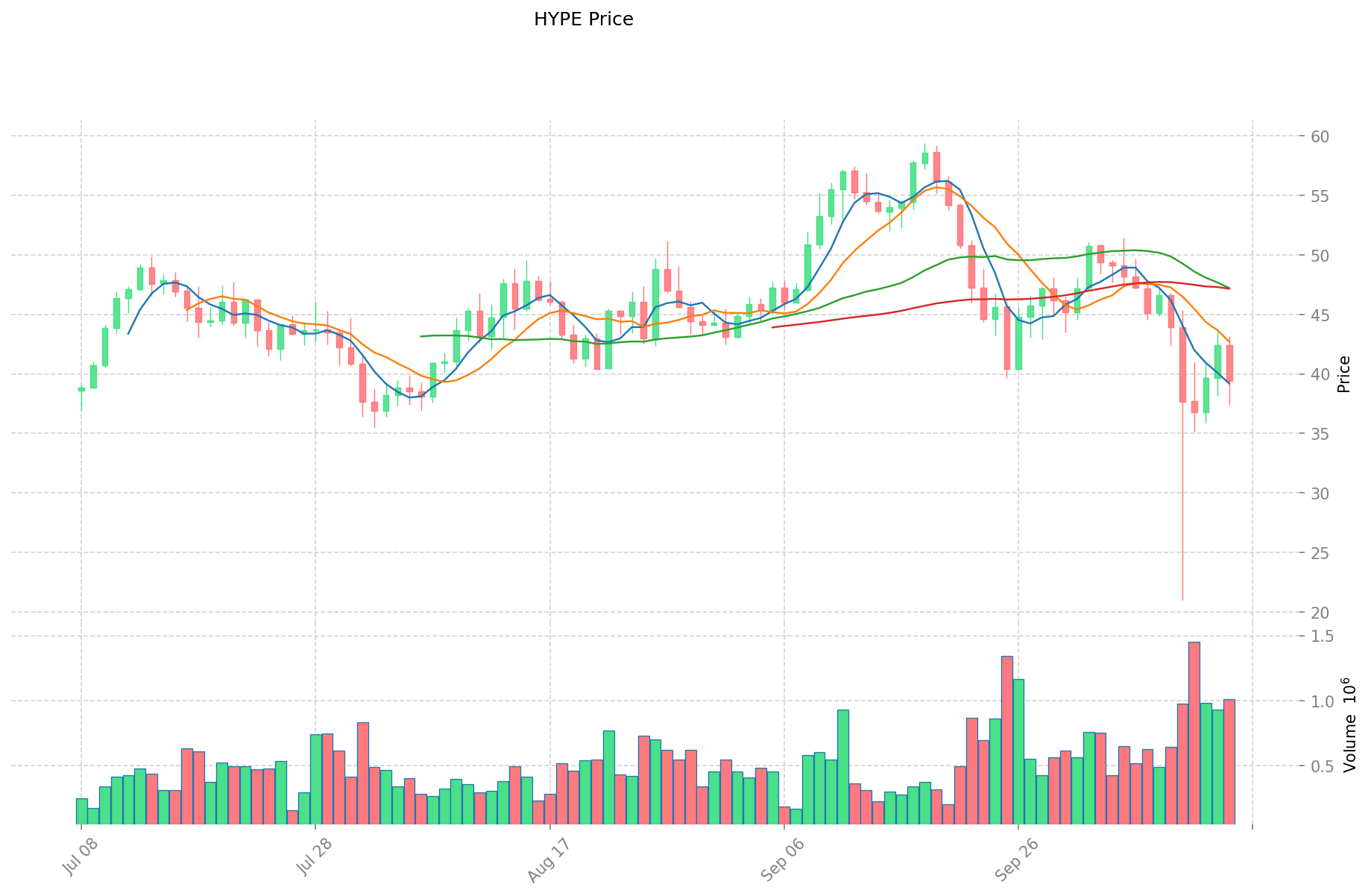
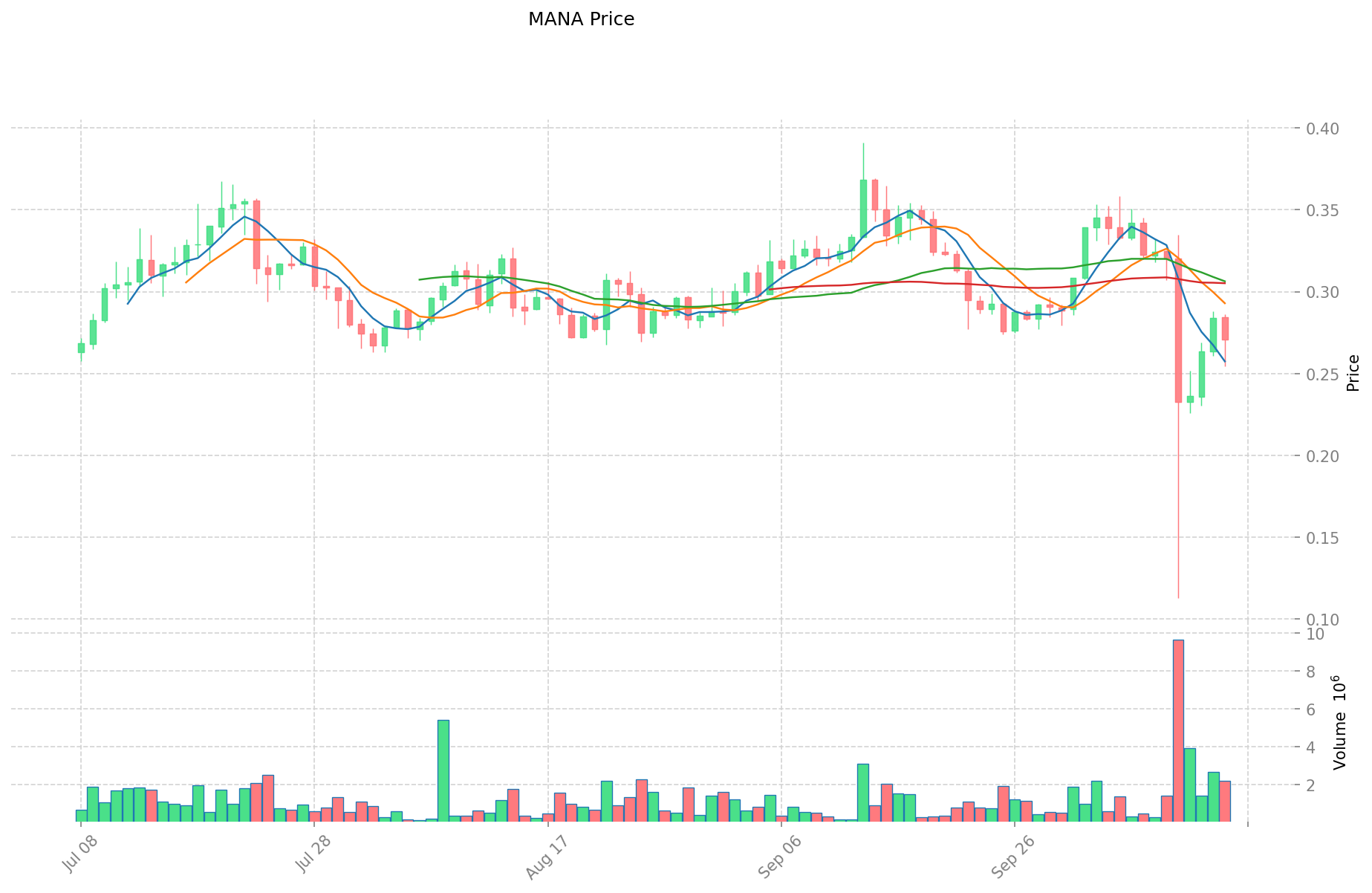
  • Comparative analysis: During the recent market cycle, HYPE rose from its low of $3.20 to a high of $59.39, while MANA declined from its peak of $5.85 to current levels around $0.32.

Current Market Situation (2025-10-15)

  • HYPE current price: $39.295
  • MANA current price: $0.2692
  • 24-hour trading volume: HYPE $38,566,545 vs MANA $576,364
  • Market sentiment index (Fear & Greed Index): 34 (Fear)

Click to view real-time prices:

price_image1 price_image2

Key Factors Influencing HYPE vs MANA Investment Value

Supply Mechanism Comparison (Tokenomics)

  • HYPE: Fixed supply cap of 1 billion tokens, integrated into Hyperliquid's decentralized exchange ecosystem with transaction fee discounts and staking options
  • MANA: Ethereum-based utility token with fixed supply, used for transactions and governance in the Decentraland metaverse
  • šŸ“Œ Historical pattern: Supply mechanisms drive price cycles through controlled distribution and utility-based demand creation

Institutional Adoption and Market Applications

  • Institutional holdings: HYPE has seen significant whale accumulation, with notable large purchases recorded in on-chain data
  • Enterprise applications: HYPE focuses on DeFi trading infrastructure while MANA centers on metaverse virtual land and digital asset transactions
  • Regulatory landscape: Both operate in evolving regulatory environments with decentralized governance mechanisms

Technical Development and Ecosystem Building

  • HYPE technology upgrades: HyperEVM implementation and Hyperliquidity (HIP-2) for decentralized on-chain strategies providing automated market making with 0.3% spreads
  • MANA ecosystem development: Focuses on expanding the Decentraland metaverse platform with NFT-based virtual land ownership and digital assets
  • Ecosystem comparison: HYPE emphasizes DeFi infrastructure and decentralized trading while MANA builds around virtual world interactions and digital ownership

Macroeconomic Factors and Market Cycles

  • Performance in inflationary environments: Both tokens serve as potential hedges through different mechanisms - HYPE through trading utility and MANA through digital asset ownership
  • Monetary policy impacts: Interest rates and USD index fluctuations affect trading volumes on Hyperliquid's platform and metaverse investment appetite
  • Market sentiment: HYPE shows strong market momentum with potential for significant value growth, while MANA's value correlates with broader metaverse adoption trends

III. 2025-2030 Price Prediction: HYPE vs MANA

Short-term Prediction (2025)

  • HYPE: Conservative $28.97 - $39.14 | Optimistic $39.14 - $54.02
  • MANA: Conservative $0.22 - $0.27 | Optimistic $0.27 - $0.30

Mid-term Prediction (2027)

  • HYPE may enter a growth phase, with prices estimated at $26.29 - $54.03
  • MANA may enter a consolidation phase, with prices estimated at $0.22 - $0.38
  • Key drivers: Institutional capital inflow, ETFs, ecosystem development

Long-term Prediction (2030)

  • HYPE: Base scenario $62.66 - $92.11 | Optimistic scenario $92.11+
  • MANA: Base scenario $0.47 - $0.59 | Optimistic scenario $0.59+

View detailed price predictions for HYPE and MANA

Disclaimer

HYPE:

幓份 é¢„ęµ‹ęœ€é«˜ä»· é¢„ęµ‹å¹³å‡ä»·ę ¼ é¢„ęµ‹ęœ€ä½Žä»· ę¶Øč·Œå¹…
2025 54.01872 39.144 28.96656 0
2026 50.7736824 46.58136 23.7564936 18
2027 54.032048532 48.6775212 26.285861448 23
2028 65.22057677982 51.354784866 45.70575853074 30
2029 67.0308329463465 58.28768082291 33.2239780690587 48
2030 92.109107620403527 62.65925688462825 34.462591286545537 59

MANA:

幓份 é¢„ęµ‹ęœ€é«˜ä»· é¢„ęµ‹å¹³å‡ä»·ę ¼ é¢„ęµ‹ęœ€ä½Žä»· ę¶Øč·Œå¹…
2025 0.301056 0.2688 0.223104 0
2026 0.30202368 0.284928 0.25928448 5
2027 0.381518592 0.29347584 0.22010688 9
2028 0.48599599104 0.337497216 0.2362480512 25
2029 0.5229181864704 0.41174660352 0.2799876903936 52
2030 0.593512141643904 0.4673323949952 0.406579183645824 73

IV. Investment Strategy Comparison: HYPE vs MANA

Long-term vs Short-term Investment Strategies

  • HYPE: Suitable for investors focused on DeFi infrastructure and trading ecosystem potential
  • MANA: Suitable for investors interested in metaverse and digital asset ownership

Risk Management and Asset Allocation

  • Conservative investors: HYPE 30% vs MANA 70%
  • Aggressive investors: HYPE 70% vs MANA 30%
  • Hedging tools: Stablecoin allocation, options, cross-currency portfolios

V. Potential Risk Comparison

Market Risks

  • HYPE: High volatility due to nascent market and potential overvaluation
  • MANA: Dependence on metaverse adoption and overall crypto market sentiment

Technical Risks

  • HYPE: Scalability, network stability
  • MANA: Platform adoption, technical obsolescence

Regulatory Risks

  • Global regulatory policies may impact both tokens differently, with DeFi and metaverse sectors facing varying scrutiny

VI. Conclusion: Which Is the Better Buy?

šŸ“Œ Investment Value Summary:

  • HYPE advantages: Strong growth potential, DeFi infrastructure focus, recent market momentum
  • MANA advantages: Established metaverse platform, digital asset ownership, broader market recognition

āœ… Investment Advice:

  • New investors: Consider a balanced approach with exposure to both tokens, emphasizing MANA for its established market presence
  • Experienced investors: Higher allocation to HYPE for potential growth, balanced with MANA for diversification
  • Institutional investors: Strategic allocation to both, with HYPE for DeFi exposure and MANA for metaverse sector representation

āš ļø Risk Warning: Cryptocurrency markets are highly volatile. This article does not constitute investment advice. None

VII. FAQ

Q1: What are the main differences between HYPE and MANA? A: HYPE is focused on DeFi infrastructure and decentralized trading, while MANA is centered on the metaverse and virtual land ownership. HYPE has a fixed supply of 1 billion tokens, while MANA is an Ethereum-based utility token. HYPE has shown recent strong growth, while MANA peaked earlier during the metaverse hype.

Q2: Which token has performed better recently? A: HYPE has shown stronger recent performance, rising from a low of $3.20 to a high of $59.39 in the recent market cycle. MANA, on the other hand, has declined from its all-time high of $5.85 to current levels around $0.32.

Q3: What are the price predictions for HYPE and MANA by 2030? A: For HYPE, the base scenario predicts a range of $62.66 - $92.11, with an optimistic scenario above $92.11. For MANA, the base scenario predicts a range of $0.47 - $0.59, with an optimistic scenario above $0.59.

Q4: How do the supply mechanisms of HYPE and MANA compare? A: HYPE has a fixed supply cap of 1 billion tokens and is integrated into Hyperliquid's decentralized exchange ecosystem. MANA is an Ethereum-based utility token with a fixed supply, used for transactions and governance in the Decentraland metaverse.

Q5: What are the main risks associated with investing in HYPE and MANA? A: For HYPE, risks include high volatility due to its nascent market and potential overvaluation, as well as scalability and network stability issues. For MANA, risks include dependence on metaverse adoption, overall crypto market sentiment, and potential technical obsolescence.

Q6: How should investors allocate their portfolio between HYPE and MANA? A: Conservative investors might consider allocating 30% to HYPE and 70% to MANA, while aggressive investors might allocate 70% to HYPE and 30% to MANA. New investors may want to take a balanced approach, while experienced investors might lean more towards HYPE for its growth potential.

* The information is not intended to be and does not constitute financial advice or any other recommendation of any sort offered or endorsed by Gate.
Related Articles
TOKE vs MANA: The Battle for Dominance in the Metaverse Token Ecosystem

TOKE vs MANA: The Battle for Dominance in the Metaverse Token Ecosystem

The article "TOKE vs MANA: The Battle for Dominance in the Metaverse Token Ecosystem" offers a comprehensive investment analysis of Tokemak (TOKE) and Decentraland (MANA), two influential cryptocurrency assets with contrasting roles in DeFi and virtual worlds. It evaluates historical price trends, current market conditions, and future predictions, while addressing investor concerns about volatility, institutional adoption, and regulatory risks. The article is structured to guide both new and experienced investors in portfolio allocation strategies, considering supply mechanisms and technological advancements. Ideal for readers interested in the evolving metaverse and crypto landscape, it includes strategic insights and market forecasts up to 2030.
2025-10-04 00:30:54
ONX vs MANA: Comparing Two Blockchain Platforms for Digital Asset Creation and Management

ONX vs MANA: Comparing Two Blockchain Platforms for Digital Asset Creation and Management

The article "ONX vs MANA: Comparing Two Blockchain Platforms for Digital Asset Creation and Management" provides a comprehensive analysis of OnX Finance and Decentraland, focusing on their investment value, market performance, and future potential. It addresses key investor concerns such as price history, supply mechanisms, technological ecosystems, and regulatory risks, catering to cryptocurrency investors seeking informed investment strategies. Structured to examine historical trends, current market status, and future outlook, the article aims to aid decisions by comparing ONX's DeFi focus with MANA's metaverse prominence. Keywords: ONX, MANA, blockchain, investment, market analysis.
2025-11-01 15:11:47
CLV vs MANA: Analyzing the Performance and Potential of Two Leading Metaverse Tokens

CLV vs MANA: Analyzing the Performance and Potential of Two Leading Metaverse Tokens

The article "CLV vs MANA: Analyzing the Performance and Potential of Two Leading Metaverse Tokens" offers a detailed comparison of Clover Finance (CLV) and Decentraland (MANA) to guide investors in making informed decisions. It addresses historical price trends, token supply mechanisms, and institutional adoption, providing insights into their market status and future projections. The article targets both new and experienced investors, offering strategies for portfolio allocation based on risk tolerance. It highlights the pros and cons of each token and emphasizes risk factors, ensuring a thorough evaluation for investment strategy planning.
2025-11-21 18:12:17
DBR vs MANA: Analyzing the Performance of Two Leading Crypto Assets in the Metaverse Space

DBR vs MANA: Analyzing the Performance of Two Leading Crypto Assets in the Metaverse Space

The article "DBR vs MANA: Analyzing the Performance of Two Leading Crypto Assets in the Metaverse Space" offers a comprehensive comparison of DBR and MANA as investment options, focusing on historical price trends, supply mechanisms, adoption, technological ecosystems, and market predictions up to 2030. It addresses key investor questions about which asset might be the better buy by analyzing factors such as market status, institutional interest, and risk management. The target audience includes crypto investors seeking insights into metaverse and DeFi assets. Presented in a logical sequence, the article's structure aids quick understanding, enhancing keyword visibility and readability.
2025-11-18 00:13:35
PDEX vs MANA: Comparing Two Leading Metaverse Tokens in the Digital Asset Landscape

PDEX vs MANA: Comparing Two Leading Metaverse Tokens in the Digital Asset Landscape

The article "PDEX vs MANA: Comparing Two Leading Metaverse Tokens" offers an in-depth analysis of Polkadex and Decentraland, critical for cryptocurrency investors distinguishing between these digital assets. It details historical price trends, supply mechanisms, institutional adoption, and technical development to aid investment decision-making. Key questions addressed include which token is a better buy, market status comparisons, and long-term predictions. The article targets both novice and experienced investors, enhancing keyword density for terms like "PDEX," "MANA," "investment strategies," and "market forecasts," facilitating efficient reading and comprehension.
2025-11-27 15:14:09
LMTS vs MANA: A Comprehensive Comparison of Two Leading Metaverse Tokens in the Digital Economy

LMTS vs MANA: A Comprehensive Comparison of Two Leading Metaverse Tokens in the Digital Economy

This article provides an in-depth comparison between LMTS and MANA, focusing on their investment potential in the metaverse token marketplace. It evaluates historical price trends, market positions, liquidity, and technical analysis to determine which token offers superior investment characteristics. The analysis targets investors seeking insights into blockchain-based assets with varying degrees of market maturity and ecosystem integration. The structured review allows readers to understand each token's strategic value, liquidity dynamics, and regulatory impacts effectively. Key topics include investment strategies, risk assessment, and future price projections, with emphasis on quick scanning and keyword optimization.
2025-12-20 09:23:16
Recommended for You
What is Virtuals Protocol (VIRTUAL) market overview: trading volume, liquidity, and exchange coverage in 2026?

What is Virtuals Protocol (VIRTUAL) market overview: trading volume, liquidity, and exchange coverage in 2026?

# Article Introduction Virtuals Protocol (VIRTUAL) commands a significant position in the AI token sector with a $574 million market capitalization and robust $156.92 million daily trading volume. This comprehensive market overview examines VIRTUAL's token economics, featuring 656 million circulating tokens from a 1 billion total supply, alongside its extensive exchange coverage across 45+ platforms including Gate. The analysis evaluates trading liquidity, order book depth, and VIRTUAL/USDT pair accessibility to help investors and traders understand market dynamics. Designed for cryptocurrency participants seeking AI gaming exposure, this guide clarifies VIRTUAL's competitive advantages, market penetration strategy, and liquidity infrastructure for informed investment decisions in the AI-blockchain convergence space.
2026-01-04 05:03:30
Do You Need to Pay Tax on Cryptocurrency If You Reinvest?

Do You Need to Pay Tax on Cryptocurrency If You Reinvest?

# Article Introduction This comprehensive guide addresses critical cryptocurrency taxation principles that investors, traders, and digital asset users must understand. Learn how tax obligations arise from realized gains regardless of reinvestment decisions, and discover essential strategies for compliance and financial optimization. The article covers real-world scenarios, current tax tracking technologies, and jurisdiction-specific implications to help you navigate complex crypto tax rules effectively. Explore practical frameworks for calculating cost basis, managing multiple transactions on Gate, and avoiding substantial penalties through proper documentation. Whether you're reinvesting profits or holding long-term positions, this resource provides actionable insights to ensure compliance while maximizing your investment outcomes across cryptocurrency taxation strategies.
2026-01-04 05:03:16
What is token economics model: FLOKI's deflationary mechanism with 0.3% transaction fee explained

What is token economics model: FLOKI's deflationary mechanism with 0.3% transaction fee explained

# Article Introduction FLOKI's innovative token economics model combines a 0.3% transaction fee mechanism with multi-channel burning strategies to create genuine deflationary pressure and sustainable value appreciation. This article deconstructs FLOKI's deflationary tokenomics across four core dimensions: the 0.3% transaction tax powering treasury and automatic burns, the 5.87 trillion tokens destroyed to date through ecosystem activities, community-focused 66.7% token allocation empowering 714,000+ active members, and cross-ecosystem utility spanning DeFi, NFTs, gaming, and education. Designed for investors, token holders, and crypto enthusiasts seeking to understand sustainable token economics, this guide explains how FLOKI's interconnected burning mechanisms and governance structure create self-reinforcing cycles where ecosystem adoption directly fuels deflation and long-term holder value appreciation. Trade FLOKI on Gate with confidence, backed by transparent tokenomics and demonstrated deflationary comm
2026-01-04 05:01:04
How does FLOKI community activity drive ecosystem development in 2026?
How does FLOKI community activity drive ecosystem development in 2026?

# How FLOKI Community Activity Drives Ecosystem Development in 2026 Discover how FLOKI's 320% surge in social media engagement transforms a meme coin into a comprehensive Web3 utility platform. This article explores the direct correlation between community mobilization and ecosystem expansion, covering Valhalla's play-to-earn gaming, NFT markets, and FlokiFi DeFi integration. Learn how Q4 2025's 18% active wallet growth and strategic community-driven initiatives fuel sustainable development. Perfect for investors, developers, and community members seeking to understand FLOKI's ecosystem fundamentals, governance participation, and token utility across gaming, trading, and blockchain infrastructure on Gate.
2026-01-04 04:58:33
How is Litecoin community and ecosystem vitality measured in 2025: Twitter followers, developer contributions, and DApp growth analysis?

How is Litecoin community and ecosystem vitality measured in 2025: Twitter followers, developer contributions, and DApp growth analysis?

# Article Introduction This comprehensive analysis measures Litecoin's ecosystem vitality through three critical dimensions: social media engagement, developer contributions, and DApp growth. With 892,000 Twitter followers and a 3.8% interaction rate significantly outperforming industry benchmarks, Litecoin demonstrates robust community activation. The ecosystem supports 101 active developers while LitVM's EVM-compatible Layer-2 solution expands technical capabilities beyond payments. A 22% year-over-year surge in network usage reveals diversifying applications across gaming, DeFi, and cross-chain solutions. This guide equips investors, developers, and community members with quantifiable metrics to assess Litecoin's ecosystem health and competitive positioning within the cryptocurrency landscape. --- **Key Topics Covered:** - Social media engagement metrics and community activation levels - Developer contributions and technical roadmap progress - DApp ecosystem expansion and network usage growth - Comparat
2026-01-04 04:55:21
What is XLM's regulatory compliance risk amid SEC oversight in 2025?

What is XLM's regulatory compliance risk amid SEC oversight in 2025?

# Article Introduction **XLM's Regulatory Compliance Risk Amid SEC Oversight in 2025** This comprehensive analysis examines Stellar Lumens' regulatory positioning as the SEC transitions from enforcement-driven actions to establishing clear, framework-based digital asset regulations. The article addresses institutional investors' critical concern: whether XLM maintains competitive advantage through robust compliance infrastructure. Structured across four core sections, it reveals how the SEC's 2025 regulatory shift benefits XLM, explores Stellar's institutional partnerships with Wall Street firms, and identifies emerging compliance barriers in stablecoin and cross-chain markets. Institutional players integrating XLM via Gate and regulated platforms demonstrate mainstream adoption potential. Essential reading for investors evaluating crypto regulatory risk and compliance-focused asset opportunities.
2026-01-04 04:49:31