What is AURORA: Revolutionizing Real-Time Data Processing and Analytics in the Cloud

Aurora (AURORA) - Comprehensive Research Report
Aurora's Positioning and Significance
Aurora (AURORA) is an Ethereum Virtual Machine (EVM) built on the NEAR Protocol, designed to address the scalability and transaction cost challenges faced by Ethereum developers and users. By providing a turn-key solution for developers to operate applications on an Ethereum-compatible, high-throughput, scalable platform, Aurora bridges the gap between Ethereum and the NEAR blockchain ecosystem.
As a Layer 1 scaling solution, Aurora plays a pivotal role in enabling seamless migration of Ethereum dApps and users to the NEAR blockchain while maintaining full EVM compatibility. The platform has established itself as a critical infrastructure component within the NEAR ecosystem, currently ranking 676th by market capitalization with a fully diluted valuation of $47.41 million as of December 19, 2025.
Origins and Development History
Background of Creation
Aurora was developed to solve the fundamental inefficiencies of Ethereum: high transaction fees, network congestion, and limited throughput. By leveraging the NEAR Protocol's infrastructure, Aurora provides developers and users with a cost-effective alternative to Ethereum while preserving complete compatibility with existing Solidity smart contracts and Ethereum tooling.
The project emerged from the recognition that Ethereum's scalability challenges were creating barriers to adoption. Aurora's innovative approach allows developers to deploy their existing Ethereum applications without modification, significantly reducing transaction costs while maintaining security and decentralization.
Key Milestones
Aurora's development trajectory demonstrates its evolution as a critical bridge between Ethereum and NEAR ecosystems:
- 2020-2021: Aurora Engine development initiated on the NEAR Protocol, establishing the technical foundation for EVM compatibility on NEAR.
- 2021: Aurora Mainnet launch, enabling developers to deploy Solidity contracts directly on NEAR with low transaction costs.
- 2021: Introduction of the AURORA token, facilitating governance and ecosystem incentives.
- 2022: Peak market performance with AURORA reaching its all-time high of $35.40 on January 17, 2022, reflecting strong market enthusiasm.
- 2022-2025: Continuous platform optimization, ecosystem development, and integration enhancements to improve user experience and developer adoption.
Throughout its development, Aurora has maintained active development through its core team at Aurora Labs, with ongoing support from the NEAR Foundation and the broader NEAR community.
How Aurora Operates?
Decentralized Architecture
Aurora operates on the NEAR Protocol's decentralized network of validators spread globally, eliminating dependence on centralized entities. This architecture ensures that no single entity controls the network, providing users with sovereignty over their assets and interactions. The decentralized validator set maintains transaction integrity and network security through collective consensus mechanisms.
EVM Compatibility Layer
Aurora functions as a specialized execution layer that interprets Ethereum Virtual Machine bytecode on the NEAR blockchain. This allows developers to:
- Upload and execute Solidity smart contracts directly on the Aurora network
- Maintain full compatibility with Ethereum tools, libraries, and development frameworks
- Access NEAR's infrastructure benefits without rewriting existing code
The technical implementation uses a custom EVM engine compiled to WebAssembly (WASM), enabling efficient execution within NEAR's runtime environment while preserving Ethereum semantic compatibility.
Interoperability Protocol
Aurora enables seamless asset and data movement between Ethereum and NEAR blockchains:
- Token bridging: Users can transfer ERC-20 tokens from Ethereum to Aurora-wrapped versions
- Cross-chain communication: Protocols can interact across both blockchains
- Multi-chain liquidity: DeFi applications can tap into Ethereum's deep liquidity while leveraging NEAR's cost efficiency
This dual-chain approach allows users to optimize for either Ethereum's liquidity or NEAR's performance depending on their needs.
Transaction Validation and Security
Aurora leverages the NEAR Protocol's Proof of Stake (PoS) consensus mechanism, where validators stake NEAR tokens to participate in transaction validation. This approach provides:
- Energy efficiency: PoS requires significantly less computational resources than Proof of Work
- Economic security: Validators' stake serves as collateral, incentivizing honest behavior
- Finality: Transactions achieve fast finality without requiring extensive confirmations
The cryptographic security model employs public-key cryptography where users hold private keys to authorize transactions and sign smart contract interactions, ensuring full custody and control over their digital assets.
Market Performance
Current Market Metrics (As of December 19, 2025)
| Metric | Value |
|---|---|
| Current Price | $0.04742 |
| Market Capitalization | $31.51 Million |
| Fully Diluted Valuation | $47.41 Million |
| 24-Hour Volume | $68,253.29 |
| Circulating Supply | 664,507,321 AURORA |
| Total Supply | 999,842,894 AURORA |
| All-Time High | $35.40 (January 17, 2022) |
| All-Time Low | $0.04593 (December 19, 2025) |
Price Performance Analysis
| Time Period | Change |
|---|---|
| 1 Hour | +0.02% |
| 24 Hours | +1.10% |
| 7 Days | -15.58% |
| 30 Days | -28.13% |
| 1 Year | -80.95% |
Aurora's price trajectory reflects broader market cycles within the crypto sector, with the token experiencing significant depreciation from its 2022 peak. The current price represents a 99.87% decline from the all-time high, indicating substantial market re-evaluation of the project's near-term prospects.
Network Adoption Indicators
- Active Holders: 7,640 unique token holders
- Listed Exchanges: 11 trading venues, including Gate.com
- Market Dominance: 0.0014% of total cryptocurrency market capitalization
Trading and Accessibility
Aurora (AURORA) is available for trading on Gate.com and other major cryptocurrency exchanges. The token maintains active liquidity across multiple trading pairs, enabling users to acquire or trade AURORA efficiently.
Contract Addresses:
- Ethereum Chain: 0xAaAAAA20D9E0e2461697782ef11675f668207961
- Aurora EVM Chain: 0x8bec47865ade3b172a928df8f990bc7f2a3b9f79
Resources and Community
Official Channels:
- Website: https://aurora.dev/
- Twitter: https://twitter.com/auroraisnear
- GitHub: https://github.com/aurora-is-near/aurora-engine
Conclusion
Aurora represents a pragmatic approach to Ethereum scalability through seamless EVM compatibility on the NEAR Protocol. By eliminating the need for developers to rewrite code while providing dramatic cost reductions and performance improvements, Aurora serves as a critical bridge infrastructure within the multi-chain ecosystem. Despite recent market headwinds reflected in its price performance, Aurora's technological foundation and role in enabling interoperability between two distinct blockchain ecosystems position it as a significant infrastructure component within the broader Web3 landscape.
Aurora Market Performance Report
Market Overview
Aurora (AURORA) is an EVM built on the NEAR Protocol, delivering a turn-key solution for developers to operate their applications on an Ethereum-compatible, high-throughput, scalable and future-safe platform with low transaction costs for users. As of December 19, 2025, Aurora holds the 676th position in market capitalization rankings.
Circulation Overview
As of December 19, 2025, Aurora's circulating supply stands at 664,507,321 AURORA tokens, representing 66.45% of the total supply. The maximum supply is fixed at 1,000,000,000 AURORA tokens.
The current circulating supply reflects the project's token distribution mechanism, with new tokens entering the market as part of the protocol's emission schedule, influencing market supply and demand dynamics.
Price Performance
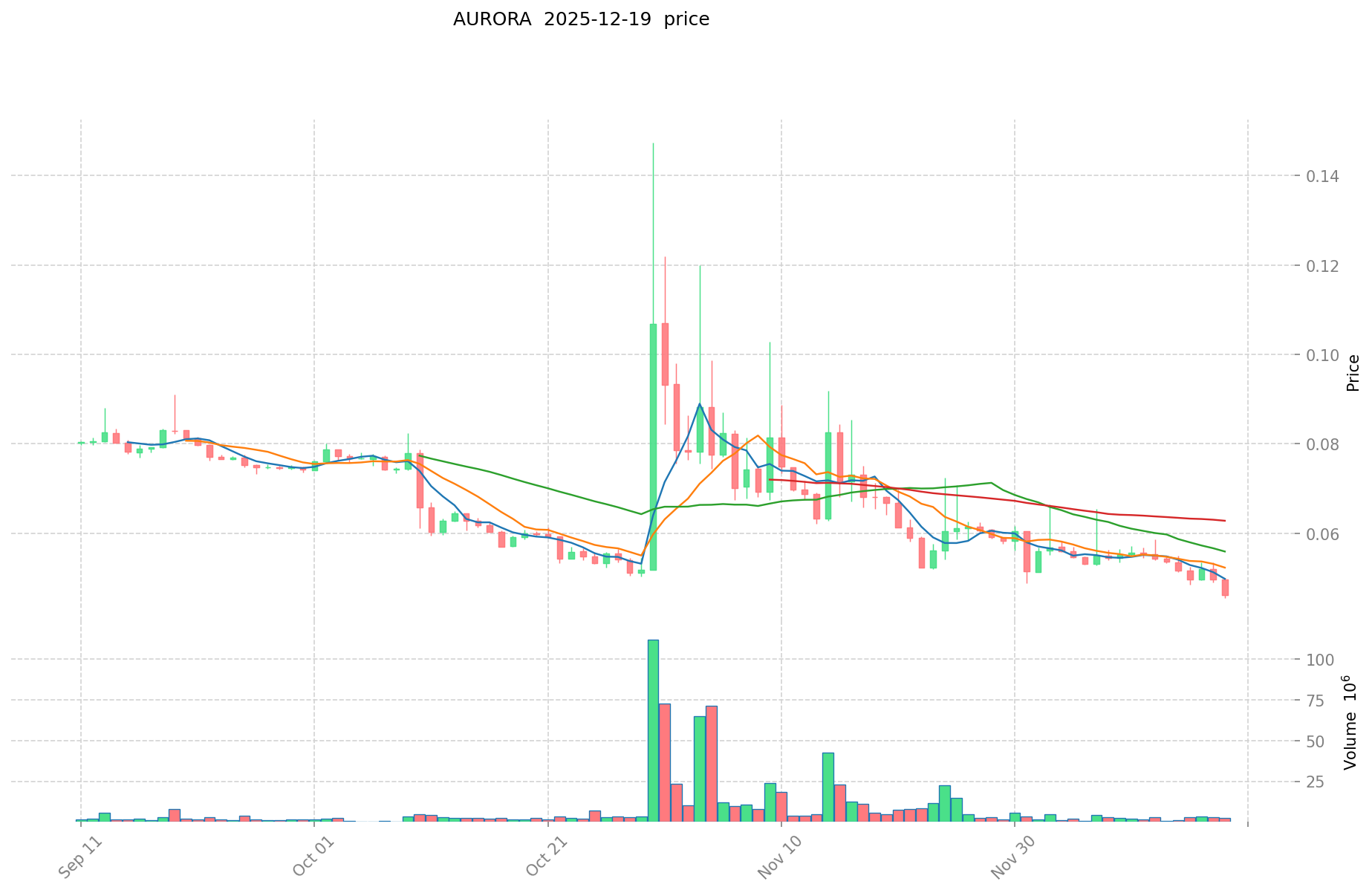
Aurora reached its all-time high of $35.40 on January 17, 2022, driven by market enthusiasm during the broader cryptocurrency bull market and growing interest in NEAR Protocol-based solutions.
The token's all-time low of $0.04593082 was recorded on December 19, 2025, reflecting significant market corrections and declining investor sentiment over the extended bear market period.
Current Price Status (December 19, 2025):
- Current Price: $0.04742
- 24-Hour High: $0.04878
- 24-Hour Low: $0.04548
- 24-Hour Change: +1.1%
- 7-Day Change: -15.58%
- 30-Day Change: -28.13%
- 1-Year Change: -80.95%
Click to view current AURORA market price
Market Capitalization Metrics
- Market Cap: $31,510,937.16
- Fully Diluted Valuation (FDV): $47,412,550.03
- Market Dominance: 0.0014%
- 24-Hour Trading Volume: $68,253.29
- Total Holders: 7,640
Key Information
- Website: https://aurora.dev/
- GitHub Repository: https://github.com/aurora-is-near/aurora-engine
- Twitter: https://twitter.com/auroraisnear
- Listed on: 11 exchanges, including Gate.com
Aurora (AURORA) Comprehensive Market Report
Market Overview
Aurora (AURORA) is an EVM (Ethereum Virtual Machine) built on the NEAR Protocol, delivering a turn-key solution for developers to operate their applications on an Ethereum-compatible, high-throughput, scalable and future-safe platform with low transaction costs for users. Aurora serves as a bridge helping Ethereum users and dApps to easily migrate to the NEAR blockchain.
Current Market Metrics
| Metric | Value |
|---|---|
| Current Price | $0.04742 |
| Market Cap | $31,510,937.16 |
| Fully Diluted Valuation | $47,412,550.03 |
| 24H Trading Volume | $68,253.29 |
| Circulating Supply | 664,507,321 AURORA |
| Total Supply | 999,842,894 AURORA |
| Market Ranking | #676 |
| 24H Price Change | +1.1% |
| 7D Price Change | -15.58% |
| 30D Price Change | -28.13% |
| 1Y Price Change | -80.95% |
Price Performance
Aurora has experienced significant volatility since its inception:
- All-Time High (ATH): $35.4 (January 17, 2022)
- All-Time Low (ATL): $0.04593082 (December 19, 2025)
- 24H Range: $0.04548 - $0.04878
- Market Dominance: 0.0014%
The token's performance reflects a substantial decline from its peak valuation, with year-to-date losses of approximately 80.95%.
Technical Infrastructure
Blockchain Integration
Aurora operates across multiple blockchain networks:
| Chain | Contract Address | Explorer |
|---|---|---|
| Ethereum (ETH) | 0xAaAAAA20D9E0e2461697782ef11675f668207961 | Etherscan |
| Aurora EVM | 0x8bec47865ade3b172a928df8f990bc7f2a3b9f79 | Aurorascan |
Core Functionality
Aurora's platform enables:
- Smart Contract Deployment: Users can upload and interact with Solidity smart contracts directly on the NEAR blockchain
- Cross-Chain Asset Transfer: Seamless movement of assets between Ethereum and NEAR, including ERC-20 token migrations
- Developer-Friendly Environment: Ethereum-compatible development tools and frameworks
- Low Transaction Costs: Leveraging NEAR's efficient infrastructure for cost-effective transactions
Community and Network Activity
Aurora maintains an active community with:
- Total Holders: 7,640 token holders
- Exchange Listings: Available on 11 cryptocurrency exchanges
- Primary Resources:
- Official Website: https://aurora.dev/
- GitHub Repository: https://github.com/aurora-is-near/aurora-engine
- Twitter: https://twitter.com/auroraisnear
Challenges and Considerations
Aurora faces several headwinds in the competitive blockchain landscape:
- Market Competition: The emergence of alternative Layer 2 solutions and sidechain technologies (such as Polygon, Arbitrum, and Optimism) has created intense competition
- Price Volatility: The dramatic decline from all-time highs indicates substantial market skepticism and investor losses
- Adoption Rate: Despite its technical capabilities, Aurora has not achieved mainstream adoption levels comparable to leading blockchain platforms
- NEAR Ecosystem Dependency: Aurora's success is intrinsically linked to NEAR Protocol's development and market performance
How to Trade Aurora
Purchase Options
AURORA tokens are available for trading on Gate.com and 10 additional cryptocurrency exchanges, providing multiple liquidity venues for traders and investors.
Trading Considerations
Before trading Aurora, investors should conduct thorough due diligence, understand the risks associated with blockchain technology investments, and only allocate capital they can afford to lose. The significant historical price decline warrants careful risk assessment.
Summary
Aurora represents an innovative bridge between Ethereum and the NEAR blockchain ecosystem, offering developers and users a scalable alternative with reduced transaction costs. As an EVM-compatible platform, it addresses the growing demand for high-performance blockchain infrastructure.
However, the token's dramatic decline from its peak valuation reflects broader market challenges facing Layer 2 and alternative blockchain solutions. The project's future viability depends on increasing developer adoption, expanding its ecosystem of decentralized applications, and demonstrating competitive advantages over other cross-chain solutions.
For investors and developers, Aurora warrants monitoring as blockchain technology continues to evolve, particularly as the platform focuses on attracting projects seeking Ethereum compatibility with NEAR's technical benefits. The current market conditions may present opportunities for risk-tolerant participants who believe in the long-term potential of cross-chain interoperability solutions.
FAQ
What is an aurora?
Aurora is a natural light display in Earth's sky, primarily visible near the poles. It occurs when charged particles from the sun interact with the planet's magnetic field and atmosphere, creating colorful displays known as northern lights (aurora borealis) or southern lights (aurora australis). Auroras also occur on other planets.
What causes auroras?
Auroras are caused by energetic particles from the sun's solar wind colliding with atoms in Earth's atmosphere. These collisions excite atmospheric particles, causing them to emit colorful light displays in the sky.
Are the aurora and Northern Lights the same?
Yes, aurora and Northern Lights refer to the same natural phenomenon. Aurora Borealis is the scientific term, while Northern Lights is the common name. Both occur when solar particles interact with Earth's atmosphere, creating spectacular light displays in high-latitude skies.
What does aurora mean?
Aurora is the native token of the Aurora blockchain, a scalable Ethereum-compatible layer-2 solution built on NEAR Protocol. It powers transactions, smart contracts, and ecosystem governance while enabling fast, low-cost decentralized applications.
Share
Content
Aurora's Positioning and Significance
Origins and Development History
How Aurora Operates?
Market Performance
Trading and Accessibility
Resources and Community
Conclusion
Market Overview
Circulation Overview
Price Performance
Market Capitalization Metrics
Key Information
Market Overview
Technical Infrastructure
Community and Network Activity
Challenges and Considerations
How to Trade Aurora
Summary
FAQ
How to Buy Cryptocurrency


Trending Cryptocurrencies



2025 SKL Price Prediction: Skale Network's Potential Growth and Market Outlook

What is ETHS: Understanding the Comprehensive Educational Tracking System
What is SYND: A Comprehensive Guide to Syndication Technology and Its Applications in Modern Business

What is NAORIS: A Comprehensive Guide to Nature-Based Asset Optimization and Restoration in Sustainable Infrastructure Systems

Aptos vs Giants: Performance Analysis & Market Share of This Rising Layer 1 Blockchain
1inch Network White Paper: Addressing Critical DeFi Challenges in 2025

What is MIDNIGHT: A Comprehensive Guide to Understanding the Witching Hour and Its Cultural Significance
What is PRARE: A Comprehensive Guide to Precision Rare Earth Element Processing and Applications

What is VTG: Understanding Vintage Technology and Its Growing Role in Modern Digital Culture
Top 7 Website Đào Ethereum Hiệu Quả Và Uy Tín Nhất
Bitcoin Halving