What is ETN: A Comprehensive Guide to Exchange-Traded Notes and Their Role in Modern Investment Portfolios


Electroneum (ETN) Research Report
Electroneum's Positioning and Significance
Electroneum (ETN) is an EVM-compatible Layer 1 blockchain designed to serve over 4 million users worldwide. Launched to address the need for fast, secure, and energy-efficient blockchain infrastructure, Electroneum distinguishes itself as a Layer 1 solution featuring transaction speeds of just 5 seconds with instant finality and potentially the lowest smart contract fees available.
As of December 2025, Electroneum has established itself as a notable blockchain platform with a market capitalization of approximately $27.7 million and a circulating supply of approximately 17.98 billion ETN tokens. The platform demonstrates active development and real-world utility through its support of AnyTask.com, a successful freelance platform in the crypto space, attracting a diverse user base across the globe.
This report provides a comprehensive analysis of Electroneum's technical architecture, market performance, and operational mechanisms.
Origins and Development History
Background of Creation
Electroneum was created with the vision of providing a blockchain infrastructure that combines speed, security, and energy efficiency. The project was conceived to address the limitations existing in many blockchain networks, including high transaction fees, slow confirmation times, and significant energy consumption.
The platform targets users and developers seeking an alternative to congested networks, enabling fast and cost-effective smart contract deployment and transaction execution. By focusing on real-world applications like freelance work through AnyTask.com, Electroneum has positioned itself as a practical blockchain solution beyond purely speculative use cases.
Key Milestones
The project's journey has been marked by significant achievements:
-
Mainnet Launch: Electroneum successfully launched its mainnet, establishing itself as a fully operational Layer 1 blockchain capable of processing transactions at high speed with minimal fees.
-
EVM Compatibility: The network achieved EVM compatibility, enabling developers to deploy existing Ethereum-based applications and smart contracts without major modifications, thereby accelerating ecosystem adoption.
-
Real-World Integration: The network gained prominence through integration with AnyTask.com, demonstrating practical cryptocurrency utility in the freelance economy and establishing a use case beyond speculation.
-
Validator Network Growth: The platform has attracted known validators including universities and Web3 infrastructure companies, strengthening network security and decentralization.
Throughout its development, Electroneum has maintained focus on delivering a practical, efficient blockchain solution supported by an active community and infrastructure providers.
How Electroneum Works?
Decentralized Architecture
Electroneum operates on a distributed network of computers (nodes) spread across the globe, eliminating reliance on central authorities like banks or governments. These nodes work collaboratively to validate transactions, ensuring system transparency, censorship resistance, and enhanced security. This decentralized model grants users greater autonomy over their assets and strengthens network resilience against single points of failure.
Blockchain Foundation
Electroneum's blockchain functions as a public, immutable digital ledger recording every transaction on the network. Transactions are grouped into blocks and cryptographically linked together, forming a secure and tamper-evident chain. This transparent design allows anyone to verify transactions independently without requiring intermediaries, establishing trust through mathematics rather than institutional authority.
Consensus Mechanism: IBFT
Electroneum employs the IBFT (Istanbul Byzantine Fault Tolerance) consensus mechanism to validate transactions and maintain network security. This mechanism prevents fraudulent activities such as double-spending and ensures network participants operate honestly.
How IBFT operates:
- Validators (designated network participants including universities and infrastructure companies) propose and validate new blocks
- The mechanism reaches consensus through multiple rounds of voting among validators
- Once consensus is achieved, transactions receive instant finality—once confirmed, they cannot be reversed
- The network can tolerate up to one-third of validators acting maliciously while remaining secure
This consensus model offers significant advantages:
- Speed: Achieves 5-second transaction finality, enabling rapid settlement
- Energy Efficiency: Requires substantially less computational power compared to Proof-of-Work systems
- Instant Finality: Eliminates the need for transaction confirmations, providing immediate certainty
Transaction Security
Electroneum employs public-key cryptography to secure transactions:
- Private Keys: Function as secret passwords used to sign and authorize transactions, granting exclusive control over funds
- Public Keys: Function like account numbers, allowing others to verify transaction signatures and confirm asset ownership
This cryptographic framework ensures:
- Fund Security: Only private key holders can authorize transactions
- Transaction Authenticity: Recipients can verify that transactions were genuinely initiated by the sender
- Pseudonymity: Users interact with pseudonymous addresses rather than personal identities, providing privacy
Market Performance and Data
Current Market Metrics (As of December 20, 2025)
| Metric | Value |
|---|---|
| Current Price | $0.0013196 |
| 24-Hour Change | +3.16% |
| Market Capitalization | $27,711,600 |
| Circulating Supply | 17,979,817,604.56 ETN |
| Total Supply | 21,000,000,000 ETN |
| Market Dominance | 0.00086% |
| 24-Hour Trading Volume | $18,768.69 |
| 24-Hour High / Low | $0.00137 / $0.001257 |
Price Trends
| Time Period | Change | Amount |
|---|---|---|
| 1 Hour | -1.05% | -$0.000014 |
| 24 Hours | +3.16% | +$0.000040 |
| 7 Days | -2.23% | -$0.000030 |
| 30 Days | -27.33% | -$0.000496 |
| 1 Year | -55.37% | -$0.001637 |
Historical Price Milestones
- All-Time High: $0.01 (April 11, 2024)
- All-Time Low: $0.0012527 (December 9, 2025)
- Launch Price: $0.01
The token's 85.62% circulating supply ratio relative to fully diluted valuation indicates substantial token distribution across the market.
Market Rank and Exchange Presence
Electroneum currently ranks 797th among cryptocurrencies by market capitalization and is traded on 7 exchanges globally, including Gate.com, enabling users to access and trade ETN across multiple platforms.
Technical Architecture
Layer 1 Design
As an EVM-compatible Layer 1 blockchain, Electroneum processes transactions directly on its own mainnet rather than relying on a parent chain. This architecture provides:
- Sovereign Security: The network maintains its own validator set and security guarantees
- Full Programmability: Complete smart contract functionality through EVM compatibility
- Direct Settlement: Transactions settle directly on Electroneum without requiring cross-chain bridges
Performance Characteristics
Speed: 5-second transaction finality enables rapid settlement of transactions, supporting time-sensitive applications like real-time payments and trading.
Scalability: The IBFT consensus mechanism enables the network to process transactions efficiently without the computational overhead of Proof-of-Work systems.
Cost Efficiency: Smart contract execution and transaction fees are positioned as among the lowest available, reducing barriers to adoption for users and developers.
Energy Efficiency: Consensus validation through IBFT requires minimal computational resources compared to alternative consensus mechanisms.
Validator Network
The network is supported by known validators including:
- Academic institutions (universities)
- Web3 infrastructure companies
This validator composition ensures a balance between academic rigor, technical expertise, and infrastructure reliability while promoting decentralization.
Ecosystem and Real-World Applications
AnyTask.com Integration
Electroneum provides the foundational infrastructure for AnyTask.com, a established freelance marketplace in the crypto space. This integration demonstrates practical cryptocurrency utility beyond speculation:
- Freelancer Payments: Workers receive compensation in ETN for completed tasks
- Reduced Fees: Low transaction costs maximize earnings for freelancers
- Fast Settlements: 5-second finality enables rapid payment confirmation
- Global Access: Enables participation regardless of geographic location or banking infrastructure
This use case validates Electroneum's design philosophy of creating fast, affordable, and practical blockchain infrastructure.
Developer Ecosystem
The platform's EVM compatibility attracts developers by:
- Reduced Migration Friction: Existing Ethereum-based projects can deploy with minimal modifications
- Cost Advantages: Lower transaction and smart contract fees compared to congested networks
- Performance Benefits: Fast finality and block times improve application responsiveness
Risk Factors and Market Considerations
Volatility
ETN has experienced significant price volatility, declining 55.37% over the past year and 27.33% over the past month. This volatility reflects broader cryptocurrency market dynamics and token-specific factors.
Liquidity
With 24-hour trading volume of approximately $18,768, ETN exhibits relatively lower trading volume compared to major cryptocurrencies, which may impact trading efficiency for large transactions.
Market Position
As a smaller-capitalization cryptocurrency ranked 797th, Electroneum competes in a highly competitive Layer 1 blockchain market against established and well-funded projects.
Regulatory Environment
Like all cryptocurrency projects, Electroneum operates within an evolving regulatory landscape that may impact adoption and market dynamics.
How to Get Started
To begin using Electroneum:
- Create a Digital Identity: Choose a secure wallet solution to store ETN tokens and private keys
- Acquire ETN: Purchase ETN tokens through supported exchanges including Gate.com
- Access Applications: Transfer ETN to your wallet and begin using Electroneum-based applications like AnyTask.com
- Explore Development: Developers can access technical documentation and deploy smart contracts on the network
For detailed instructions on acquiring ETN, visit the Electroneum buying guide on Gate.com.
Conclusion
Electroneum represents a focused approach to blockchain infrastructure, prioritizing speed, efficiency, and practical utility. Through its 5-second transaction finality, low fees, energy-efficient IBFT consensus mechanism, and real-world integration with AnyTask.com, the platform demonstrates a commitment to solving tangible problems in global finance and freelance work.
While the project operates in a competitive landscape and faces market volatility challenges, its technical architecture and practical applications position it as a noteworthy blockchain solution for users and developers seeking fast, affordable, and sustainable blockchain infrastructure.
For current information, visit the official Electroneum website or review the technical documentation.
Report Date: December 20, 2025
Data Source: Gate.com Electroneum Market Data
Electroneum Market Performance Report
Electroneum's Market Performance
Circulating Supply Overview
As of December 20, 2025, Electroneum (ETN) has a circulating supply of 17,979,817,604.56 ETN tokens, with a total supply of 21,000,000,000 ETN. The token supply follows a fixed model with a maximum cap of 21 billion tokens, mirroring a deflationary design similar to established cryptocurrencies. This capped supply structure is designed to create scarcity and support long-term value appreciation.
Price Volatility
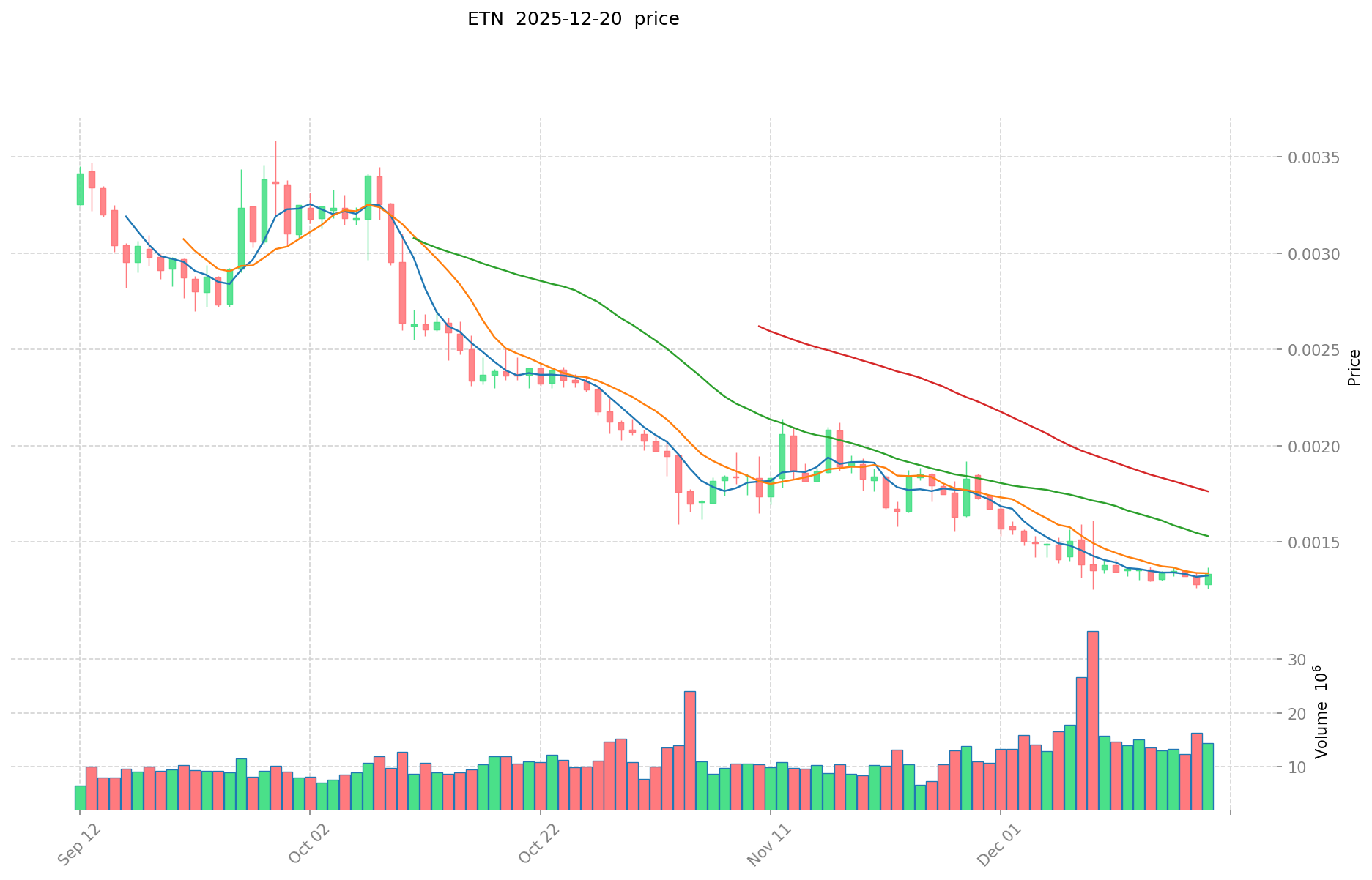
Electroneum reached its all-time high of $0.01 on April 11, 2024, driven by growing adoption of the Electroneum Layer 1 blockchain and increased recognition of its fast transaction capabilities. The token's lowest price of $0.0012527 was recorded on December 9, 2025, reflecting recent market-wide volatility and profit-taking pressures.
As of the latest data on December 20, 2025, ETN is trading at $0.0013196, representing a 24-hour increase of 3.16%. However, the token has faced significant headwinds over longer timeframes, declining 27.33% over the past 30 days and 55.37% over the past year. These fluctuations reflect broader cryptocurrency market dynamics and the evolving investor sentiment toward Layer 1 blockchain solutions.
Check current ETN market price
Market Capitalization and Dominance
Electroneum's current market capitalization stands at $23,726,167.31, with a fully diluted valuation of $27,711,600.00. The token ranks 797th by market cap among all cryptocurrencies, with a market dominance of 0.00086%. The 24-hour trading volume is $18,768.69, indicating moderate liquidity for the asset.
The circulating supply represents approximately 85.62% of the maximum supply, demonstrating that most tokens have already entered circulation, reducing future inflationary pressure from new issuances.
Network Activity and Adoption
Electroneum operates as an EVM-compatible Layer 1 blockchain with significant real-world utility. The network serves over 4 million users globally and provides the infrastructure backbone for AnyTask.com, a successful freelance platform in the crypto space. With transaction speeds of just 5 seconds and instant finality, Electroneum offers competitive performance compared to other blockchain networks.
The network is powered by the IBFT (Istanbul Byzantine Fault Tolerant) consensus mechanism and supported by known validators targeting universities and Web3 infrastructure companies, ensuring security, decentralization, and energy efficiency.
Electroneum (ETN) Comprehensive Analysis Report
Market Overview
Electroneum is a Layer 1 EVM-compatible blockchain designed to serve 4+ million users worldwide. As of December 20, 2025, ETN is ranked #797 in the cryptocurrency market with the following key metrics:
| Metric | Value |
|---|---|
| Current Price | $0.0013196 |
| 24-Hour Change | +3.16% |
| 24-Hour Volume | $18,768.69 |
| Market Capitalization | $23,726,167.31 |
| Fully Diluted Valuation | $27,711,600.00 |
| Circulating Supply | 17,979,817,604.56 ETN |
| Total Supply | 21,000,000,000 ETN |
| All-Time High | $0.01 (April 11, 2024) |
| All-Time Low | $0.0012527 (December 9, 2025) |
Price Performance Trends
| Timeframe | Change |
|---|---|
| 1 Hour | -1.05% |
| 24 Hours | +3.16% |
| 7 Days | -2.23% |
| 30 Days | -27.33% |
| 1 Year | -55.37% |
Technical Architecture & Network Specifications
Core Features
Electroneum distinguishes itself through several key technical characteristics:
- Consensus Mechanism: IBFT (Istanbul Byzantine Fault Tolerance) consensus protocol
- Transaction Speed: 5-second block times with instant finality
- Smart Contract Fees: Among the lowest available in the blockchain ecosystem
- EVM Compatibility: Full Ethereum Virtual Machine compatibility, enabling seamless deployment of existing applications
- Validator Network: Supported by known validators targeting universities and Web3 infrastructure companies
- Energy Efficiency: Designed as an environmentally efficient blockchain network
- Algorithm Classification: EVM Layer One
Ecosystem Applications & Partnerships
Core Use Cases
Electroneum powers critical real-world applications:
- Freelance Platform: ETN provides the backbone for AnyTask.com, a successful freelance marketplace in the crypto space, enabling creators and service providers to operate efficiently on blockchain infrastructure.
How to Participate in Electroneum
1. Acquisition Channels
Purchase ETN on Gate.com, where the token is actively traded with liquidity support.
2. Network Participation
- Access the Electroneum blockchain at: https://blockexplorer.electroneum.com/
- Explore network statistics and transaction details through the official block explorer
3. Developer Engagement
Developers can access comprehensive technical documentation at the Electroneum developer portal to build applications on the network.
Additional Information Sources
-
Official Website: Visit Electroneum Official Website for feature updates, use cases, and latest developments.
-
Technical Documentation: Access Electroneum Foundational Topics for detailed information on the IBFT consensus mechanism and network architecture.
-
X (Twitter) Presence: Follow @electroneum on X platform for real-time updates on protocol developments, community activities, and ecosystem announcements.
Market Position & Competitive Landscape
With a market dominance of 0.00086%, Electroneum operates as a specialized blockchain platform focused on practical utility rather than capturing broad market share. The network's emphasis on transaction speed (5-second finality), low fees, and EVM compatibility positions it competitively within the Layer 1 ecosystem.
The 85.62% ratio of market capitalization to fully diluted valuation indicates relatively modest token circulation pressure, with over 85% of maximum supply already in circulation.
Summary
Electroneum represents a focused approach to Layer 1 blockchain development, prioritizing transaction efficiency, cost-effectiveness, and practical applications. Through its support for platforms like AnyTask.com and its robust technical infrastructure powered by IBFT consensus, ETN addresses real-world needs in the cryptocurrency ecosystem.
The network's combination of fast transaction finality, low smart contract fees, and EVM compatibility makes it suitable for developers and users seeking an alternative to more congested Layer 1 networks. With support from known validators and an energy-efficient design, Electroneum maintains a position as a practical blockchain solution for global users.
For those interested in exploring emerging Layer 1 platforms with distinct technical advantages and real-world applications, Electroneum warrants consideration. Whether as an investor, developer, or user, the platform offers accessible entry points through major exchanges like Gate.com and comprehensive technical documentation for ecosystem participation.
FAQ
What is the difference between an ETF and an ETN?
ETFs invest in physical assets like stocks or bonds, while ETNs are unsecured debt notes issued by financial institutions tracking indexes without holding underlying assets. ETNs don't pay dividends, unlike most ETFs.
What are the risks of ETN?
ETN risks include credit risk from issuer default, lack of regulatory oversight, tracking error, and potential liquidity issues. As unsecured debt instruments, they depend entirely on issuer creditworthiness. Market volatility and redemption challenges also pose significant risks to investors.
How do ETNs work and what are their key characteristics?
ETNs are unsecured debt securities issued by financial institutions, tracking underlying assets or indices. They trade on exchanges like stocks without paying dividends. Key features include exchange trading, price tracking mechanisms, and issuer credit risk exposure.
What are the advantages and disadvantages of investing in ETNs?
Advantages include market flexibility, diverse exposure, and easy trading. Disadvantages include credit risk from issuers, lack of asset backing, and potential early redemption fees. ETNs suit investors seeking convenient market access without owning underlying assets directly.
How is an ETN different from a bond or other debt instrument?
ETNs are unsecured debt obligations linked to underlying indices, unlike traditional bonds backed by assets. They carry issuer credit risk and offer index-tracking exposure without physical asset ownership, providing unique cryptocurrency market exposure.
Share
Content
Electroneum's Positioning and Significance
Origins and Development History
How Electroneum Works?
Market Performance and Data
Technical Architecture
Ecosystem and Real-World Applications
Risk Factors and Market Considerations
How to Get Started
Conclusion
Electroneum's Market Performance
Market Overview
Technical Architecture & Network Specifications
Ecosystem Applications & Partnerships
How to Participate in Electroneum
Additional Information Sources
Market Position & Competitive Landscape
Summary
FAQ
How to Buy Cryptocurrency


Trending Cryptocurrencies



What is QKC: A Comprehensive Guide to QuarkChain's Native Cryptocurrency and Its Role in the Blockchain Ecosystem

Aptos vs Giants: Performance Analysis & Market Share of This Rising Layer 1 Blockchain

2025 SUI价格预测:区块链新贵的未来发展与投资价值分析

What is KAS: Understanding the Key Agreement Scheme in Modern Cryptography

What is AVAX: A Comprehensive Guide to Avalanche's Native Cryptocurrency

What is TIA: Understanding Transient Ischemic Attack and Its Warning Signs

What is TWAP (Time-Weighted Average Price) Strategy and How Does It Work

How to Delete My Account

What is P2P Trading on a Leading Platform?

BTC Option Flows Explained, Why Bitcoin Above 93,000 Suggests a Bullish Start to 2026
Bitcoin Options Traders Eye USD $100,000 as Derivatives Signal Market Reset