After the surge in AI Agents, many have already started writing obituaries for SaaS—but I believe that’s premature.
Investor anxiety is real. At the start of 2026, fears of a SaaS apocalypse swept through the tech industry. In late January, Anthropic rolled out a feature update allowing Claude to use plugins, and in just three weeks, the US software sector saw hundreds of billions of dollars wiped out.
The logic behind the panic is simple. Investors believe that since AI can now write code, find bugs, and even generate tools on the fly, the cost of coding is heading toward zero. Once Agents can instantly build custom tools for any enterprise, the carefully constructed moats of subscription-based software companies will simply disappear.
That’s why, from CrowdStrike to IBM, Salesforce to ServiceNow, even stellar earnings haven’t spared them from brutal sell-offs.
Meanwhile, a wave of AI entrepreneurs is pitching VCs with slides about “building the middleware for the Agent era” and “starting companies for Agents.”
They’re all betting on one thing: building tools is the hottest business of our time.
But step away from the pitch decks and look at how real companies operate, and the story changes.
Software Was Never About Selling Code
There’s a classic, well-tested economic theory called “factor scarcity migration.” Every productivity revolution makes one scarce resource abundant while turning another, previously overlooked resource, into the new bottleneck—concentrating wealth around it.
Before the Industrial Revolution, labor was scarce. The steam engine made mechanical labor abundant, shifting scarcity to capital and factories—making factory owners the richest of their time.
The Internet drove the cost of distributing information to zero, shifting scarcity to user “attention” and turning traffic into big business.
Now, the AI revolution is making coding and tool-building superabundant. In the Agent era, where code isn’t scarce, what is?
In reality, code has never been a true moat in the software industry.
Linux is open source, yet Red Hat was acquired by IBM for $34 billion. MySQL is free, but Oracle still sells high-priced service contracts after acquiring it. PostgreSQL is free to download, yet AWS’s Aurora database service brings in billions a year from enterprise customers.
Code is free, but the business is thriving.
What really matters are three things: institutionalized business processes, years of accumulated customer data, and the resulting high switching costs.
When you buy Salesforce, you’re not buying CRM source code—you’re buying access to over 50 trillion enterprise customer records and the process know-how that seamlessly links sales, support, and marketing. This data isn’t just lines of code—it’s the living history and time of the business.
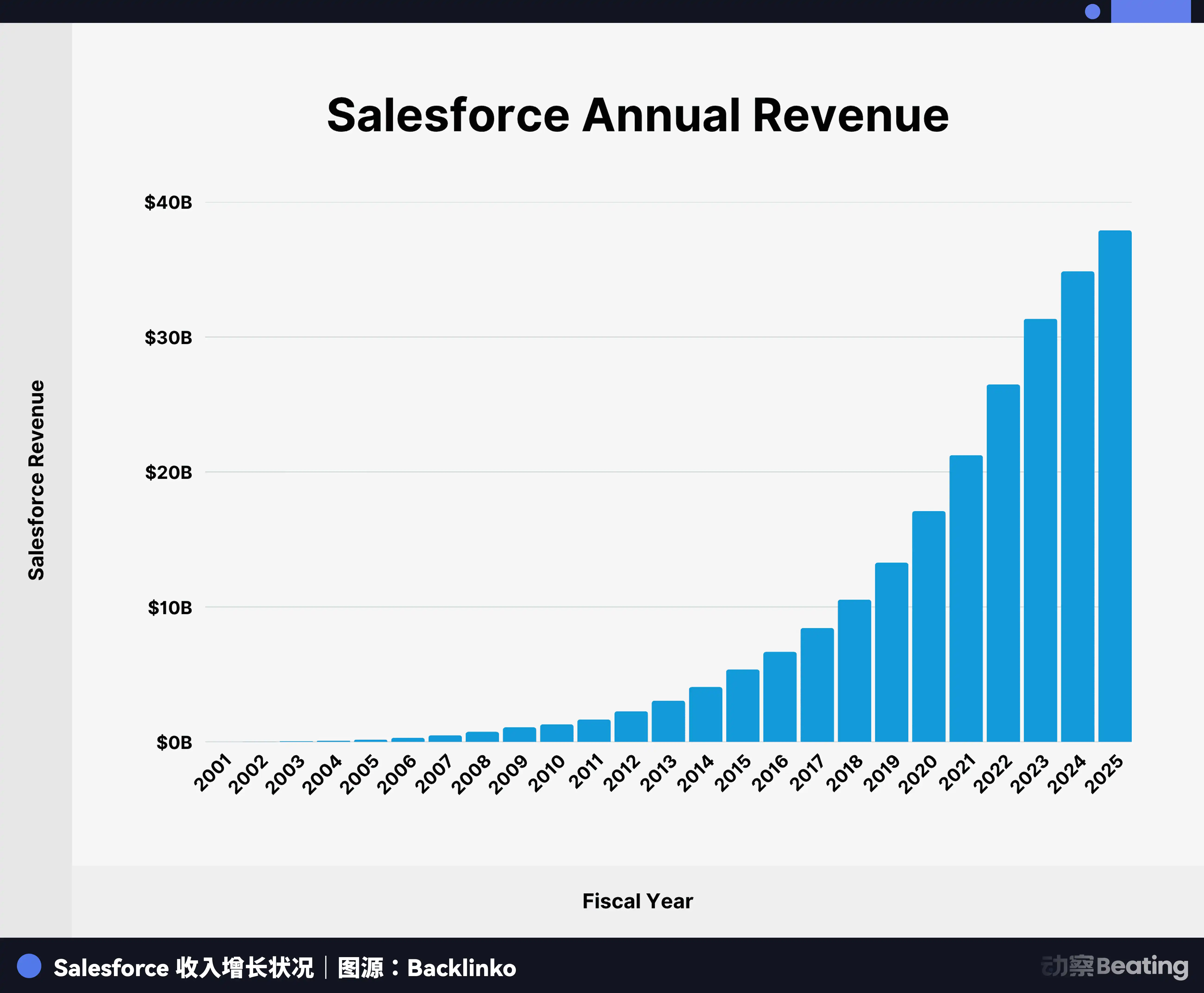
A company that’s used Salesforce for a decade has every customer interaction, transaction, and sales follow-up recorded. Switching isn’t just about changing software—it’s like moving the company’s entire memory. That’s why Salesforce can post $41 billion in annual revenue and set a $63 billion target for 2030.
So, if Agents can build tools and the cost of code is zero, what’s the scarcest resource in enterprise services?
What Really Limits an Agent
What really constrains an Agent isn’t a lack of hands—it’s a lack of context.
A super Agent with every tool is like a top-of-the-line juicer: it spins fast and has sharp blades, but without fruit, there’s no juice.
McKinsey’s annual report notes that 88% of companies use AI, but only 23% have deployed Agent systems at scale. The real bottleneck isn’t model intelligence—it’s unprepared enterprise data architectures.
SAP Data & Analytics President Irfan Khan told MIT Technology Review, “No company will toss out its entire general ledger for an Agent—because without business context, an Agent can’t do anything.”
“Business context” means: the company’s compliance boundaries, industry regulations, a customer’s decade-long history, a supplier’s payment terms and defaults, an employee’s performance and promotion path. None of this is public, available to web crawlers, or generatable by AI text prediction.
Foundation Capital partner Ashu Garg agrees. He says Agents need more than just data—they need a “context graph,” a reasoning layer that records not just what a company does, but how it thinks. This can only be built from real business operations—not conjured out of thin air.
So scarcity has shifted from “tool-building ability” to “ownership of irreplaceable business context data.”
If Agents can’t create juice on their own, who holds the fruit?
The Golden Age of Data Landlords
The answer points to the “old guard” once thought doomed by AI.
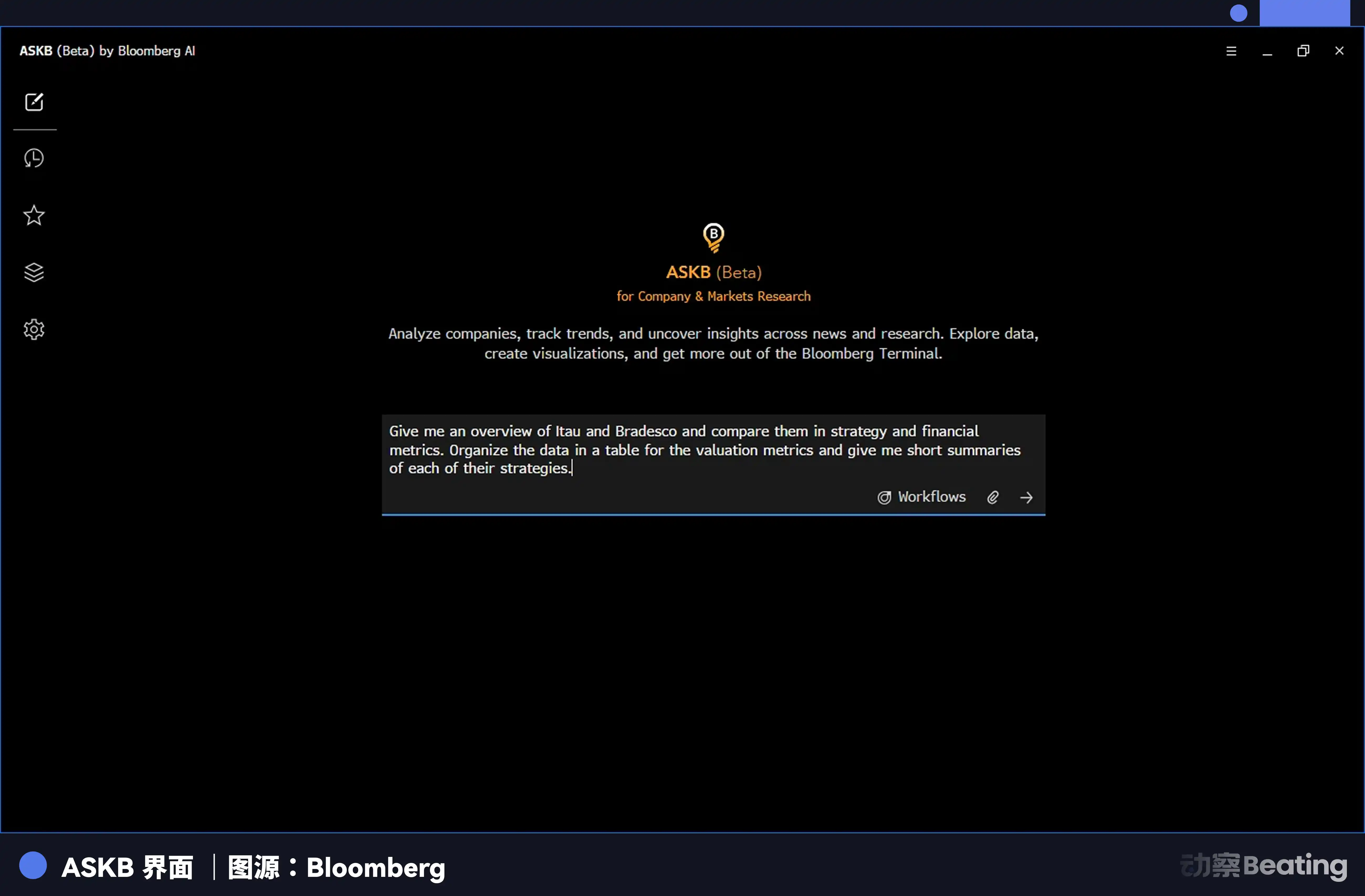
On February 23, 2026, Bloomberg launched its “ASKB” Agentic AI interface. Bloomberg Terminal is one of the most iconic products in software. With just 325,000 global subscribers—each paying $32,000 annually—Bloomberg generates over $10 billion a year, more than 85% of Bloomberg LP’s total revenue.
In the Internet world, where “more users is better” is gospel, Bloomberg’s fortress is built on a small, high-value customer base.
Why? Because Bloomberg holds the world’s most comprehensive, real-time, and deeply structured financial data. This is the result of decades of investment—real-time markets, historical records, news, analyst reports, company financials. Anyone making serious financial decisions can’t avoid it.
For ASKB, AI is the engine, but Bloomberg’s exclusive data is the fuel. Any Agent operating in finance can’t invent this data—it has to plug into Bloomberg.
WatersTechnology put it well: Bloomberg’s Agentic strategy “shows how those who own the data can turn AI into their own ATM.”
This holds true across verticals. Veeva controls global pharmaceutical compliance and R&D data—any pharma Agent handling trials or filings needs it. Epic holds records for over 250 million US patients—every healthcare Agent diagnosis depends on this real-world data. LexisNexis dominates legal archives—legal Agents can’t bypass it for case research or compliance.
This data is the product of decades of business operations—a unique, irreplaceable historical asset. This is “factor scarcity migration” at its peak: when everyone has top-tier AI, the real differentiator is your unique oil field.
Previously, these subscription data services were sold to human analysts—a big firm might need 100 Bloomberg Terminals. In the future, with machines as data consumers, a firm might run tens of thousands of Agents, each making millisecond-level API calls.
This is a quantum leap. Human analysts are limited in daily queries; Agents can call data orders of magnitude more. Demand for continuous, real-time, high-value data will skyrocket. The subscription business model isn’t disrupted—it’s amplified by machine demand.
Code is free; data is now the revenue generator.
But does this mean every SaaS and data company can rest easy?
Not Every SaaS Company Holds the Winning Hand
If you read this as a blanket endorsement of SaaS, you’re mistaken. AI is forcing a brutal split within SaaS.
In March 2026, TechCrunch interviewed top VCs about what they’re avoiding.
Silicon Valley investors are voting with their feet. Simple workflow wrappers, horizontal tools, lightweight project management—once fundable stories—are being passed over. Why? Agents can do these tasks themselves. SaaS companies without exclusive data are rapidly losing investor interest.
This divides SaaS into two camps.
One camp: thinly wrapped tools that just package public data or polish a single workflow. Their moat is user habit and interface stickiness.
But as Emergence Capital’s Jake Saper puts it: “Previously, getting humans to form habits in your software was a powerful moat. But if Agents are doing the work, who cares about human workflows?”
These SaaS products face real threats. The GTM tool stack is a prime example: Gainsight, Zendesk, Outreach, Clari, Gong—each covers a specific function, requiring separate budgets, operations, and integrations. AI-native companies can now use a single Agent to connect all these, diminishing the value of point solutions.
The other camp: SaaS deeply embedded in core business processes, holding irreplaceable proprietary data. These companies won’t be replaced by Agents—they’ll become more valuable.
Take Salesforce. In February 2026, its earnings showed Agentforce’s annual recurring revenue hit $800 million, up 169% year-over-year; 2.4 billion “Agentic work units” delivered; nearly 20 trillion tokens processed; over 29,000 Agentforce customers signed, up 50% quarter-over-quarter. Critically, Agentforce and Data 360’s combined ARR topped $2.9 billion, up over 200% year-over-year.
On the call, Marc Benioff said: “We have rebuilt Salesforce as the operating system for the Agentic Enterprise. The more AI can replace work, the more valuable Salesforce becomes.”
Salesforce hasn’t been replaced by Agents—it’s become the platform they run on. Its value comes from business data and process context Agents can’t bypass.
ServiceNow CEO Bill McDermott declared in February 2026: “We’re not a SaaS company.”

He wasn’t denying his roots, but making a strategic distinction: SaaS is a software delivery model, but ServiceNow aims to be the orchestration and execution layer for enterprise AI Agents. AI can find problems and make suggestions, but real execution in enterprise systems still needs a deeply embedded workflow platform like ServiceNow.
On March 17, 2026, Workday released “Sana,” a conversational AI suite deeply integrating HR and financial data. The core idea isn’t to replace Workday with AI, but to feed AI with Workday’s data.
Workday holds payroll, performance, org structure, and budgeting data for thousands of companies. The depth and uniqueness of this data can’t be replicated by AI-native startups anytime soon.
So, the real moat isn’t just having data—it’s having data others can’t access, buy, or create.
Who Will Collect Rent in the Next Decade
Every tech revolution sees the biggest profits go not to the inventors, but to those who control the scarce factors the new tech depends on. In this AI-driven era, models will only get stronger, and Agents will become even more capable at coding and tool-building.
Once these “black box” abilities become infrastructure, “factor scarcity migration” leaves one conclusion: those frantically building tools for Agents likely won’t be the ultimate winners.
Foundation Capital’s February 2026 analysis says the software sector’s market cap will grow tenfold in the next decade—but that growth won’t be evenly spread. It’ll concentrate among those who truly master the Agent era.
The real winners are those who hold data assets Agents can’t bypass.
For today’s founders and investors, there are only two fates: build shovels for Agents, or claim the land first. You should know which you’re doing.
Don’t focus on the Agent’s hands—focus on what constrains the Agent.
Disclaimer:
-
This article is republished from [BlockBeats], copyright belongs to the original author [Sleepy.md]. For republication concerns, please contact the Gate Learn team, who will address the issue promptly according to relevant procedures.
-
Disclaimer: The views and opinions expressed in this article are solely those of the author and do not constitute investment advice.
-
Other language versions of this article are translated by the Gate Learn team. Unless Gate is mentioned, it is prohibited to copy, distribute, or plagiarize the translated article.