As decentralized AI networks evolve, user focus has expanded beyond computational power to include resource allocation, node participation incentives, and network stability—issues that point directly to the design of the token’s functionality. In practice, developers pay inference fees and nodes earn rewards, positioning OPG as the central medium powering network operations.
Addressing these concerns requires examining fee payment mechanisms, incentive models, and security constraints, which collectively define OPG’s role within OpenGradient.
What Is the OPG Token?
OPG is the native token of the OpenGradient Network, acting as the bridge between computing demand and resource supply.
Functionally, OPG serves as the unit of account and settlement for AI inference services, allowing users to pay for computing resources in a standardized currency. Each node receives rewards proportionate to the services it delivers.
From an architectural perspective, OPG lies at the core of the economic model, linking users, inference nodes, and verification nodes. Users access services by paying with tokens, while nodes are compensated for providing resources.
This structure is designed to create a stable supply-demand equilibrium, sustaining decentralized computation over time.
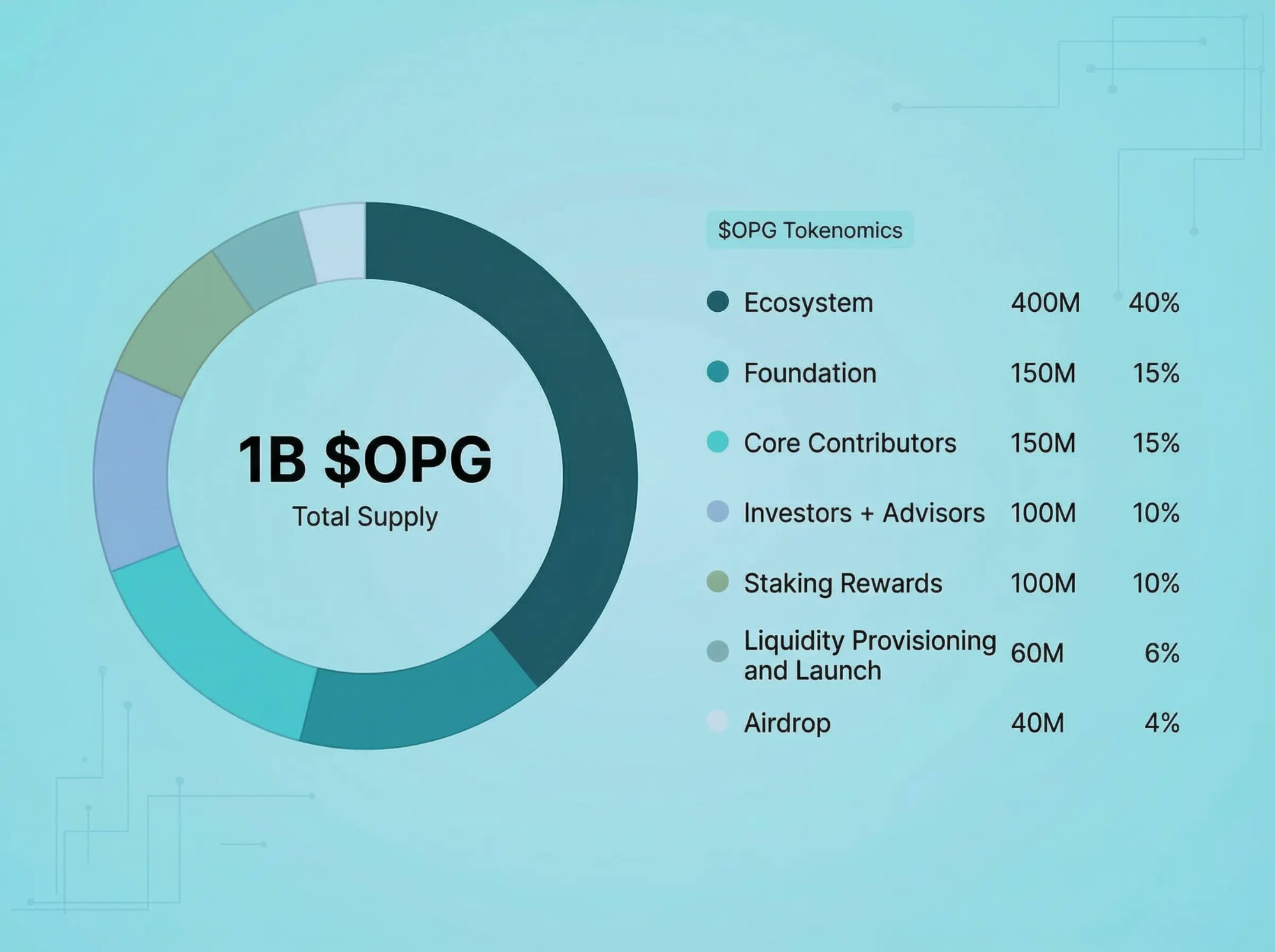
How Is OPG Used to Pay Inference Fees in OpenGradient?
Inference fees are OPG’s foundational use case.
When users submit AI inference requests, they must pay OPG to cover computational costs. These fees adjust dynamically based on model complexity, computation time, and resource consumption.
The fees are distributed to both inference nodes and verification nodes: inference nodes collect the bulk of computational rewards, while verification nodes receive validation rewards, completing the distribution chain.
This fee structure uses price signals to optimize resource allocation, ensuring computational capacity is directed toward legitimate demand and mitigating resource abuse.
How Does the Incentive Mechanism Drive Node Participation?
A clear incentive structure is essential for node engagement.
The network distributes OPG rewards to motivate both inference and verification nodes to participate in computation and validation. Nodes delivering greater computational power or higher-quality services earn higher rewards.
The incentive system typically comprises a base reward for sustained node operation and a performance reward to encourage efficiency and accuracy improvements.
This alignment ensures node actions serve network needs, enhancing overall performance and reliability.
How Does the Staking Mechanism Enhance Network Security?
Staking mechanisms enforce node accountability.
Nodes must lock a specified amount of OPG as collateral to join the network. If a node returns incorrect results or acts maliciously, its staked tokens can be slashed.
Staking and penalty mechanisms create a self-regulating loop, with nodes assuming risk as they earn rewards—effectively moderating their behavior.
This economic constraint strengthens network security, reducing fraud and computational errors.
What Is OPG’s Role in Network Governance?
Governance mechanisms shape the network’s evolution.
Holders of OPG can vote on protocol upgrades, parameter changes, and rule modifications. Voting power is generally proportional to the amount of OPG held or staked.
The governance system transforms token holders into active decision-makers, enabling the network to evolve through decentralized consensus rather than centralized control.
How Do Supply and Demand Dynamics Shape OPG Value?
OPG’s value is directly tied to its utility within the network.
As inference requests rise, demand for OPG increases. The supply side is determined by the computational resources nodes provide, with both factors collectively influencing price.
The balance between user demand, node participation, and network scale establishes a dynamic supply-demand equilibrium.
| Factor |
Impact Direction |
Effect |
| Increased inference demand |
Increases demand |
Drives token utility |
| More nodes |
Increases supply |
Expands computing power |
| Network expansion |
Dual impact |
Reshapes supply-demand |
| Higher staking ratio |
Reduces circulation |
Increases scarcity |
| More frequent usage |
Boosts demand |
Stabilizes value basis |
This structure illustrates that OPG’s value is intrinsically linked to network activity, not independent of it.
What Are the Limitations of the OPG Economic Model?
No economic model is without constraints.
If incentives are poorly distributed, the result can be node centralization or wasted resources; if fees are too high, user demand may be suppressed.
The model must balance costs, incentives, and security, or network efficiency will suffer.
Continuous adjustments are necessary for the economic model to match changes in network scale and usage patterns.
Summary
By integrating payment, incentive, staking, and governance mechanisms, OPG forms the foundation of OpenGradient’s economic system, enabling decentralized AI computation to maintain a stable balance between supply, demand, and security.
FAQ
What is the primary use of the OPG token?
To pay AI inference fees, incentivize node participation, and support network governance.
How is OPG used to pay for computing costs?
Users pay OPG when submitting inference requests, with fees dynamically calculated based on resource use.
Why is staking OPG required?
Staking enforces responsible node behavior, prevents malicious actions, and increases network security.
How does OPG function in governance?
Token holders vote on protocol upgrades and parameter changes.
What determines OPG’s value?
Primarily the interplay between inference demand and the supply of computing resources.







