Ripple Bitcoin Price Prediction: Will Bitcoin Surge to $180,000 in 2026?
As 2025 comes to a close, the cryptocurrency market is once again turning its attention to Bitcoin (BTC). The question now is whether this digital asset can continue to emerge as “digital gold” and become a major topic in 2026. Since its launch, Bitcoin has consistently attracted intense market attention. As its price repeatedly reaches new highs, it draws in more investors. So, in 2026, could Bitcoin break through $180,000 and become a mainstream financial asset?
Review of the Bitcoin Market at the End of 2025
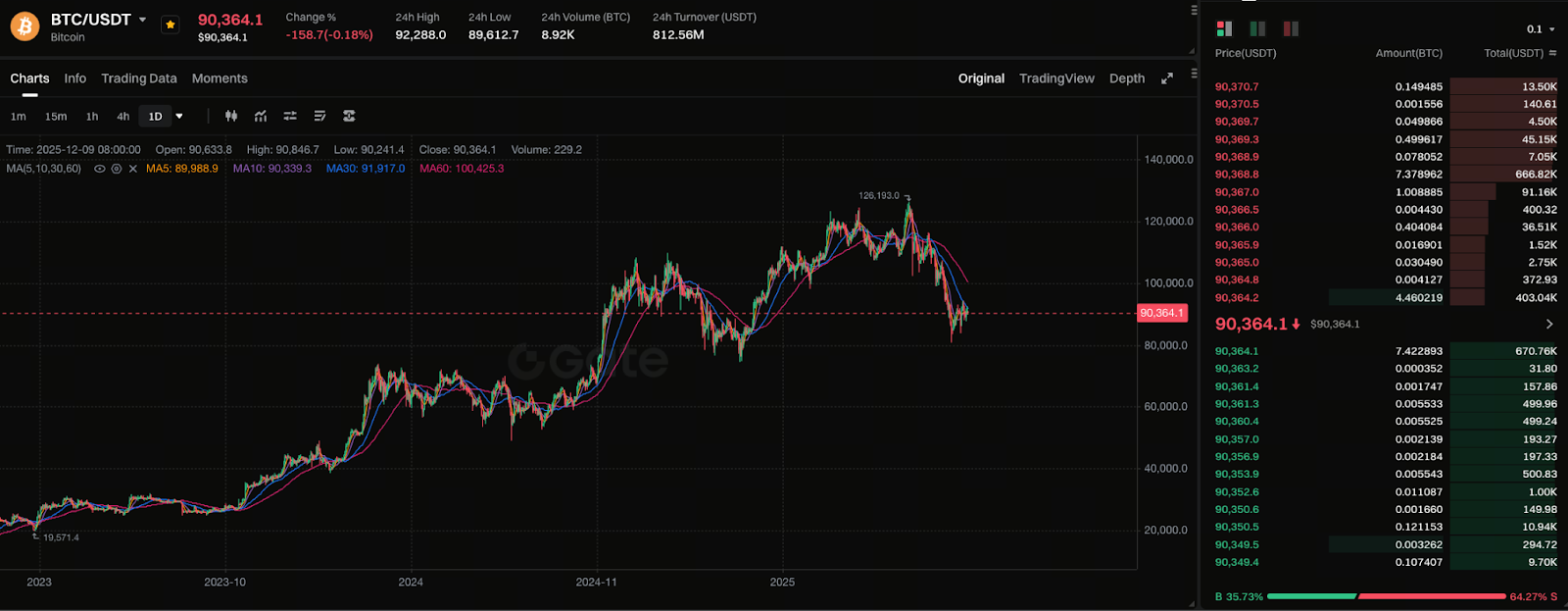
Source: https://www.gate.com/trade/BTC_USDT
By the end of 2025, Bitcoin’s price hovered around $90,000, demonstrating relative stability. While short-term volatility persisted, BTC maintained a strong long-term upward trajectory. Since 2023, Bitcoin has held its dominant position in the global cryptocurrency market, with a market capitalization that still far surpasses all other digital assets.
With shifting market sentiment, more institutional and individual investors now view Bitcoin as “digital gold”—a hedge against inflation and financial crises. Compared to traditional market assets, Bitcoin offers advantages such as decentralization, being unregulated, and having a fixed supply. These features make it especially appealing during periods of macroeconomic instability.
However, Bitcoin still faces significant challenges. The cryptocurrency market remains subject to global regulatory policy, financial market volatility, and technological innovation—all of which could impact Bitcoin’s future performance.
Long-Term Value and the $180,000 Target: Bitcoin Analysis
Many analysts see Bitcoin’s long-term potential as making it one of the most attractive investment assets for the years ahead. Over time, Bitcoin’s price has shown a persistent upward trend, largely fueled by a growing influx of institutional investors. As the cryptocurrency market matures, Bitcoin is transitioning from a “risk asset” to a mainstream financial asset.
Ripple executives have publicly stated that Bitcoin could potentially reach the $180,000 mark by 2026. Several factors underpin this outlook: First, global acceptance of digital currencies continues to rise, with more businesses and countries adopting Bitcoin as a payment method or store of value. Second, as global inflation and currency devaluation pressures mount, Bitcoin’s status as “digital gold” will become even more prominent.
Additionally, the long-term outlook for Bitcoin remains optimistic, especially as more financial institutions worldwide enter the crypto market through products like Bitcoin ETFs. This trend further enhances Bitcoin’s price growth potential.
Bitcoin: Technical and Market Support Factors
From a technical analysis standpoint, Bitcoin’s current price range sits between key support and resistance levels. In recent months, Bitcoin has fluctuated between $80,000 and $100,000, a range that is likely to act as a critical short-term support zone.
If Bitcoin can break through the significant $100,000 technical level, it could unleash a wave of buying momentum, driving the price closer to the $180,000 target. Although market sentiment remains volatile, Bitcoin’s scarcity and decentralized nature are still its most fundamental sources of long-term value for investors.
Investor Psychology and Market Sentiment
Investor sentiment toward Bitcoin has shifted dramatically in recent years. Initially, Bitcoin was dominated by dispersed retail investors and was widely seen as a “speculative asset.” Over time, however, more institutions and professional investors have entered the market, viewing Bitcoin as a new asset class. Today, investor psychology is moving from “speculation” to “long-term holding.” With mounting global economic uncertainty, more investors now see Bitcoin as a hedge against inflation and currency depreciation. This shift in sentiment is fueling Bitcoin’s long-term appreciation.
Nonetheless, the cryptocurrency market remains highly uncertain and volatile. Investors should carefully assess market risks, diversify their portfolios, and avoid over-concentration in a single asset.
Potential Risks and Opportunities in 2026
Despite the positive long-term outlook for Bitcoin, there are still considerable risks. First, shifts in global regulatory policy could have a major impact on Bitcoin, especially as some key markets adopt stricter cryptocurrency regulations. Second, high volatility continues to challenge Bitcoin. While it has significant upside potential, short-term price swings could trigger investor panic and sharp market corrections. At the same time, 2026 also presents new opportunities. If Bitcoin continues to attract institutional investors and drives innovation in financial products—especially with the influx of institutional capital—Bitcoin could break its previous records and reach even higher targets.
In short, whether Bitcoin can surpass $180,000 in 2026 will depend on a combination of factors, including the global macroeconomic environment, the further maturity of the digital asset market, and shifts in investor sentiment. For investors, the key is to balance potential returns with caution, diversify risk, and stay alert to market developments.
Conclusion
For the cryptocurrency market, 2026 could prove to be a pivotal year. Bitcoin’s long-term outlook remains promising, but market uncertainty should not be underestimated. Rational investors should maintain sharp insight, allocate assets according to their risk tolerance, and pursue opportunities while avoiding excessive exposure to a single asset.
Share
Content


Related Articles

2025 BTC Price Prediction: BTC Trend Forecast Based on Technical and Macroeconomic Data

Pi Coin Transaction Guide: How to Transfer to Gate.com

Flare Crypto Explained: What Is Flare Network and Why It Matters in 2025

How to Use a Crypto Whale Tracker: Top Tool Recommendation for 2025 to Follow Whale Moves

What is N2: An AI-Driven Layer 2 Solution