The debate between tokenized deposits and stablecoins: The future of finance is not replacement, but integration.
12-12-2025, 7:16:53 AM
Intermediate
FinanceStableCoin
This article discusses how tokenized deposits facilitate low-cost lending within the banking system, while stablecoins provide cross-border, 24/7, and permissionless solutions for capital movement. It further highlights that the future of the financial system lies in the coexistence and synergy of these two approaches.

Banks generate money, while stablecoins fuel liquidity. Both are essential.

Supporters of tokenized deposits claim, Stablecoins are unregulated shadow banks. Once banks tokenize deposits, everyone will choose banks.

Many banks and central banks welcome this argument.

Stablecoin advocates counter, Banks are dinosaurs. We don’t need them on-chain. Stablecoins are the future of money.

This narrative especially resonates with crypto natives.

But both sides are missing the real issue.

Banks Provide Cheaper Credit to Their Largest Clients

Deposit $100, and it becomes $90 in loans—or even more. That’s fractional reserve banking in action, a system that has fueled economic growth for centuries.

  • Fortune 500 firms deposit $500 million at JPMorgan Chase.
  • In return, they receive enormous credit lines at rates below market averages.
  • Deposits are the core of the banking business model, and large corporations know this well.

Tokenized deposits bring this dynamic on-chain, but only for the bank’s own clients. You remain under bank oversight, bound by their hours, processes, and compliance requirements.

For businesses seeking low-cost credit, tokenized deposits are a compelling option.

Stablecoins Operate Like Cash

Circle and Tether maintain full reserves, holding $200 billion in securities. They earn 4–5% yields but pass on none of that to you.

In return, your funds are outside the reach of banking regulations. By 2025, stablecoins are projected to handle $9 trillion in cross-border transfers. With an internet connection, you can access your money anytime, anywhere—permissionless and always on.

No need for a correspondent bank, no waiting on SWIFT, and no more “we’ll respond in 3–5 business days.”

For businesses needing to pay an Argentinian supplier at 11 p.m. on a Saturday, stablecoins are the ideal solution.

The Future Integrates Both

A company seeking favorable bank credit may also want to use stablecoins to reach long-tail markets.

Picture this:

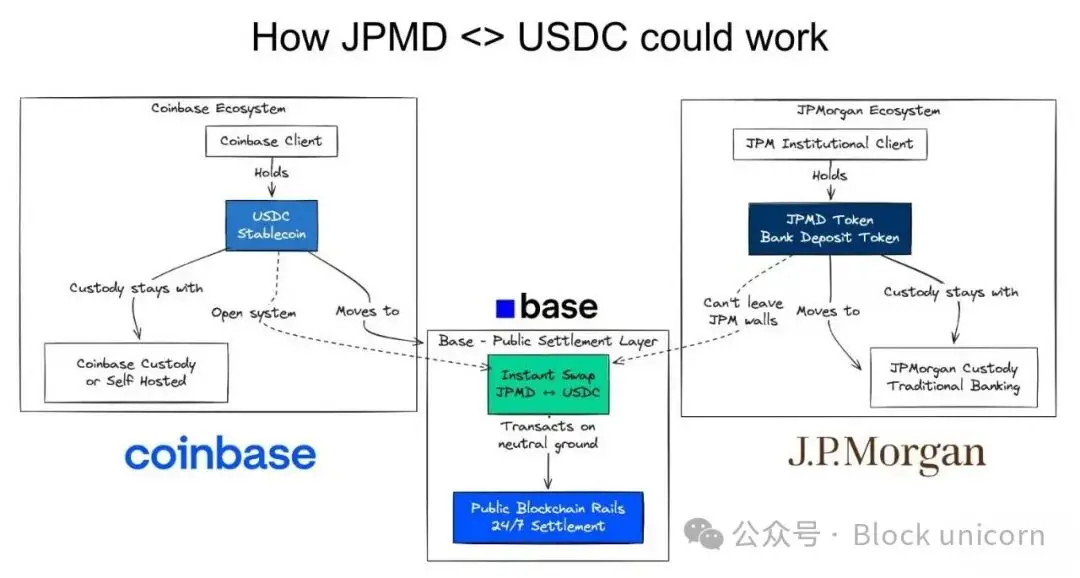
  • A Fortune 500 company holds tokenized deposits at JPMorgan Chase
  • In return, it secures attractive credit for its U.S. operations
  • It needs to pay an Argentinian supplier who prefers stablecoins
  • So, it converts JPMD to USDC

This scenario illustrates the direction we’re heading.

On-chain. Atomic-level.

Best of both worlds.

Use traditional rails when they fit.

Use stablecoins when they don’t.

This isn’t a binary choice—it’s about integration.

  • Tokenized deposits → Low-cost credit within the banking system
  • Stablecoins → Cash-like settlement outside the banking system
  • On-chain exchange → Instant conversion, zero settlement risk

Each approach has its strengths and weaknesses.
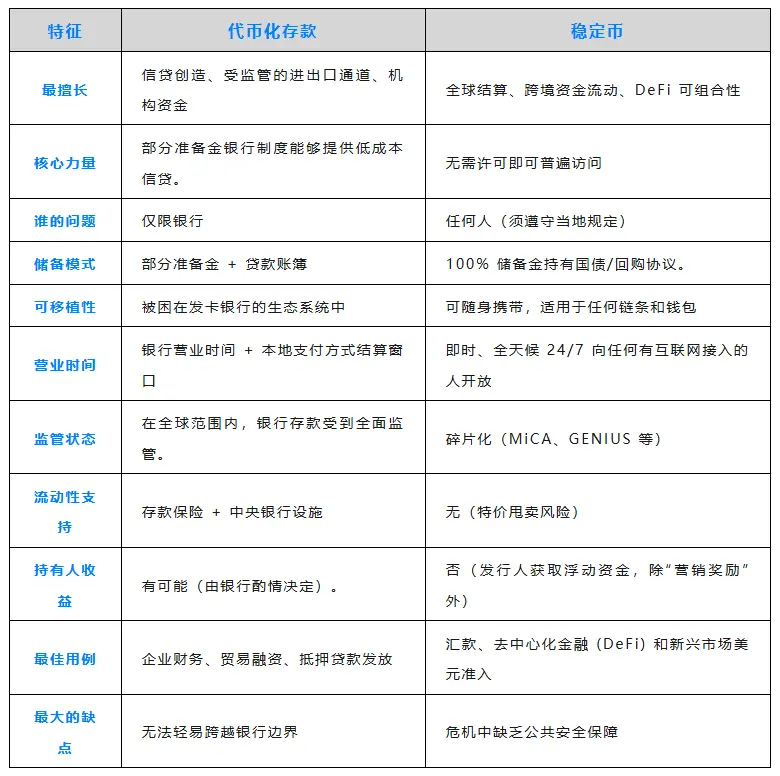

They will coexist.

On-Chain Payments Surpass Payment Orchestration APIs

Some large banks argue, We don’t need tokenized deposits—we have APIs. In certain cases, they’re right.

That’s precisely where on-chain finance excels.

Smart contracts can automate logic across multiple organizations and individuals. When a supplier’s deposit lands, a smart contract can instantly trigger inventory financing, working capital loans, or FX hedging. Both banks and non-banks can execute these actions automatically and in real time.

Deposit → Stablecoin → Pay invoice → Complete downstream payment.

APIs connect point-to-point; smart contracts connect many-to-many. That’s why they’re perfect for workflows that cross organizational boundaries. This is the true strength of on-chain finance.

This is a fundamentally different financial architecture.

The Future Is On-Chain

Tokenized deposits address the need for low-cost credit. Deposits are locked, and banks lend against them. Their business model remains unchanged.

Stablecoins solve the portability challenge. Funds move freely and permissionlessly. The Global South gains dollar access. Businesses achieve rapid settlement.

Tokenized deposit advocates want regulated payment rails only.

Stablecoin advocates want to displace banks entirely.

The future requires both.

Fortune 500 companies want massive credit lines and instant global settlement. Emerging markets want local credit creation and dollar rails. DeFi wants composability and real-world asset backing.

Arguing over who wins misses the point. The future of finance is on-chain. Tokenized deposits and stablecoins are both foundational to this vision.

Stop debating winners. Start building interoperability.

Composable money.

Statement:

  1. This article is republished from [chaincatcher] and the copyright belongs to the original author [Simon Taylor]. If you have concerns about this republication, please contact the Gate Learn team, and we will address the issue promptly according to our procedures.
  2. Disclaimer: The views and opinions expressed in this article are solely those of the author and do not constitute investment advice.
  3. Other language versions of this article are translated by the Gate Learn team. Unless Gate is mentioned, do not copy, distribute, or plagiarize the translated article.
* The information is not intended to be and does not constitute financial advice or any other recommendation of any sort offered or endorsed by Gate.
* This article may not be reproduced, transmitted or copied without referencing Gate. Contravention is an infringement of Copyright Act and may be subject to legal action.

Share

Crypto Calendar
Hayabusa Yükseltmesi
VeChain, Aralık ayında planlanan Hayabusa yükseltmesini duyurdu. Bu yükseltmenin, protokol performansını ve tokenomi'yi önemli ölçüde artırmayı hedeflediği belirtiliyor ve ekip, bu güncellemeyi bugüne kadarki en çok fayda odaklı VeChain sürümü olarak nitelendiriyor.
VET
-3.53%
2025-12-27
Litewallet Gün Batımları
Litecoin Vakfı, Litewallet uygulamasının 31 Aralık'ta resmi olarak sona ereceğini duyurdu. Uygulama artık aktif olarak korunmamakta olup, bu tarihe kadar yalnızca kritik hata düzeltmeleri yapılacaktır. Destek sohbeti de bu tarihten sonra sona erecektir. Kullanıcıların Nexus Cüzdan'a geçiş yapmaları teşvik edilmektedir; Litewallet içinde geçiş araçları ve adım adım bir kılavuz sağlanmıştır.
LTC
-1.1%
2025-12-30
OM Token Göçü Sona Erdi
MANTRA Chain, kullanıcıları OM token'larını 15 Ocak'tan önce MANTRA Chain ana ağına taşımaları için bir hatırlatma yayınladı. Taşıma işlemi, $OM'nin yerel zincirine geçişi sırasında ekosistemdeki katılıma devam edilmesini sağlar.
OM
-4.32%
2026-01-14
CSM Fiyat Değişikliği
Hedera, Ocak 2026'dan itibaren KonsensüsSubmitMessage hizmeti için sabit USD ücretinin $0.0001'den $0.0008'e yükseleceğini duyurdu.
HBAR
-2.94%
2026-01-27
Vesting Kilidi Gecikti
Router Protocol, ROUTE tokeninin Hakediş kilidinin 6 aylık bir gecikme ile açılacağını duyurdu. Ekip, projenin Open Graph Architecture (OGA) ile stratejik uyum sağlamak ve uzun vadeli ivmeyi koruma hedefini gecikmenin başlıca nedenleri olarak belirtiyor. Bu süre zarfında yeni kilit açılımları gerçekleşmeyecek.
ROUTE
-1.03%
2026-01-28
sign up guide logosign up guide logo
sign up guide content imgsign up guide content img
Start Now
Sign up and get a
$100
Voucher!
Create Account

Related Articles

In-depth Explanation of Yala: Building a Modular DeFi Yield Aggregator with $YU Stablecoin as a Medium

Beginner

In-depth Explanation of Yala: Building a Modular DeFi Yield Aggregator with $YU Stablecoin as a Medium

Yala inherits the security and decentralization of Bitcoin while using a modular protocol framework with the $YU stablecoin as a medium of exchange and store of value. It seamlessly connects Bitcoin with major ecosystems, allowing Bitcoin holders to earn yield from various DeFi protocols.
11-29-2024, 10:10:11 AM
What is Stablecoin?
Beginner

What is Stablecoin?

A stablecoin is a cryptocurrency with a stable price, which is often pegged to a legal tender in the real world. Take USDT, currently the most commonly used stablecoin, for example, USDT is pegged to the US dollar, with 1 USDT = 1 USD.
12-16-2022, 9:13:56 AM
Gate Research: 2024 Cryptocurrency Market  Review and 2025 Trend Forecast

Advanced

Gate Research: 2024 Cryptocurrency Market Review and 2025 Trend Forecast

This report provides a comprehensive analysis of the past year's market performance and future development trends from four key perspectives: market overview, popular ecosystems, trending sectors, and future trend predictions. In 2024, the total cryptocurrency market capitalization reached an all-time high, with Bitcoin surpassing $100,000 for the first time. On-chain Real World Assets (RWA) and the artificial intelligence sector experienced rapid growth, becoming major drivers of market expansion. Additionally, the global regulatory landscape has gradually become clearer, laying a solid foundation for market development in 2025.
1-24-2025, 8:09:57 AM
Altseason 2025: Narrative Rotation and Capital Restructuring in an Atypical Bull Market

Intermediate

Altseason 2025: Narrative Rotation and Capital Restructuring in an Atypical Bull Market

This article offers a deep dive into the 2025 altcoin season. It examines a fundamental shift from traditional BTC dominance to a narrative-driven dynamic. It analyzes evolving capital flows, rapid sector rotations, and the growing impact of political narratives – hallmarks of what’s now called “Altcoin Season 2.0.” Drawing on the latest data and research, the piece reveals how stablecoins have overtaken BTC as the core liquidity layer, and how fragmented, fast-moving narratives are reshaping trading strategies. It also offers actionable frameworks for risk management and opportunity identification in this atypical bull cycle.
4-14-2025, 7:05:46 AM
Top 15 Stablecoins
Intermediate

Top 15 Stablecoins

The stablecoin landscape is evolving rapidly, driven by innovation, regulatory changes, and market demand. Each of the top 15 stablecoins analyzed offers unique features, pegging mechanisms, and reserve reports. From Tether's increasing market dominance to the decentralized governance of DAI and the hybrid model of FRAX.
9-22-2024, 2:01:27 PM
A Complete Overview of Stablecoin Yield Strategies
Intermediate

A Complete Overview of Stablecoin Yield Strategies

This article explores stablecoins, covering their concepts, types, and investment strategies. It examines the main categories of stablecoins—fiat-collateralized, crypto-collateralized, algorithmic, and commodity-collateralized—and analyzes various investment approaches, from liquidity mining to automated yield optimization and compound rewards. The article also addresses critical risk factors in stablecoin investment, including platform risks, interest rate fluctuations, and liquidity concerns. By offering specific risk prevention strategies and investment optimization techniques, it serves as a comprehensive guide for stablecoin market investors.
1-16-2025, 3:22:54 PM