Will the market become more and more violent? The loser of a $14 million bet on Polymarket issued death threats to an Israeli reporter reporting on Iran missiles, leaked his family address, and demanded he “change his report.”
(Background: What is the leading prediction market Polymarket?)
Table of Contents
Toggle
- A missile equals a $14 million wager
- Fake screenshots, death threats, leaking family addresses
- Polymarket condemns, but the issue is more complex
An Israeli journalist, after accurately reporting Iran’s missile landings, received death threats, his family’s address was leaked, and a message said: “You made us lose $900,000, we’ll spend the same amount to kill you.”
This is not a movie plot. This is a real incident that happened in March 2026 involving Emanuel Fabian, a military reporter for the Times of Israel.
A missile equals a $14 million wager
On March 10, Iran launched ballistic missile attacks on Israel. One missile landed in a wooded area near Beit Shemesh, about 500 meters from residential homes, with no injuries.
Fabian reported based on rescue service data and explosion footage: the missile’s warhead indeed landed and was not intercepted. The Israel Defense Forces (IDF) later confirmed this, and his report was entirely accurate.
The problem is, there was a betting market on Polymarket asking: “Did Iran’s missile land in Israel on March 10?” The total bet amount exceeded $14 million (about NT$45 million). The rules were clear:
A missile that was intercepted does not count as a “Yes,” even debris from a landed missile does not count.
Fabian’s reporting as a military journalist caused the “No” bettors to suddenly go from having a chance to win to being definitively out.
Fake screenshots, death threats, leaking family addresses
What happened next exceeded most people’s expectations of “prediction market controversy.” The losers took the following actions:
- Sent polite emails requesting Fabian to change his report to “intercepted debris”
- Faked screenshots of Fabian’s email and spread them on X, claiming he “agreed to revise the report”
- Issued death threats: “You made us lose $900,000, we’ll spend the same amount to kill you”
- Threatening messages included his home address, personal details of his parents and siblings, and a note: “It took less than 5 minutes to find your exact address”
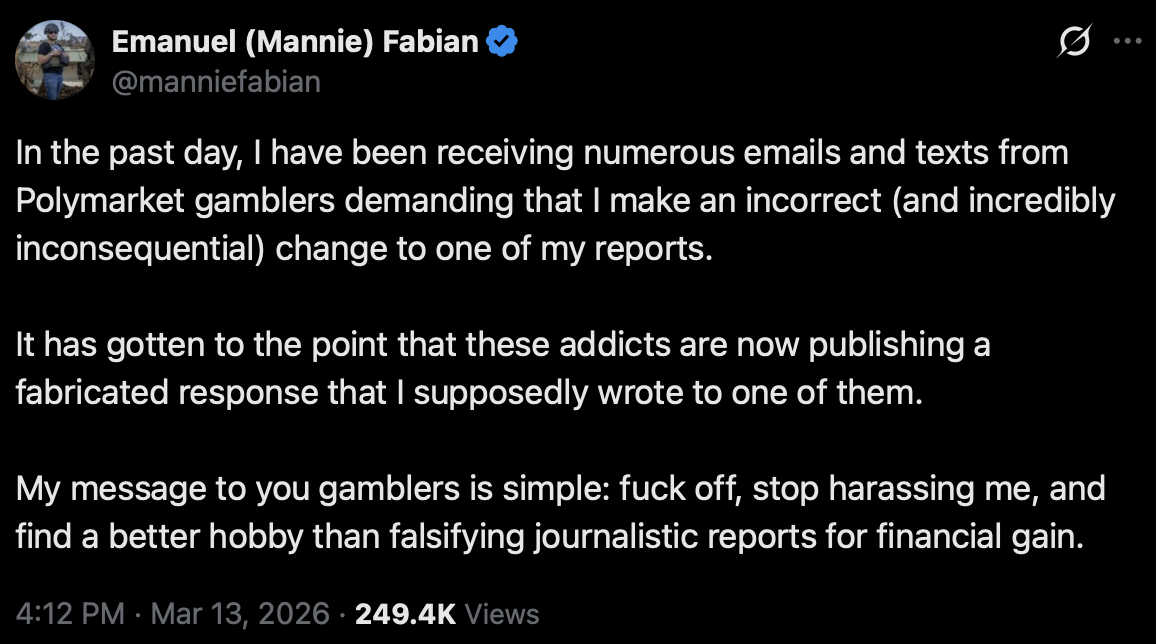
Fabian publicly shared this on X on March 13, with over 250,000 views. His response was straightforward:
“To those gamblers: go to hell, stop harassing me, find a more meaningful hobby than faking news.”
Polymarket condemns, but the issue is more complex
Fabian has reported the incident to the police. Polymarket issued a statement condemning the harassment, has banned the involved accounts, and said they will hand over relevant information to authorities.
However, the problems exposed by this incident go far beyond a simple statement. The core logic of prediction markets is to use financial incentives to aggregate information and discover truth. But when the betting amounts are large enough to drive people to harass, threaten, or even fake news, the fundamental issues of this mechanism become apparent.
Reporters who present facts should not become victims of betting disputes. This time, the Israel Defense Forces confirmed Fabian’s report was correct.
His report was accurate; he simply reported what happened.
But in the future, not every journalist will have someone backing them.
Any market, once it grows large enough, will attract more illegal manipulation and insider trading.
Prediction markets are likely to follow this old path.

Disclaimer: The information on this page may come from third parties and does not represent the views or opinions of Gate. The content displayed on this page is for reference only and does not constitute any financial, investment, or legal advice. Gate does not guarantee the accuracy or completeness of the information and shall not be liable for any losses arising from the use of this information. Virtual asset investments carry high risks and are subject to significant price volatility. You may lose all of your invested principal. Please fully understand the relevant risks and make prudent decisions based on your own financial situation and risk tolerance. For details, please refer to
Disclaimer.


