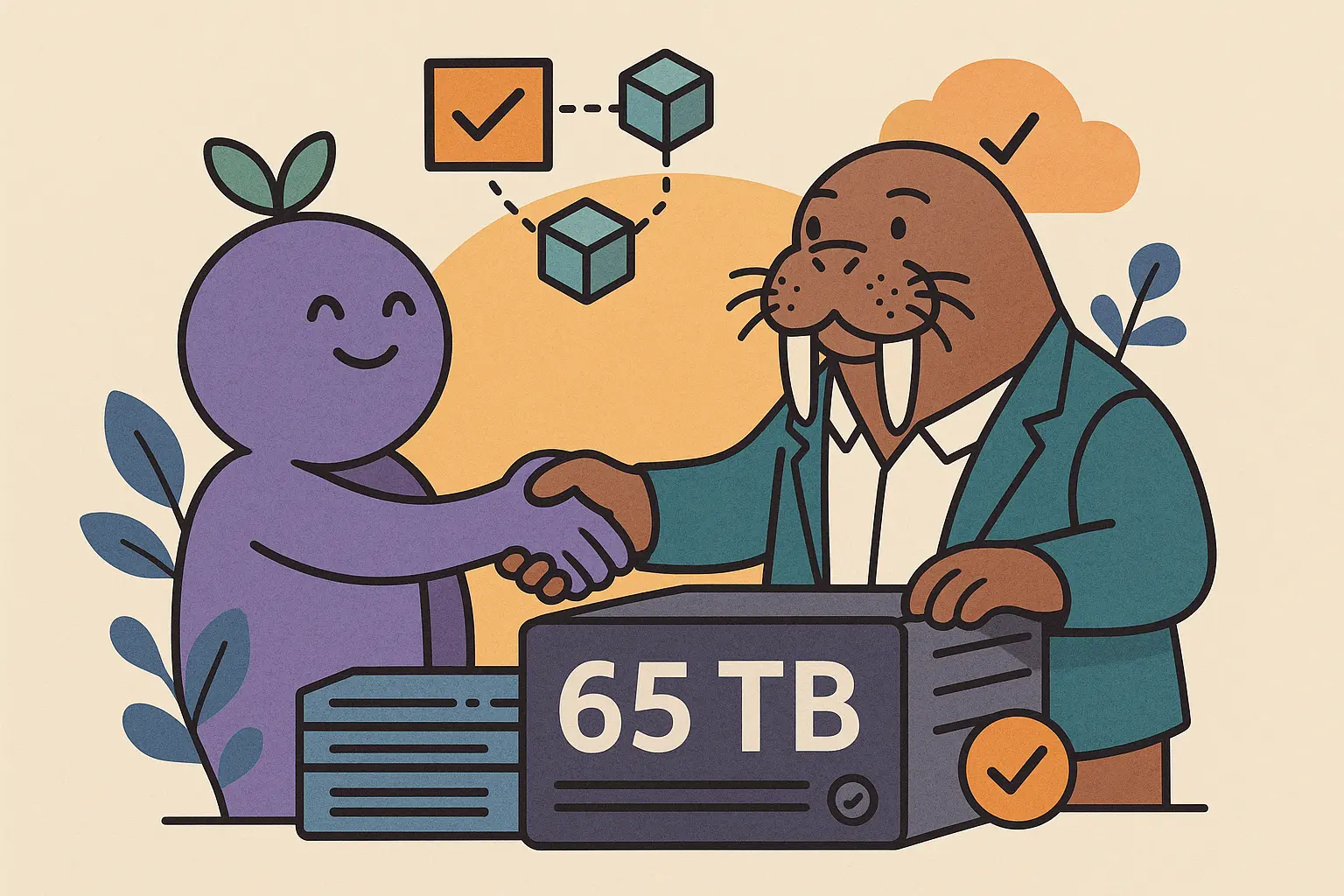
The blockchain data platform Allium announced a partnership with the decentralized data layer Walrus, integrating over 65TB of historical indexed data from Bitcoin, Ethereum, Sui, Arbitrum, Tron, and XRP into the Walrus platform, enabling institutions, developers, and AI agents to access this data in a verifiable and always-available manner.
Core Mechanisms and Technical Architecture of the Partnership
This collaboration is built upon several of Walrus’s core technical capabilities. Walrus is developed by Mysten Labs, behind the Sui Layer-1 blockchain, and is positioned as a “verifiable data platform for AI and on-chain financial developers”—less than a year since launch, its protocol has stored over 450TB of unencoded data.
Allium’s datasets on Walrus incorporate the following key technical features:
Node Fault Tolerance: Data remains accessible even if some nodes are offline, avoiding the single point of failure typical of traditional centralized storage.
On-Chain Data Verification: Each data entry can be verified for authenticity via on-chain mechanisms, providing an immutable data foundation for financial decision-making.
Seal Encryption and Programmable Access Control: Using Walrus’s decentralized key management service Seal, data can be encrypted and unlocked at the time of purchase without intermediaries controlling access permissions. Walrus defines this mechanism as “transforming blockchain data into programmable assets,” suitable for various applications such as quantitative funds and AI agents.
Allium’s co-founder and CEO Ethan Chan stated that the decision to release some datasets via Walrus is “an active exploration of using decentralized infrastructure as an additional distribution layer for institutional-grade blockchain data.”
Practical Benefits for AI Agents and Institutional Users
Rebecca Simmonds, Executive Director of the Walrus Foundation, emphasized the importance of verifiable data for institutional decision-making: “Data supporting high-risk financial decisions needs a verifiable foundation. Allium has already served fintech giants, and now, by delivering data through the Walrus platform—this makes the data verifiable, always accessible, and with built-in programmable access controls.”
Regarding this emerging application scenario of AI agents, Walrus believes this partnership will bring a significant breakthrough. Currently, AI agents relying on external data often depend on traditional APIs or centralized data providers, lacking independent verification of data authenticity. Through the collaboration between Walrus and Allium, AI agents can autonomously discover, purchase, and utilize structured blockchain historical data, all without trusting any intermediaries—the Seal access control mechanism ensures agents automatically obtain data within a compliant framework.
Both platforms have stated that this is the beginning of a long-term partnership, and the institutional-grade multi-chain data available on Walrus will continue to expand over the coming weeks and months.
Frequently Asked Questions
How does Allium’s data compare to existing services like Dune Analytics or The Graph?
Allium, Dune Analytics, and The Graph all provide blockchain data access, but they differ in focus. Allium’s core differentiation lies in providing compliant, structured historical blockchain data tailored for traditional financial institutions like Visa and Stripe. With the integration of Walrus, an additional dimension of on-chain verifiability is introduced, allowing the authenticity of data to be independently confirmed through decentralized mechanisms, rather than relying solely on Allium’s credibility.
Why is 65TB of historical data particularly important for AI agents?
AI agents performing on-chain financial tasks require large volumes of high-quality historical data for training and inference, such as analyzing smart contract interaction patterns, cross-chain liquidity research, and fraud detection. The main obstacle is that most institutional data sources lack verifiability, preventing AI agents from independently confirming data authenticity. Deploying Allium on Walrus provides a foundational infrastructure that is “source-trusted, programmable, and verifiable,” enabling AI agents to access reliable data independently.
How does Walrus’s decentralized storage differ from Filecoin or Arweave?
Walrus’s design emphasizes not only data storage but also verifiability and programmable access control. While Filecoin and Arweave primarily address the problem of long-term data preservation, Walrus, through integration with Seal, additionally solves the issues of encrypted data storage, rule-based unlocking, and on-chain verification of access history. This makes Walrus more suitable for institutional financial data scenarios that require precise access control.
Please note: The original source text is complete; this translation fully covers all content provided.
Disclaimer: The information on this page may come from third parties and does not represent the views or opinions of Gate. The content displayed on this page is for reference only and does not constitute any financial, investment, or legal advice. Gate does not guarantee the accuracy or completeness of the information and shall not be liable for any losses arising from the use of this information. Virtual asset investments carry high risks and are subject to significant price volatility. You may lose all of your invested principal. Please fully understand the relevant risks and make prudent decisions based on your own financial situation and risk tolerance. For details, please refer to
Disclaimer.


