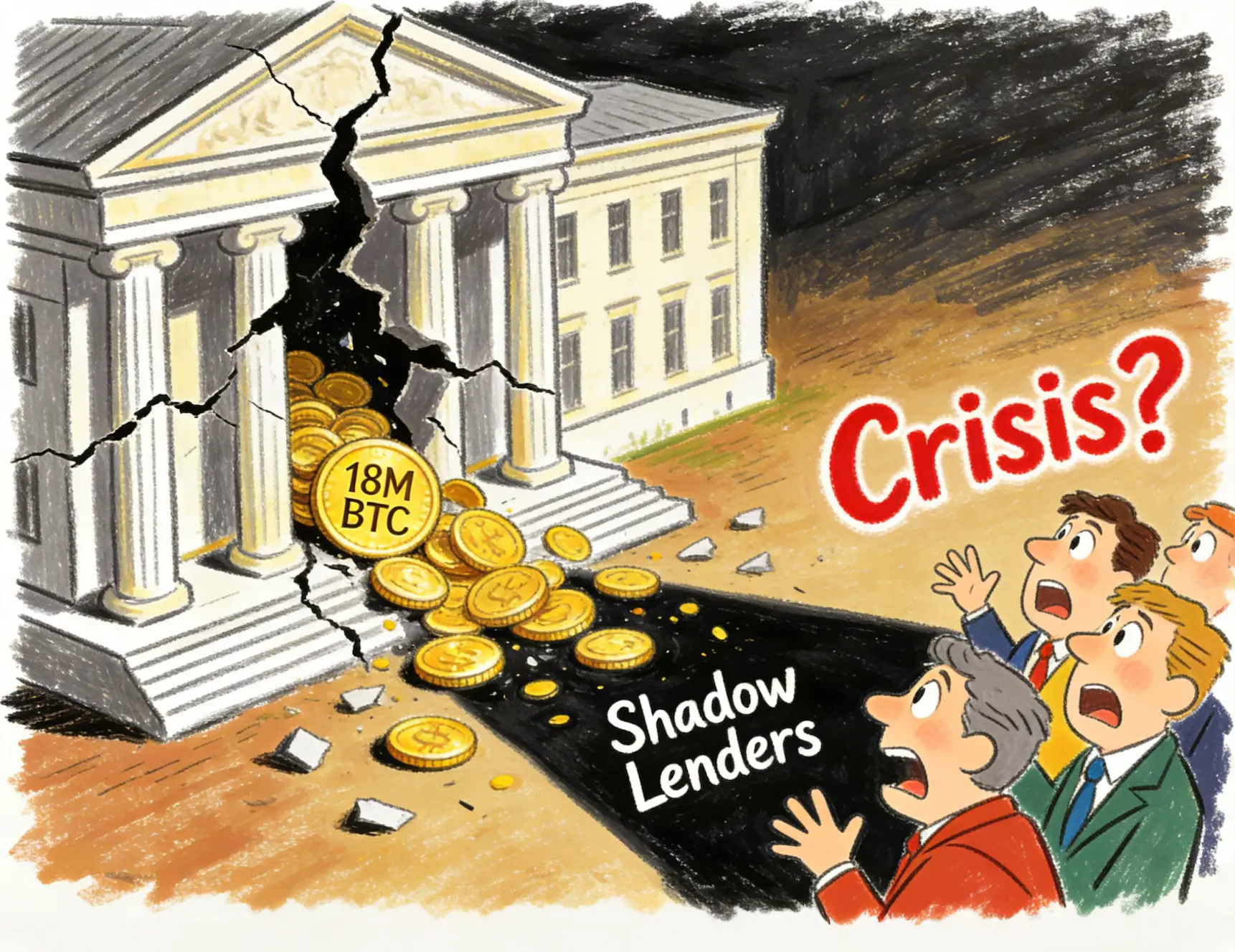
 U.S. bank lending to nondepository financial institutions (NDFIs)—including private credit funds, mortgage finance firms, and securitization vehicles—has grown to $1.32 trillion as of the third quarter of 2025, a 2,320% increase from $56 billion in early 2010.
This category has become the fastest-growing loan segment since the 2008-09 financial crisis, compounding at 21.9% annually over 15 years and now representing approximately 10% of total bank lending. While the banking sector remains well-capitalized overall—posting $295 billion in 2024 earnings with return on assets of 1.24%—the structural shift has moved credit risk off bank balance sheets and into less transparent corners of the financial system, where stress may surface first if private markets begin to crack.
The exposure has drawn renewed scrutiny as recent redemption restrictions at major private credit funds and selective tightening of bank financing terms signal potential pressure points in a system built on long-duration, illiquid assets.
The Scale of Bank Lending to NDFIs
Growth Trajectory
The post-2008 regulatory crackdown has driven a dramatic structural shift in bank balance sheets. Loans to nondepository financial institutions have grown from $56 billion in Q1 2010 to $1.32 trillion by Q3 2025—a compound annual growth rate of 21.9% over 15 years. The category encompasses a broad range of counterparties, including private credit vehicles, mortgage intermediaries, consumer finance firms, securitization structures, private equity funds, and other nonbank lenders.
Year-over-year growth remained robust at 35% through year-end 2025, with the category expanding 7% in Q4 alone. This rapid expansion makes NDFI exposure the single fastest-growing segment of bank loan books since the financial crisis.
Composition of Exposure
Within the NDFI category, exposures carry varying risk profiles. Subscription line lending and secured real estate lending represent the two largest components, both generally considered relatively low-risk. Business credit—including lending tied to AI data centers—accounts for approximately 20% of total NDFI exposure across the U.S. banking system.
Median exposure to NDFIs across banks under coverage stands at about 11% of total loans, with institutions typically maintaining internal underwriting limits by industry to manage concentration risk.
Private Credit: The Visible Point of the Iceberg
Market Size and Growth
Private credit, a significant subset of the NDFI category, has ballooned to an estimated $2-3 trillion in assets. Projections suggest the market could approach $5 trillion by 2029. Direct lending yields have fallen below 10% for the first time in three years as competition intensifies and Federal Reserve rate cuts compress spreads.
Bank Financing Lines to Private Credit
Committed credit lines from the largest U.S. banks to private credit vehicles have risen from approximately $8 billion in Q1 2013 to roughly $95 billion by Q4 2024, with about $56 billion already drawn. Total committed bank lines to private credit and private equity combined stand at approximately $322 billion.
While direct financial-stability risk appears limited—the largest banks can likely absorb major drawdowns—the growing linkages between banks and private credit vehicles warrant close attention.
Where Stress Is Showing
Redemption Pressures
Several major private credit funds have recently restricted or managed withdrawals, signaling liquidity stress beneath the surface:
-
A $26 billion fund received redemption requests equal to 9.3% of shares (approximately $1.2 billion) in Q1 2026 and met only its 5% quarterly cap of $620 million, citing preservation of capital while maintaining designed liquidity parameters.
-
Another fund received requests equal to 10.9% of shares and honored only its 5% cap.
-
One major alternative asset manager temporarily raised its redemption limit from 5% to 7% and injected $400 million of firm capital to meet investor withdrawals.
-
Another firm shifted payout mechanisms in one fund from quarterly tender offers to periodic capital distributions funded by asset sales.
The redemption pressure stems partly from wealthy individual investors, who have become a major funding source for private credit strategies traditionally dominated by pensions and institutions.
Collateral and Underwriting Stress
Banks are becoming more selective in financing private credit exposures:
-
One major bank marked down some software-backed private credit collateral and restricted lending to affected funds, reducing borrowing capacity and signaling tougher collateral treatment.
-
High-profile bankruptcies have rattled confidence. Industry leaders have warned: “When you see one cockroach, there are probably more. These are early signs there might be some excess out there because we’ve had a credit market bull run since 2010.” Write-offs related to specific bankruptcies have reached significant levels.
-
Some analysts suggest defaults in private credit could reach levels multiples of peak delinquency rates for bank loans during the 2008 crisis.
The AI Factor
Approximately 25% of business development company portfolios are allocated to software. AI disruption is forcing a fundamental repricing of software business models—compressing pricing power, narrowing competitive moats, and increasing R&D costs. This creates a two-edged risk: private credit exposure to software may be underwritten against a business model that AI is rapidly rendering obsolete.
Why This Matters for the Banking System
Transmission Channels
The structural shift in credit intermediation changes where stress appears first. A classic bank panic starts at the bank. In the current architecture, stress can begin in a fund, a warehouse line, or a financing vehicle, then work backward into banks if marks fall, borrowers miss payments, or investors ask for cash faster than assets can be sold.
Banks’ NDFI exposure sits atop a longer lending chain with more links—and more opacity—than traditional bank lending. Losses, redemptions, and liquidity pressure can propagate through this chain before reaching regulated institutions.
Banking System Health
The banking sector enters this phase from a position of strength: $295 billion in 2024 earnings, fourth-quarter return on assets of 1.24%, reduced unrealized securities losses to $306 billion, and just 60 problem banks—well within normal non-crisis range.
U.S. banks remain well capitalized to absorb future credit losses, with most maintaining buffers of 150-200 basis points above regulatory minimums. The sector trades at roughly 1.0 times fair value estimates following February’s selloff.
Implications for Bitcoin
First-Phase Dynamics
In a genuine liquidity crisis, Bitcoin behaves like other liquid assets—it gets sold first. With BTC trading near $73,777 and holding 58.5% market dominance, up 4.55% over seven days and 7.51% over 30 days, crypto markets are not currently pricing imminent systemic stress. But if a broader credit squeeze materialized, the initial move would likely be a selloff in highly liquid assets, including Bitcoin.
Second-Phase Dynamics
Historical patterns suggest a different second act. In the March 2020 panic, Bitcoin dropped over 30% in five days as investors sought cash. Once policy responses flooded markets with liquidity, Bitcoin rose over 900% from its low within 10 months. During the 2023 regional banking crisis, the same script played out: Bitcoin fell initially, then more than doubled by year-end as the Fed’s Bank Term Funding Program stabilized markets.
The core mechanism: when governments inject liquidity to stabilize a highly financialized, debt-burdened system, Bitcoin often responds faster and more dramatically than other assets.
Structural Resonance
Bitcoin’s origin block carries the message: “The Times 03/Jan/2009 Chancellor on brink of second bailout for banks.” The asset was born as a response to bank rescues, opaque leverage, and intermediation risk. Every time authorities step in to backstop hidden leverage, Bitcoin’s foundational logic grows stronger.
Financial infrastructure is also trending toward 24/7 operation. The Fed announced in October 2025 that Fedwire and national settlement systems plan to operate Sundays and holidays by 2028-2029—not an endorsement of Bitcoin, but an acknowledgment that the economy runs on digital, continuous rails.
What to Watch
Three Key Indicators
Fund withdrawals: Whether redemption requests remain contained or force more gating events at major private credit vehicles
Bank financing: Whether lenders maintain terms or continue selective tightening against weaker collateral
NDFI loan growth: Whether the $1.32 trillion exposure continues expanding at anything close to its prior 21.9% CAGR, or whether growth slows as underwriting tightens
The Middle-Market Transmission
If banks tighten financing to nonbank lenders, middle-market borrowers feel it quickly through reduced access and higher costs. If funds meet redemptions by selling liquid assets, public credit markets may absorb price discovery that private books avoided. If funds don’t sell and banks keep financing, exposures stay in the system longer.
Frequently Asked Questions
What are NDFIs and why does bank lending to them matter?
Nondepository financial institutions include private credit funds, mortgage finance firms, securitization vehicles, consumer finance companies, and private equity funds. Banks have shifted a growing share of lending to these entities since 2008, with exposure growing 2,320% to $1.32 trillion. This matters because credit risk has moved into less transparent parts of the financial system, where stress may surface before it reaches regulated banks.
How are banks exposed to private credit specifically?
Banks provide committed credit lines to private credit vehicles, with total commitments to private credit and private equity estimated at approximately $322 billion, of which roughly $56 billion is already drawn. Banks also finance private credit funds through warehouse lines and other facilities, creating linkages that could transmit stress from nonbank lenders back into the banking system.
Does this situation resemble 2008?
No. The banking sector is far better capitalized today, with earnings of $295 billion in 2024, return on assets of 1.24%, and most banks maintaining capital buffers 150-200 basis points above regulatory minimums. However, the structural shift in credit intermediation means that future stress may not originate in banks. It could begin in private funds or financing vehicles, then work backward into banks through the lending chain.


