
The Chair of the Financial Supervisory Commission (FSC), Peng Jinlong, testified before the Legislative Yuan on March 23 regarding the draft Virtual Asset Service Law, revealing that approximately 10% of Taiwan’s population holds cryptocurrencies. According to the Taiwan Virtual Asset Service Providers Association, about one million accounts have been opened. In this context, three foreign companies—Binance, BitGo, and Liminal—have already established companies in Taiwan, laying the groundwork for future licensing compliance.
Current State of Taiwan’s Crypto Market: Millions of Users and Regulatory Gaps
Peng Jinlong pointed out that Taiwan currently has only eight legally registered Virtual Asset Service Providers (VASPs), but there are as many as 30 unregulated foreign exchanges, creating a significant regulatory gap. The 2022 FTX bankruptcy incident is a key background for this legislation—affecting about 300,000 Taiwanese investors and resulting in losses exceeding $400 million, exposing systemic risks related to asset segregation and lack of local regulation.
The draft Virtual Asset Service Law clearly states that all operators must entrust customer assets into trusts and strictly separate them from company assets. Once passed, foreign exchanges will have two options: establish a branch in Taiwan or directly invest in setting up a new branch, both of which must be incorporated into Taiwan’s anti-money laundering framework. Peng Jinlong emphasized that soliciting business from Taiwanese users without permission will be considered illegal.
Three Foreign Companies Have Already Established Companies in Taiwan
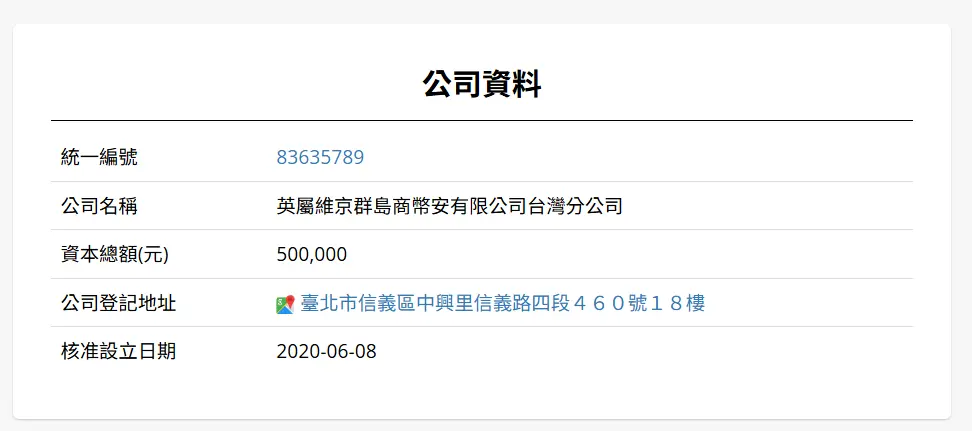
(Source: TechNews Company Registration Inquiry Website)
Against the backdrop of gradually clarifying regulatory frameworks, three foreign companies have taken the lead in establishing their presence in Taiwan:
Binance: The world’s largest cryptocurrency exchange by market capitalization, has set up “Binance Taiwan Limited,” proactively establishing compliance prerequisites.
BitGo: An American-based institutional-grade crypto asset custody service provider, has completed the establishment of its Taiwan subsidiary, targeting the banking sector’s demand for VASP custody.
Liminal: Another institutional-grade crypto custody provider, has also established a subsidiary in Taiwan, aligning with the trend of Taiwan’s financial industry entering digital asset custody.
Informed lawyers also pointed out that some foreign operators face difficulties during registration because their funding sources are suspected to involve mainland Chinese capital, which is a key focus of regulatory scrutiny.
Taiwan’s Banking Sector Advances in Custody, Stablecoins, and Asset Tokenization
Traditional financial institutions are actively preparing. Currently, 19 banks have expressed interest in virtual asset custody services, with five already approved or applying for pilot programs. Data from the Taiwan External Trade Development Council shows that by September 2025, 5.2% of Taiwanese companies are actively using stablecoins for payments, with an additional 4.2% planning to adopt, indicating that stablecoins have established a market presence among enterprises.
Yushan Financial Holding’s chairman publicly stated that the future of finance will involve parallel development of physical, digital, and virtual assets, emphasizing that they will not be absent from stablecoin issuance and tokenization. Cathay Financial Holding has completed proof of concept for physical asset tokenization by 2025 and is actively building trading platforms, planning to issue corporate bonds and financial bonds on blockchain, marking Taiwan’s traditional financial industry’s accelerated move into the new phase of crypto asset applications.
Frequently Asked Questions
What are the core requirements of Taiwan’s draft Virtual Asset Service Law?
The draft requires all virtual asset service providers to entrust customer assets into trusts and strictly separate them from their own assets to prevent incidents like FTX. Foreign exchanges must establish a branch in Taiwan or apply to set up a new branch, both of which must be incorporated into the anti-money laundering framework. Soliciting Taiwanese users without permission will be considered illegal.
What is Binance’s current compliance status in Taiwan?
Binance has established “Binance Taiwan Limited,” completing the basic company structure, and is preparing for future licensing. It does not yet hold an official license, and its specific operations are pending the formal passage of the Virtual Asset Service Law and the implementation of regulatory rules.
What is the current status of Taiwan’s banking sector entering crypto asset services?
Nineteen banks have expressed interest in virtual asset custody services, with five already approved or applying for pilot programs. Yushan Financial Holding and Cathay Financial Holding have taken concrete steps in stablecoin applications and physical asset tokenization, demonstrating that Taiwan’s traditional financial institutions are accelerating their strategic deployment in the digital asset field.
Disclaimer: The information on this page may come from third parties and does not represent the views or opinions of Gate. The content displayed on this page is for reference only and does not constitute any financial, investment, or legal advice. Gate does not guarantee the accuracy or completeness of the information and shall not be liable for any losses arising from the use of this information. Virtual asset investments carry high risks and are subject to significant price volatility. You may lose all of your invested principal. Please fully understand the relevant risks and make prudent decisions based on your own financial situation and risk tolerance. For details, please refer to
Disclaimer.


