
Pi Network announced on March 27 that over 119,000 users have completed the second migration, successfully transferring additional balances and referral mining rewards to the mainnet. At the same time, on-chain data shows that the reserves of PI on centralized exchanges reached a historic high of 472 million in March, up 79.5% from 263 million in the same period of 2025, indicating that supply-side pressure poses a significant risk to the token’s price trend.
Second Migration Milestone: Technical Complexity Surpassing the First Migration
According to the official Pi Network blog, the technical complexity of the second migration far exceeds that of the first, due to the more intricate calculation logic for referral rewards—each pioneer’s referral reward amount depends on the KYC verification status of their referral team members, and rewards may differ in each mining session, requiring substantial backend calculations and data verification work. Pi Network stated that this milestone “has paved the way for users to migrate more Pi to the mainnet and deepen their participation in the ecosystem.”
Pi Network also announced several significant advancements in its ecosystem:
Pi Launchpad: Officially launched on the testnet, laying early infrastructure for the incubation and initiation of future mainnet ecosystem projects.
Pi App Studio: Officially supported mainnet functionality on Pi Day, allowing developers to build and deploy decentralized applications in the mainnet environment.
These advancements show that Pi Network is extending from the technical execution layer of token migration to a broader phase of on-chain application ecosystem construction.
Exchange Reserves Increase by 79.5% Year-Over-Year: Supply Pressure Becomes Key Variable for Price Trend
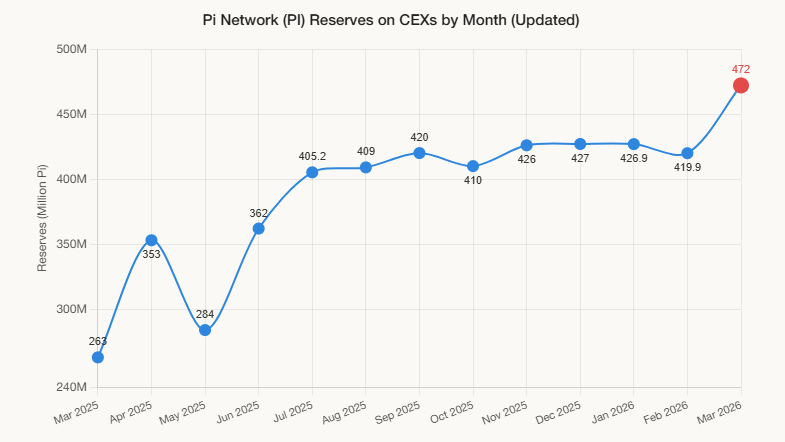 (Source: BeInCrypto)
On-chain data compiled by Pi Scan shows that in March 2026, the amount of PI held on centralized exchanges rose to 472 million, reaching a historic high and increasing by 79.5% compared to 263 million a year earlier. The continuous rise in exchange reserves is typically interpreted within market analysis frameworks as a leading indicator of potential sell-off pressure—holders moving tokens to exchanges often signals an intention to sell, and when the growth rate of reserves exceeds market absorption demand, it will create downward pressure on token prices.
The current market conditions for PI confirm this structural pressure. The current trading price of the token is approximately $0.18, down about 94% from the historical high of $2.99 reached in February 2025. As the second migration continues, more PI balances are entering a tradable circulation state, and the gap between the new supply and natural buying demand is the core factor determining the short-term price direction.
Frequently Asked Questions
What does it mean that the Pi Network’s second migration has reached a milestone?
The completion of the second migration by over 119,000 pioneers means that a corresponding number of users have successfully transferred referral mining rewards and additional balances to the mainnet. This figure reflects community activity, but it also means more PI has entered a state that can circulate and be traded in the market, impacting the supply side.
What are the functions of Pi Launchpad and Pi App Studio?
Pi Launchpad is a platform provided by Pi Network for the incubation and initiation of ecosystem projects, which is currently live on the testnet; Pi App Studio is a tool for developers to build decentralized applications in the Pi Network mainnet environment, which received mainnet functionality support on Pi Day (March 14). Both mark the extension of the Pi Network ecosystem into practical application layers.
What risks does the historic high of PI exchange reserves indicate?
The exchange reserves reaching a historic high of 472 million and increasing by 79.5% typically indicates that a significant number of holders are currently selling or preparing to sell PI, creating continuous supply-side pressure. When new supply exceeds buying demand, it may further negatively impact the token price, corroborating the current situation where PI has fallen about 94% from its historical high.
Disclaimer: The information on this page may come from third parties and does not represent the views or opinions of Gate. The content displayed on this page is for reference only and does not constitute any financial, investment, or legal advice. Gate does not guarantee the accuracy or completeness of the information and shall not be liable for any losses arising from the use of this information. Virtual asset investments carry high risks and are subject to significant price volatility. You may lose all of your invested principal. Please fully understand the relevant risks and make prudent decisions based on your own financial situation and risk tolerance. For details, please refer to
Disclaimer.


