
The rise of on-chain detectives, tracking fraud and money laundering flows through address clustering and OSINT, with ZachXBT and others exposing multiple major cases, intensifying the tug-of-war between transparency and privacy.
As fraud and money laundering activities in the cryptocurrency space become increasingly rampant, traditional law enforcement agencies often struggle to track and respond in a timely manner. At this point, civilian detectives known as “crypto sleuths” or “Blockchain Investigators” are gradually emerging, using on-chain data analysis and open-source intelligence to expose fraudulent activities and assist law enforcement agencies in investigating crimes. Data analytics firm Arkham provides a detailed analysis of how to become a qualified on-chain detective.
What is an on-chain detective? Connecting known data to reveal true identities
The anonymity and immediacy of cryptocurrencies make it difficult for traditional law enforcement and regulatory agencies to trace illicit flows of money and criminal activities. At this time, civilian investigators have become an indispensable force in the crypto ecosystem.
The so-called “blockchain investigators” refer to individuals or groups that use public data (OSINT) and on-chain data analysis to investigate potential fraud or criminal activities. Unlike traditional law enforcement agencies, these investigators often operate anonymously or semi-anonymously and publicly share their findings through social media platforms.
Their core work includes tracking the movement of cryptocurrencies between different wallets, analyzing transaction patterns, and establishing connections between on-chain addresses and individuals or organizations in the real world. Due to the immutable and highly transparent nature of blockchain, the flow of funds is technically highly traceable.
How to become an on-chain detective? Start by unraveling blockchain anonymity
Arkham points out that the key to blockchain investigation lies in data analysis skills. Common methods include:
- Address Clustering: Determining whether multiple wallets are controlled by the same entity based on transaction time, amount, frequency, and interaction partners.
- Transaction Pattern Analysis: Identifying typical paths of money laundering or fund transfers.
- Cross-referencing on-chain and off-chain data: Combining social media accounts, domain registrations, and public documents to further infer true identities.
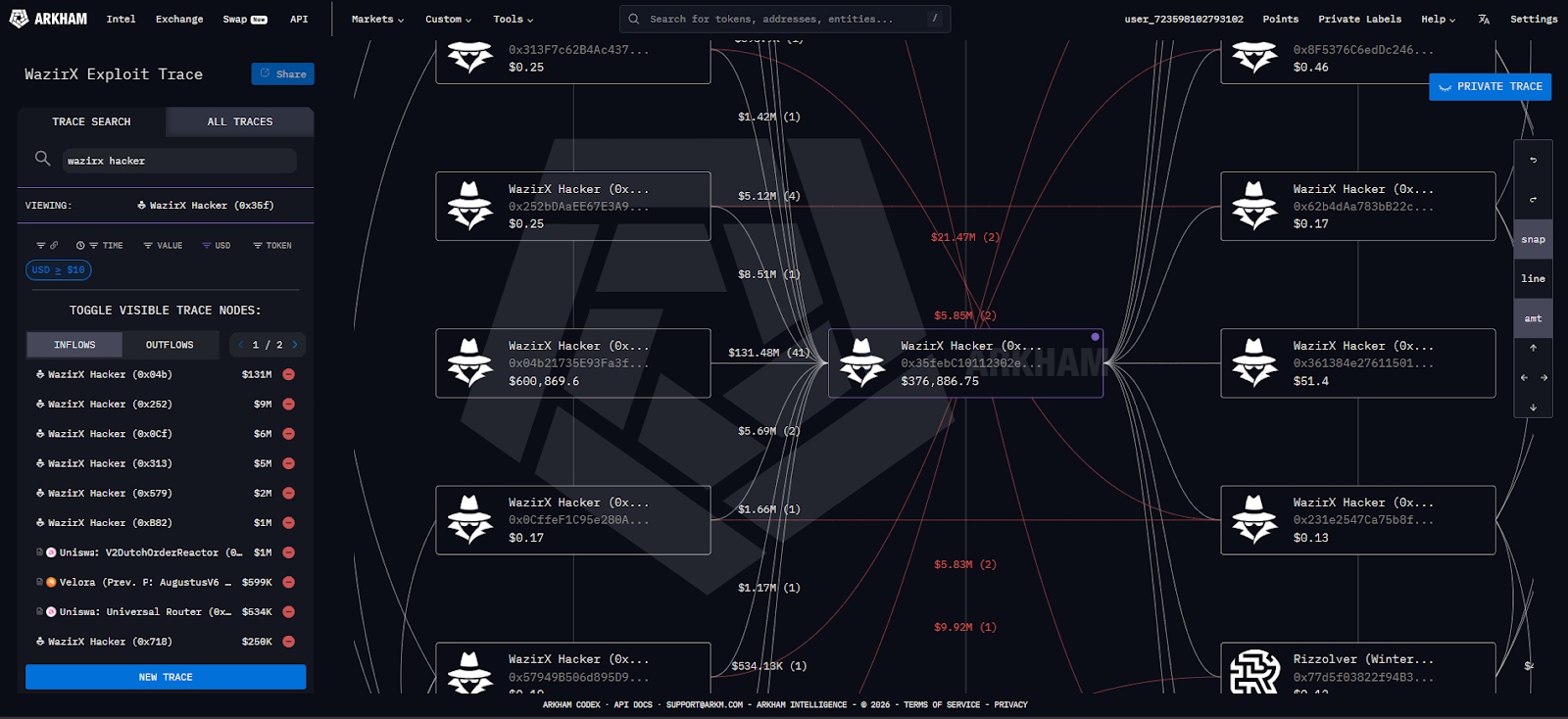
Image source: Arkham’s flow visualization tool from Arkham Intelligence
Of course, using Arkham’s own analytical platform, Arkham Intelligence, is also an option. This platform provides wallet tagging and storage, fund flow visualization tools, and cross-chain tracking features. These technologies allow originally anonymous blockchain transactions to gradually reveal characteristics that can be parsed and tracked.
The rise of key figures: The influence of ZachXBT and Coffeezilla in the crypto market
Among many blockchain investigators, ZachXBT and Coffeezilla are regarded as the most influential representatives.
ZachXBT operates under an anonymous identity in the on-chain investigation field, utilizing fund flow tracking and public data analysis to help expose several major hacking incidents, insider trading, and even cybersecurity issues, successfully leading to the arrest of multiple suspects and the recovery of victims’ assets. His investigations are often published in the form of articles on social media platforms, impacting the entire crypto community.
In contrast, YouTuber Coffeezilla exposes financial and crypto scams through video content, drawing public attention through interviews and investigative reports. He has deeply tracked the SafeMoon and FTX incidents, revealing controversies involving celebrity endorsements of crypto projects, driving public opinion and legal actions.
Blockchain investigation and analysis tools have played a crucial role in both everyday observations and major events, including the 2020 LuBian Bitcoin theft case in China, which resulted in losses of up to $9.5 billion; as well as the routine tracking of MicroStrategy’s Bitcoin holdings.
The tug-of-war between transparency and privacy: The double-edged sword of the blockchain world
The core value of blockchain technology lies in its openness and transparency, allowing all transaction records to be queried. However, this transparency also brings privacy risks. Once a wallet address is linked to a personal identity, all past and future transactions may be continuously tracked.
Therefore, the crypto world is also facing a problem: how to enhance market transparency and prevent crime while balancing individual privacy rights, which requires further discussion.
- This article is reprinted with permission from: “Chain News”
- Original title: “Anyone Can Be ZachXBT! Arkham’s Guide on How to Become an On-Chain Cryptocurrency Detective?”
- Original author: Crumax
Disclaimer: The information on this page may come from third parties and does not represent the views or opinions of Gate. The content displayed on this page is for reference only and does not constitute any financial, investment, or legal advice. Gate does not guarantee the accuracy or completeness of the information and shall not be liable for any losses arising from the use of this information. Virtual asset investments carry high risks and are subject to significant price volatility. You may lose all of your invested principal. Please fully understand the relevant risks and make prudent decisions based on your own financial situation and risk tolerance. For details, please refer to
Disclaimer.


