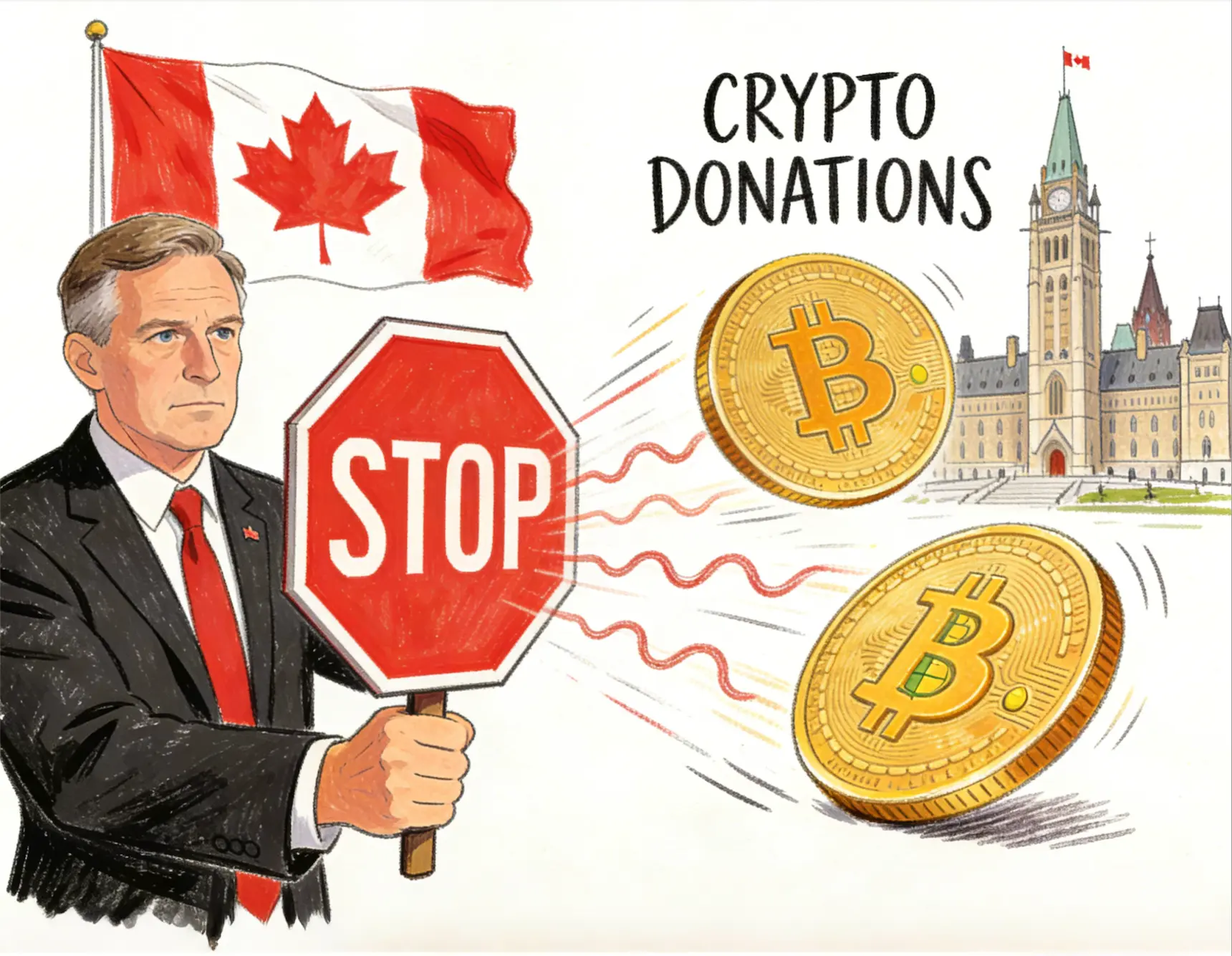
 Canada has introduced legislation to ban cryptocurrency donations to federal political entities, following similar regulatory actions in the United Kingdom and closing a funding channel that has seen minimal use since it was permitted in 2019.
Bill C-25, known as the Strong and Free Elections Act, was introduced on March 26 and is currently at its first reading in the House of Commons, aiming to prohibit contributions made in Bitcoin, other cryptoassets, money orders, and prepaid cards due to traceability concerns and risks to electoral integrity.
Legislative Scope and Enforcement Mechanisms
The proposed legislation extends the ban across the entire federal political ecosystem, explicitly prohibiting registered parties, riding associations, candidates, leadership contestants, and third parties involved in election advertising from accepting contributions in the form of digital assets. The bill mandates a 30-day deadline for political agents to return prohibited contributions to the donor or, if return is not feasible, to liquidate the assets into fiat currency and remit the proceeds to the Receiver General. Penalties for noncompliance are structured to include fines up to twice the value of the offending contribution, with corporations facing an additional automatic penalty of $100,000.
Policy Shift from Regulation to Prohibition
Canada’s move follows a significant evolution in the stance of the Chief Electoral Officer, who initially supported tighter regulations for crypto contributions in a 2022 post-election report but shifted to recommending an outright prohibition in November 2024. This recommendation was based on the pseudo-anonymity of cryptocurrency transactions and the fundamental difficulty of verifying contributor identities. While Canada has permitted crypto donations since 2019 under a framework classifying them as non-monetary property, no major federal party has publicly reported accepting such contributions in recent election cycles, and the 2019 framework excluded privacy coins and denied tax receipts for donors.
International Context and Divergence from US Policy
The Canadian bill mirrors a recent policy shift in the United Kingdom, where authorities have imposed an immediate moratorium on crypto donations to political parties over concerns about foreign money influence. This regulatory trajectory contrasts sharply with the United States, where cryptocurrency donations to campaigns have been permitted since 2014 under Federal Election Commission guidance. In the U.S., the crypto industry has become a significant political force, with entities deploying substantial resources to influence elections through direct contributions and independent expenditures.
FAQ
Why is Canada proposing a ban on cryptocurrency donations for election campaigns?
The ban is driven by concerns from Canada’s Chief Electoral Officer regarding electoral integrity. The primary issues are the pseudo-anonymity of cryptocurrency transactions, which creates transparency challenges, and the inherent difficulty in verifying the identity and origin of contributors, which could potentially allow for untraceable foreign interference.
What are the penalties for accepting banned crypto donations under Bill C-25?
The penalties are administrative and severe. Individuals or entities that knowingly accept prohibited contributions face fines of up to twice the value of the donation. Corporations involved in such violations face an additional automatic penalty of $100,000 on top of the double-value fine. Political agents are also legally required to return, destroy, or liquidate any such contributions within 30 days.
How does Canada’s proposed crypto donation ban compare to the rules in the US and UK?
Canada’s Bill C-25 aligns with a recent ban in the UK, where cryptocurrency donations to political parties have been suspended. This approach represents a direct policy divergence from the United States, where crypto donations to campaigns are legal and have become a major factor in political financing, with industry groups actively using digital assets to fund election-related activities.
Disclaimer: The information on this page may come from third parties and does not represent the views or opinions of Gate. The content displayed on this page is for reference only and does not constitute any financial, investment, or legal advice. Gate does not guarantee the accuracy or completeness of the information and shall not be liable for any losses arising from the use of this information. Virtual asset investments carry high risks and are subject to significant price volatility. You may lose all of your invested principal. Please fully understand the relevant risks and make prudent decisions based on your own financial situation and risk tolerance. For details, please refer to
Disclaimer.


