Tether hires KPMG to initiate its first complete financial statement audit, in line with a $20 billion funding and U.S. compliance strategy, strengthening the trust foundation of $185 billion USDT.
Collaborating with the Big Four accounting firms, transitioning from asset attestations to comprehensive financial audits
According to previous reports from “Crypto City,” Tether, the issuer of the world’s largest stablecoin $USDT, has decided to hire the Big Four accounting firms to conduct an audit of its finances as it formally enters a new milestone of financial transparency.
According to a recent report from the Financial Times, Tether has officially engaged KPMG, one of the Big Four accounting firms, to conduct the first-ever complete independent financial statement audit of its reserves. This collaboration symbolizes a significant shift in Tether’s operational model, with the previous practice of quarterly attestations being replaced by a more rigorous financial audit mechanism. The scope of this audit covers assets, liabilities, internal controls, and financial reporting systems comprehensively, aiming to provide the market with deeply transparent financial information.
- Related news: USDT transparency upgraded! Tether signs with the Big Four accounting firms to initiate its first independent financial audit.
Previously, Tether primarily commissioned BDO Italia to provide periodic reserve reports, which, while able to confirm asset collateral status, did not meet the depth and completeness standards of traditional financial markets. To ensure its internal systems seamlessly align with international auditing standards, Tether has also hired another Big Four firm, PwC, to assist in optimizing internal control processes and technical architecture.
Tether’s CFO Simon McWilliams stated that this decision is the result of an intense competitive selection process, and the organization is now fully aligned with the auditing standards of the Big Four accounting firms.
Currently, the circulation of $USDT has surpassed $185 billion, serving over 500 million users worldwide, and this audit is seen as a pivotal turning point for establishing trust in the stablecoin industry.
Strategizing for the U.S. market and regulatory compliance, driving a $20 billion fundraising plan
This transparency initiative is closely tied to Tether’s strategic blueprint for expanding into the U.S. market. Last year, the U.S. government passed the GENIUS Act, establishing a clear federal regulatory framework for stablecoins. Tether CEO Paolo Ardoino has explicitly stated that the company is actively incorporating its products into this regulatory framework, adhering to strict anti-money laundering regulations and reserve audits.
Tether has already launched a new stablecoin, $USAT, that fully complies with the requirements of this act, specifically for use by U.S. businesses and institutions. Although the current circulation of $USAT is approximately $28 million, which is still in the early stages compared to $USDT, its highly compliant design has laid a foundation for Tether’s establishment within the U.S. financial system.
- Related news: Tether USAT’s first reserve proof is out! $17.6 million over-collateralized, analyzing reserve composition structure.
Last year, Tether announced plans for a large-scale fundraising round, expected to reach $20 billion. CEO Paolo Ardoino revealed on social media platform X that the company is assessing proposals from a group of high-profile key investors, aiming to maximize the company’s development scale in areas such as stablecoins, artificial intelligence (AI), commodity trading, energy development, and decentralized media.
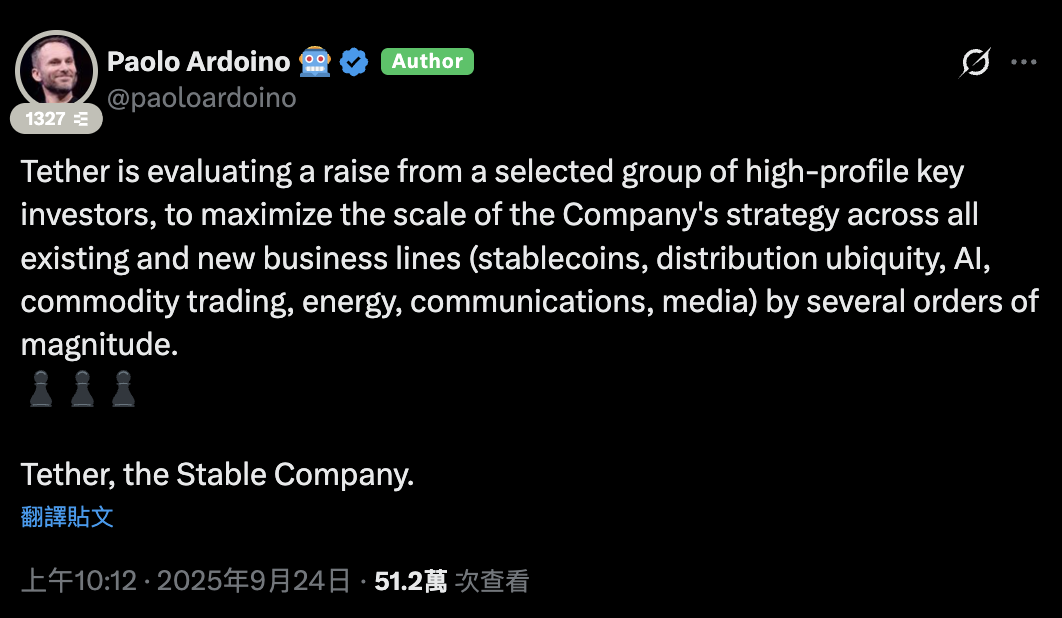
Image source: X/@paoloardoino Tether CEO Paolo Ardoino reveals that the company is assessing proposals from a group of high-profile key investors.
Market analysis indicates that KPMG’s audit report will be a key driver in attracting institutional investors, and the data provided by this report will directly impact Tether’s current valuation target of up to $500 billion.
Expanding into real asset tokenization, deepening global financial market influence
In addition to fiat-backed stablecoins, Tether is also actively deepening its layout in real-world assets (RWA). The company recently officially introduced its gold-backed stablecoin Tether Gold ($XAUT) to the BNB Chain, further expanding the application scenarios for digital gold. Each $XAUT token represents one troy ounce of physical gold stored in a Swiss vault, compliant with the standards of the London Bullion Market Association (LBMA). Through blockchain technology, investors can hold gold digitally, avoiding the cumbersome processes of traditional custody and settlement, linking the liquidity of hedging assets with a decentralized ecosystem.
Tether’s financial strength provides strong support for these expansion plans. According to the latest data, Tether reported a profit of nearly $10 billion last year, and its holdings of U.S. Treasury bonds have exceeded $122 billion, with total Treasury exposure reaching $141 billion. This financial scale positions Tether not only as a reserve center for cryptocurrencies but also as one of the main holders of U.S. Treasury bonds globally. By merging traditional safe assets with blockchain technology, Tether is positioning itself as the infrastructure of the digital asset era, and through auditing, it is strengthening its authoritative status in the global financial market.
Overcoming historical controversies and fines, reshaping industry trust mechanisms
Tether’s move towards comprehensive auditing also includes strategic considerations to resolve historical controversies. In 2021, the company was fined $41 million by the U.S. Commodity Futures Trading Commission (CFTC) for providing misleading statements regarding reserve support. Subsequently, Tether reached a settlement agreement of $18.5 million with the New York Attorney General’s Office (NYAG) and was required to submit detailed reserve reports regularly over two years.
These historical events have long been central to market skepticism regarding its transparency, and hiring the Big Four accounting firms to conduct audits is aimed at completely eliminating market doubts, transforming past compliance challenges into systematic transparency advantages.
As geopolitical risks and global economic fluctuations increase, the “anarchic asset” nature of Bitcoin and stablecoins is becoming increasingly evident in the market. Tether is ensuring the stability of its $185 billion market scale through enhanced transparency. This is not only a company-level compliance upgrade but also holds indicative significance for the overall credibility of the cryptocurrency industry.
As regulatory bodies in various countries gradually tighten regulations on digital assets, Tether has chosen to proactively open its financial data for professional scrutiny, symbolizing that the stablecoin industry is ready to integrate into the mainstream financial system and establish a more long-term development foundation.
Disclaimer: The information on this page may come from third parties and does not represent the views or opinions of Gate. The content displayed on this page is for reference only and does not constitute any financial, investment, or legal advice. Gate does not guarantee the accuracy or completeness of the information and shall not be liable for any losses arising from the use of this information. Virtual asset investments carry high risks and are subject to significant price volatility. You may lose all of your invested principal. Please fully understand the relevant risks and make prudent decisions based on your own financial situation and risk tolerance. For details, please refer to
Disclaimer.


