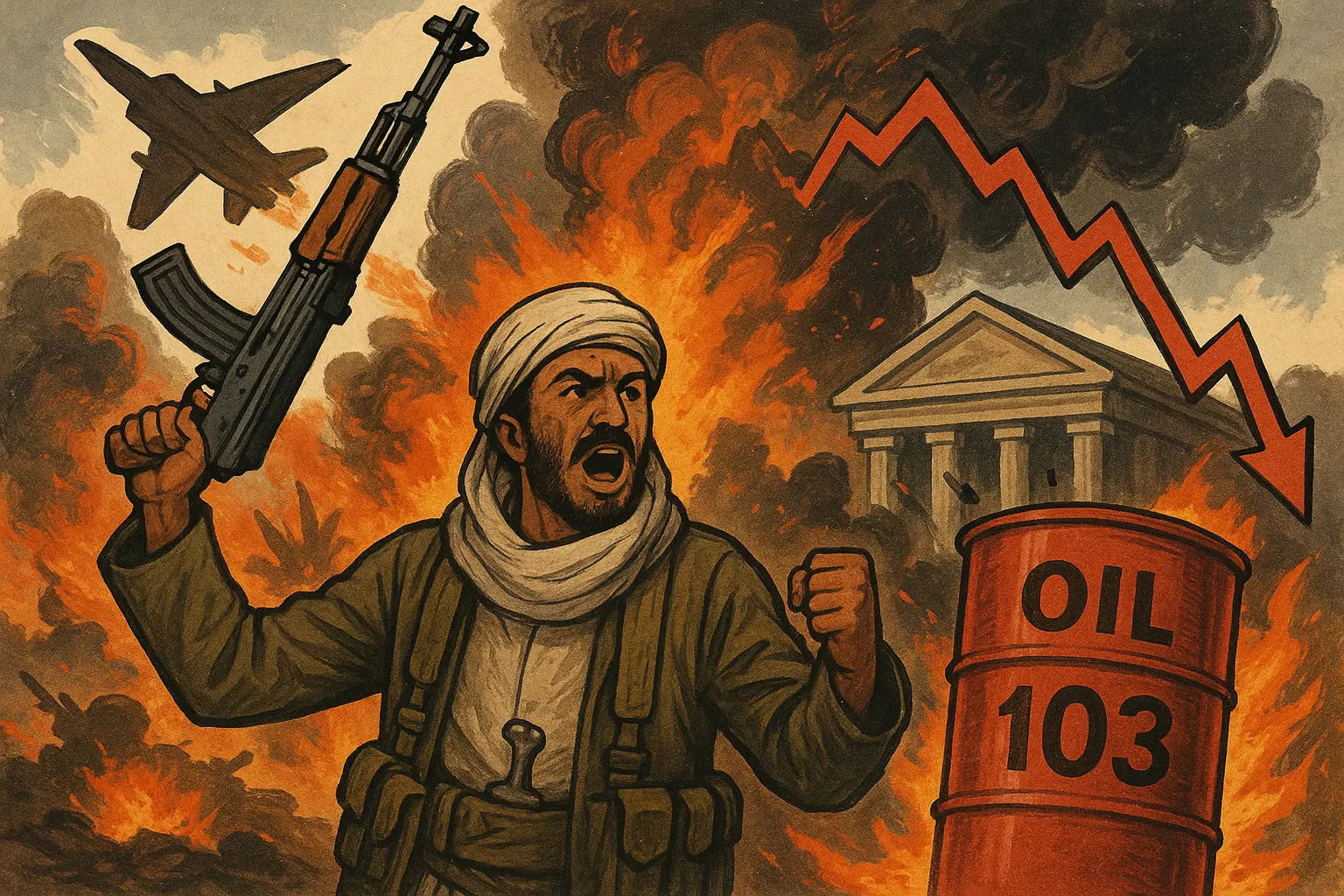
The Houthi armed group announced on Saturday that it has joined the Iran conflict and launched missiles at Israel, marking a critical turning point in the Middle East war that has been ongoing for five weeks. The three major U.S. stock index futures fell collectively on Monday (March 30), with Dow futures dropping over 200 points and Nasdaq 100 index futures down 0.6%; WTI crude oil surged over 3%, trading around $103 per barrel, while Brent crude oil rose approximately 3% as well.
Houthi Armed Group’s Entry: Renewed Threats to Red Sea Shipping and Saudi Energy Routes
The Houthis’ involvement fundamentally expands the strategic complexity of the Middle Eastern conflict. The Strait of Hormuz is currently virtually closed to tanker traffic, and the east-west pipeline (Petroline) from Saudi Arabia to the Red Sea port of Yanbu is now the most critical alternative export route. Analysts at JPMorgan noted in a report that the most significant leverage the Houthis possess is the ability to threaten this Saudi alternative oil route—if Yanbu is attacked, the blockade of the Strait of Hormuz will lose its backup option, leading to a sharp escalation in global crude oil supply pressures.
Stephen Innes, managing partner at SPI Asset Management, pointed out that the Houthis’ entry into the battlefield is “reshaping the dynamics,” with the situation evolving from seemingly “locally manageable” to a “fracture zone throughout the entire energy system,” emphasizing: “Oil prices are the most genuine signal, and the Middle East risk premium is just a step away from igniting the regional powder keg.”
Four Core Risks Brought by the Houthi Armed Group’s Entry
Threat to Red Sea Commercial Shipping Again: The Houthis have the capability to launch missiles at commercial vessels, and the scenario of a Red Sea crisis may replay in 2024.
Saudi Alternative Routes Blocked: If the Yanbu export hub is attacked, the global alternative crude oil export paths will be obstructed, significantly escalating supply pressures.
Oil Prices Face Additional Pressure: JPMorgan estimates that the related risks could cause Brent crude oil to rise an additional $20 per barrel.
Multiple Interventions Increase Uncertainty: The Iranian main forces, Houthi armed group, plans for seizing Khark Island, and potential U.S. ground operations are advancing in sync, greatly shortening the window for assessing the situation.
Market “Nowhere to Escape”: U.S. Stocks Fall for Five Weeks, Stock, Bond, and Gold Markets under Pressure
Last Friday, the Dow Jones index officially entered a technical correction zone (down more than 10% from recent highs), joining the previously corrected Nasdaq index. All three major stock indices have dropped to their lowest levels since July 2025, recording the weekly decline for the fifth consecutive week. According to FactSet data, in March, all sectors of the S&P 500 index, except for the energy sector, were in decline.
Senior portfolio manager George Cipolloni told MarketWatch: “There is almost nowhere to hide this month. You can’t go to stocks, you can’t go to bonds, and even credit spreads are starting to widen.” Gold and cryptocurrency have fallen in tandem, while U.S. Treasury yields continue to rise, rendering traditional multi-asset hedging strategies completely ineffective.
Consumer-side pressures are also intensifying: the national average gasoline price in the U.S. is nearing $4 per gallon, up about $1 from a month ago. Innes further pointed out, “The more dangerous aspect of this situation is not just the oil price itself, but the uncertainty of its duration. Markets can absorb one-off shocks, but it is difficult to endure sustained high levels.”
On the negotiation front, Pakistan announced it will facilitate U.S.-Iran talks in the coming days, but the likelihood of a short-term ceasefire remains slim. Trump stated to reporters last Sunday that the U.S. is negotiating “directly and indirectly” with Iran, while also mentioning the possibility of seizing Khark Island; The Wall Street Journal reported that Trump is considering deploying ground forces to seize Iranian uranium resources.
Frequently Asked Questions
What is the impact of the Houthi armed group’s involvement in the Middle East conflict on oil prices?
The Houthi armed group has the capability to threaten Red Sea shipping and the Saudi Yanbu export hub. Yanbu is the most important alternative oil route after the blockade of the Strait of Hormuz; if attacked, global crude oil supply pressures will significantly escalate. JPMorgan estimates that the Houthis’ escalatory actions could lead to an additional $20 increase in oil prices per barrel.
Why is there a “nowhere to escape” dilemma in the current market?
High oil prices are driving inflation expectations up, lowering the likelihood of the Federal Reserve cutting interest rates, leading to sustained high rates that put pressure on both stocks and bonds. Gold and cryptocurrency have also failed to effectively serve as safe havens, and multi-asset diversification strategies have completely failed in a geopolitical crisis dominated by inflation.
What is the progress of negotiations regarding the U.S.-Iran conflict, and what impact does it have on the market?
Pakistan announced it will facilitate U.S.-Iran talks, but most analysts remain cautious about the likelihood of a short-term ceasefire. Barclays analysts pointed out that Trump’s ongoing policy swings have severely undermined the effectiveness of “Trump support” in the market, and investors are now more focused on the substantive dynamics in the Persian Gulf rather than policy statements.
Disclaimer: The information on this page may come from third parties and does not represent the views or opinions of Gate. The content displayed on this page is for reference only and does not constitute any financial, investment, or legal advice. Gate does not guarantee the accuracy or completeness of the information and shall not be liable for any losses arising from the use of this information. Virtual asset investments carry high risks and are subject to significant price volatility. You may lose all of your invested principal. Please fully understand the relevant risks and make prudent decisions based on your own financial situation and risk tolerance. For details, please refer to
Disclaimer.


