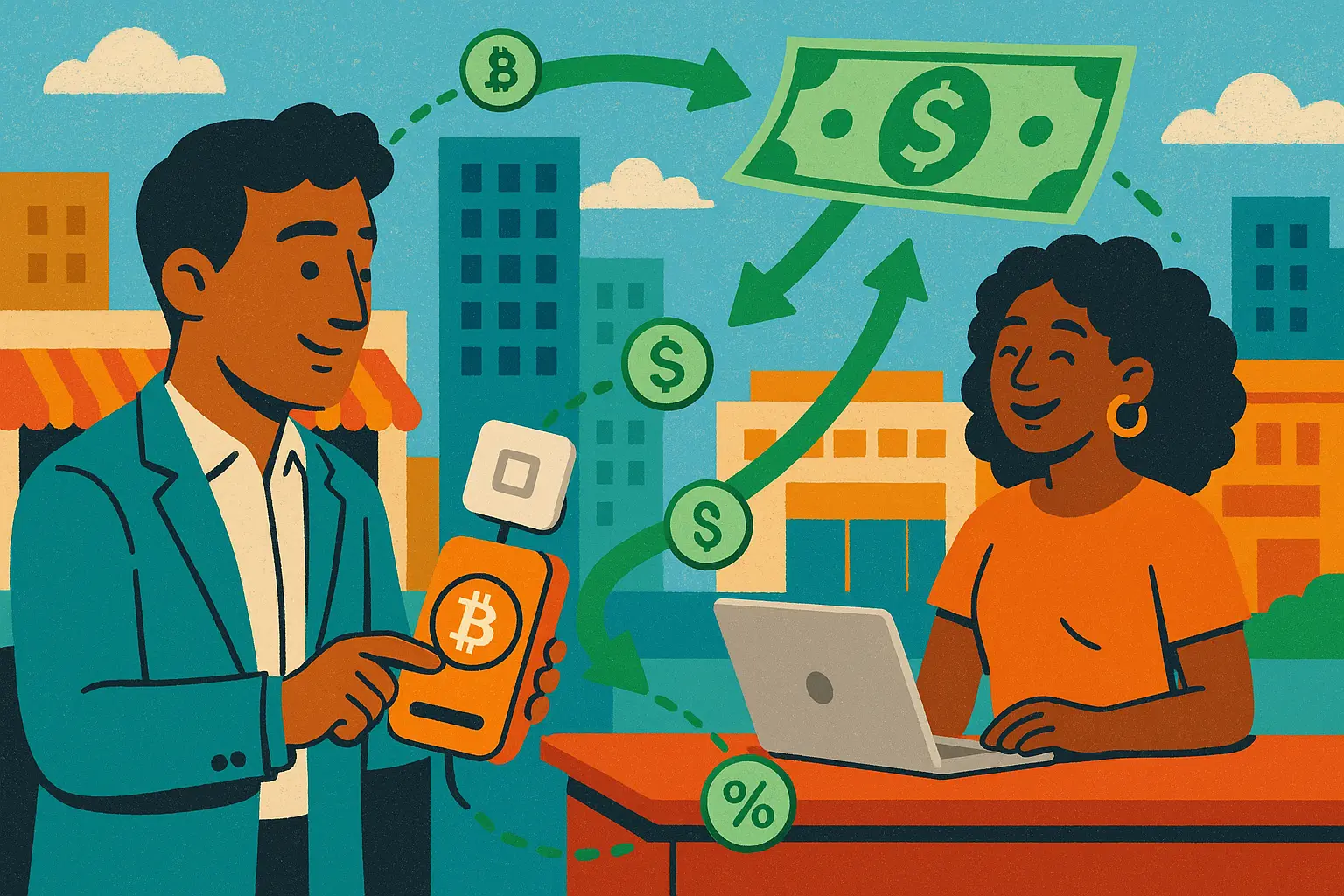
Jack Dorsey’s payments company, Square, announced on March 31 that it has begun automatically enabling Bitcoin payment functionality for millions of eligible U.S. small businesses, without merchants needing to proactively set up or apply for it. Transactions are converted to dollars immediately at checkout and credited, and merchants default to receiving fiat currency. Through the end of 2026, it will be completely free of fees.
How it works: Merchants connect seamlessly in the background handles all the complexity
 (Source: Square)
Square’s design logic is to keep all Bitcoin-related technical complexity out of the merchant’s line of sight. When customers pay with Bitcoin, the transaction is converted to dollars in real time during the checkout process. Merchants receive fiat currency, fully without bearing the risk of price volatility, and without needing to modify their existing accounting systems or apply for a crypto custody account.
Miles Suter, head of Block’s Bitcoin product, said on the X platform: “We’re making it easier for tens of millions of businesses to accept Bitcoin—this is the beginning of Bitcoin becoming everyday currency.” Dorsey himself also confirmed the feature had officially gone live on X with a succinct “Today.”
This is an important extension of the “Square Bitcoin” plan Square announced earlier, but its core breakthrough is this: Bitcoin payments are now automatically enabled by default, rather than being an option that merchants must actively choose—integrated directly into existing payment systems with no additional steps.
Industry interpretation: What does a “TCP/IP moment” mean?
The most representative industry response came from Lightspark CEO David Marcus. He likened the rollout to the significance of the TCP/IP protocol to the early internet—TCP/IP established a set of common standards so that different networks could communicate with each other. Users could use the internet without needing to understand underlying technology.
Marcus believes Bitcoin can play a similar role in financial infrastructure by providing a universal framework for value transfer across platforms and systems. “Rolling out Bitcoin payments at scale could end up recreating the process of TCP/IP becoming the internet’s foundational protocol,” he said.
The deeper meaning of the analogy is this: if merchants can accept Bitcoin without understanding it, and consumers can use the Bitcoin network without holding Bitcoin, then Bitcoin is no longer just an investment asset, but a universal transport layer for the financial foundation.
Background context: Small business targeting and the competitive landscape for crypto payments
Square’s target audience is not native crypto users, but millions of small businesses already using Square to collect payments, manage inventory, and calculate payroll—groups that have traditionally been skeptical of cryptocurrencies. Several key functional details are worth noting:
Automatic deployment scope: Automatically enables for all eligible U.S. merchants, no application required
Fiat-first design: Merchants receive dollars by default, with Bitcoin price volatility risk entirely absorbed by the back end
Zero-fee period: Bitcoin payment transactions are completely fee-free through the end of 2026
User base: 78% of Square’s users are in the U.S., integrated into existing payment, inventory, and payroll systems
This move comes as competition in crypto payments is clearly heating up. PayPal has recently promoted its dollar stablecoin PYUSD to 70 markets worldwide. While Dorsey has consistently been a Bitcoin purist, he has also recently said that Block will support dollar-pegged tokens as customer demand grows—suggesting the boundaries of the crypto payments ecosystem are being reshaped quickly.
Frequently asked questions
What impact does Square’s Bitcoin payments have on merchants’ real-world operations?
Merchants need to make almost no changes. The Bitcoin payments feature is automatically enabled. After customers pay with Bitcoin, the transaction is converted into dollars immediately and credited. Merchants receive familiar fiat settlement, without bearing the risk of crypto price volatility, and without needing to update accounting systems or apply for a crypto custody account. The operating experience is essentially no different from accepting credit cards.
What is a “TCP/IP moment,” and why does the industry describe Square’s Bitcoin payments this way?
TCP/IP is the underlying protocol that lets different networks communicate with each other. Users can use the internet without understanding the technical details of TCP/IP. Lightspark CEO David Marcus believes that by enabling millions of merchants to accept Bitcoin payments without even noticing Bitcoin, Square may be the starting point for Bitcoin becoming a foundational financial protocol—analogous to the historical moment when TCP/IP became an internet standard.
What is the significance of Square’s move for Bitcoin mainstreaming?
Square has a massive merchant base. If millions of small businesses automatically gain the ability to accept Bitcoin within existing payment workflows, it would greatly expand the real-world payment scenarios for Bitcoin and help it transform from an “investment asset” into a “means of payment.” This would enable unprecedented scale of adoption without relying on native crypto users.
Disclaimer: The information on this page may come from third parties and does not represent the views or opinions of Gate. The content displayed on this page is for reference only and does not constitute any financial, investment, or legal advice. Gate does not guarantee the accuracy or completeness of the information and shall not be liable for any losses arising from the use of this information. Virtual asset investments carry high risks and are subject to significant price volatility. You may lose all of your invested principal. Please fully understand the relevant risks and make prudent decisions based on your own financial situation and risk tolerance. For details, please refer to
Disclaimer.


