The cryptocurrency market is once again blowing in a wave of chilly winds. CEX.IO data shows that, of the Bitcoin currently circulating in the market, nearly half has fallen below its cost basis and is in a loss position. Even the most steadfast long-term investors of the past have now begun to cut their losses and exit.
According to a CEX.IO report, the “Bitcoin Impact Index” surged by 13 points last week to 57.4, marking the largest week-over-week rise since January of this year.
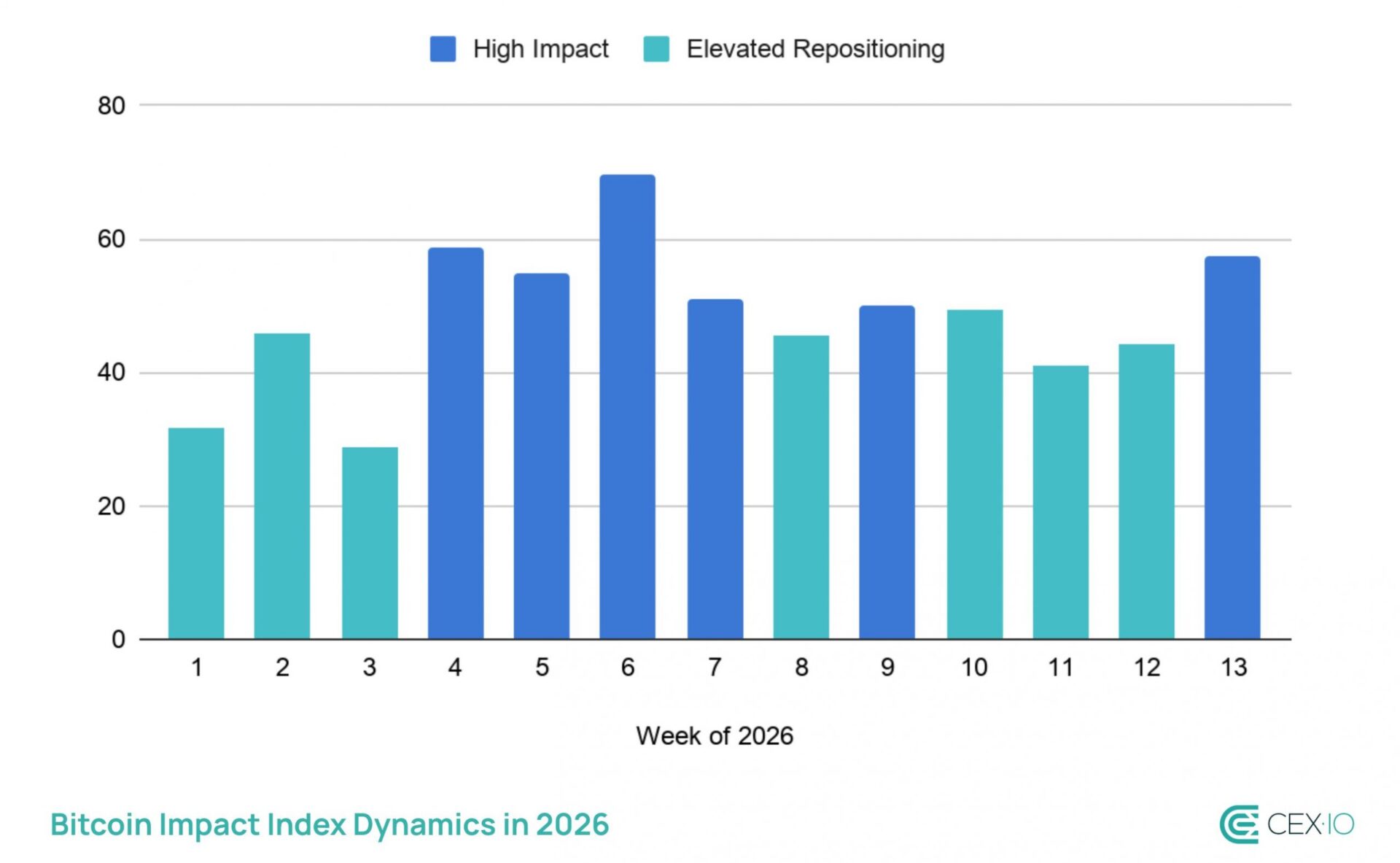 This index mainly measures the market pressure different investor cohorts face by analyzing on-chain behavior, the trading heat of ETFs and derivatives, and changes in market liquidity.
The index is out of 100, and the current 57.4 has already fallen into the so-called dangerous “High Impact” zone. Based on historical experience, when the index enters this range, it often signals that a “large-scale sell-off” is about to arrive. For example, in 2018, 2022, and earlier this year, before the market saw double-digit crashes, similar warnings had appeared.
More notably, market pressure is gradually spreading to long-term holders (holding coins for more than 6 months). Just a week ago, when Bitcoin was still above $70,000, these investors were still realizing profits, but the situation has now clearly reversed.
The report states that among these wallets, about 4.6 million Bitcoins have entered a loss state (equivalent to roughly 30% of the total Bitcoins held by long-term holders), and the losses they realized last week (meaning the financial losses caused after the actual selling) have also set the most severe record since 2023.
CEX.IO points out that this kind of divergence between “price action” and “on-chain confidence” has historically been viewed as a warning sign. For instance, similar situations appeared in mid-2018 and mid-2022, after which Bitcoin subsequently saw a pullback of more than 25%.
The situation for short-term holders is even more dire. The report shows that currently, 47% of the Bitcoins in circulation are in a loss state—this is the first time since the period of tightest market pressure in February of this year. In other words, nearly half of Bitcoin holders are now in a “stuck with losses” position.
At the same time, the funding momentum that previously supported the market has also started to fade. What used to be a steady net inflow of stablecoins as high as $250 million per day has now reversed into a net outflow of $292 million. Even ETF issuers and miners have shifted from “hoarding coins” to “selling them off.”
This index mainly measures the market pressure different investor cohorts face by analyzing on-chain behavior, the trading heat of ETFs and derivatives, and changes in market liquidity.
The index is out of 100, and the current 57.4 has already fallen into the so-called dangerous “High Impact” zone. Based on historical experience, when the index enters this range, it often signals that a “large-scale sell-off” is about to arrive. For example, in 2018, 2022, and earlier this year, before the market saw double-digit crashes, similar warnings had appeared.
More notably, market pressure is gradually spreading to long-term holders (holding coins for more than 6 months). Just a week ago, when Bitcoin was still above $70,000, these investors were still realizing profits, but the situation has now clearly reversed.
The report states that among these wallets, about 4.6 million Bitcoins have entered a loss state (equivalent to roughly 30% of the total Bitcoins held by long-term holders), and the losses they realized last week (meaning the financial losses caused after the actual selling) have also set the most severe record since 2023.
CEX.IO points out that this kind of divergence between “price action” and “on-chain confidence” has historically been viewed as a warning sign. For instance, similar situations appeared in mid-2018 and mid-2022, after which Bitcoin subsequently saw a pullback of more than 25%.
The situation for short-term holders is even more dire. The report shows that currently, 47% of the Bitcoins in circulation are in a loss state—this is the first time since the period of tightest market pressure in February of this year. In other words, nearly half of Bitcoin holders are now in a “stuck with losses” position.
At the same time, the funding momentum that previously supported the market has also started to fade. What used to be a steady net inflow of stablecoins as high as $250 million per day has now reversed into a net outflow of $292 million. Even ETF issuers and miners have shifted from “hoarding coins” to “selling them off.”
Disclaimer: The information on this page may come from third parties and does not represent the views or opinions of Gate. The content displayed on this page is for reference only and does not constitute any financial, investment, or legal advice. Gate does not guarantee the accuracy or completeness of the information and shall not be liable for any losses arising from the use of this information. Virtual asset investments carry high risks and are subject to significant price volatility. You may lose all of your invested principal. Please fully understand the relevant risks and make prudent decisions based on your own financial situation and risk tolerance. For details, please refer to
Disclaimer.


