The last week of March (3/23–3/24) saw unfavorable developments for cryptocurrency investment products. According to CoinShares’ weekly report, digital asset funds ended a consecutive streak of five straight weeks of inflows after recording net outflows of up to $414 million.
Notably, this reversal reflects not only market sentiment or mere price fluctuations.
Rising geopolitical tensions between the U.S. and Iran, combined with prolonged inflation pressure and expectations surrounding upcoming Fed meetings, have become the main catalysts driving the wave of withdrawals.
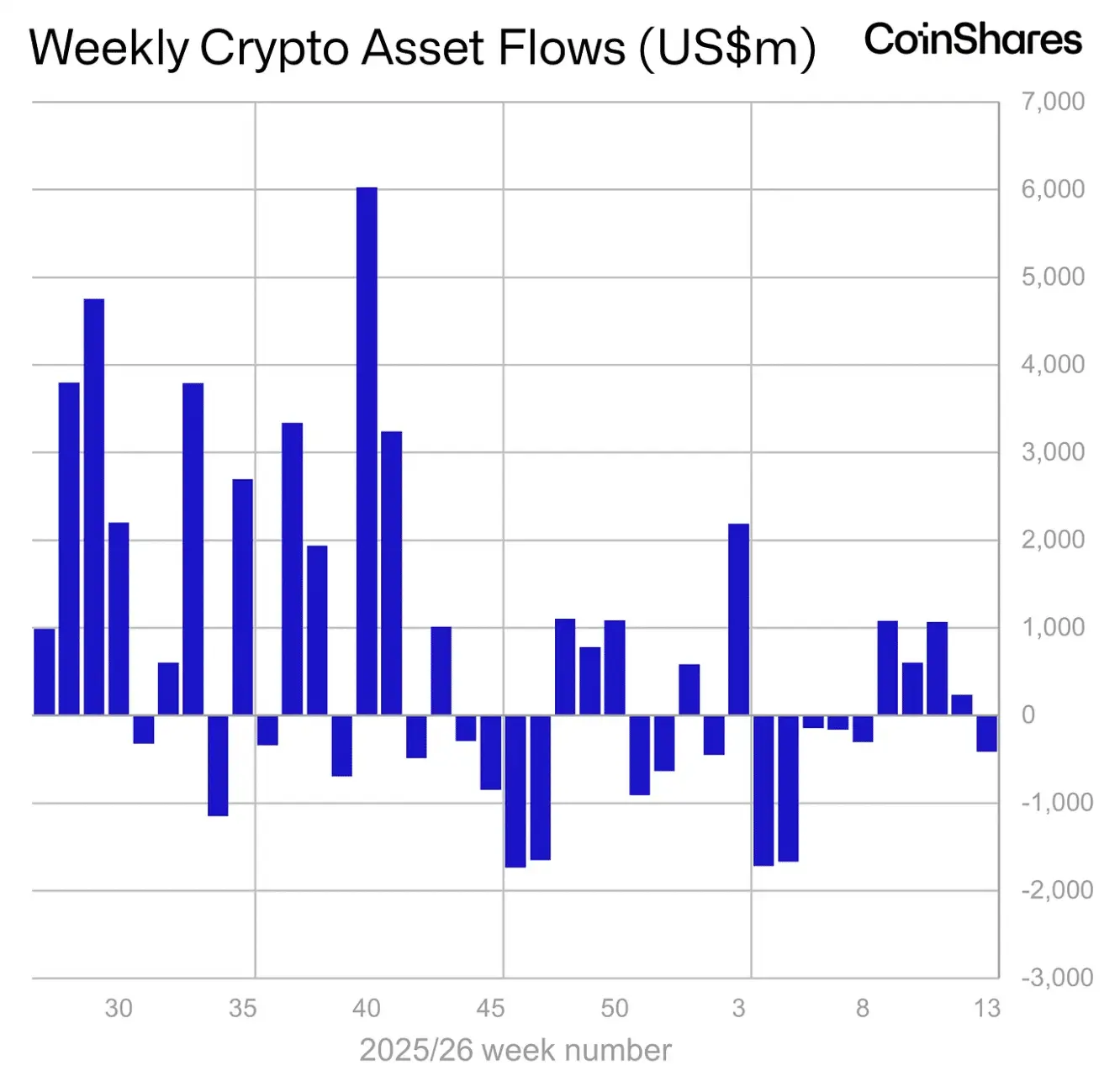 Source: CoinSharesUnder the combined impact of macro factors, total assets under management (AuM) fell to $129 billion—levels seen again in early February and April 2025, when the market faced strong pressure from changes in tariff policies.
Winners and losers from last week
Amid broad-based fund outflows, Ethereum faced the greatest pressure, with $222 million withdrawn, bringing total outflows since the start of the year to $273 million. This development was likely influenced by uncertainty surrounding the CLARITY Act, while the price of ETH also fell 2.48% over the week.
In contrast, Bitcoin remained relatively stable despite recording $194 million in outflows for the week. On a year-to-date basis, BTC still maintained positive net inflows of $964 million, despite a 3.48% price adjustment. This suggests that long-term confidence in the market-leading asset has not been broken.
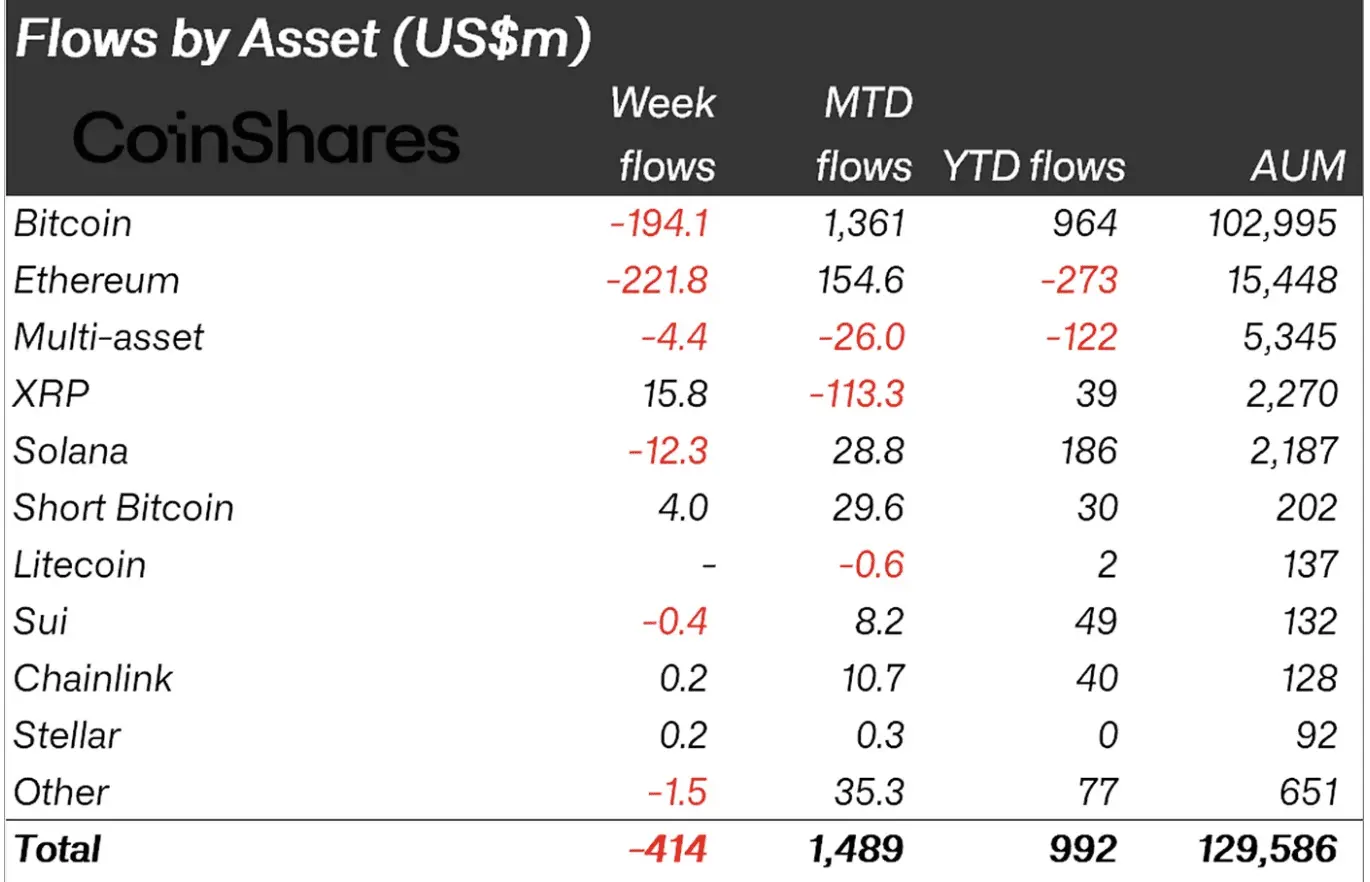 Source: CoinSharesSolana continued to face pressure as $12.3 million was withdrawn, alongside a 5.97% price drop, reflecting the overall weakness across the altcoin group.
A rare bright spot came from XRP—the only asset that recorded an inflow of $15.8 million. However, XRP’s 4.68% price decline shows that this demand is still not strong enough to reverse the market trend.
Overall, XRP became the asset with the most positive money-flow performance during the week, while ETH was the asset facing the greatest pressure.
On-chain data reinforces a cautious mindset
On-chain indicators continue to reflect weakness in market participation levels. Data from Santiment shows that the number of active addresses for both Bitcoin and Ethereum declined by the end of March, implying that new capital inflows and interaction levels are narrowing compared with the beginning of the month.
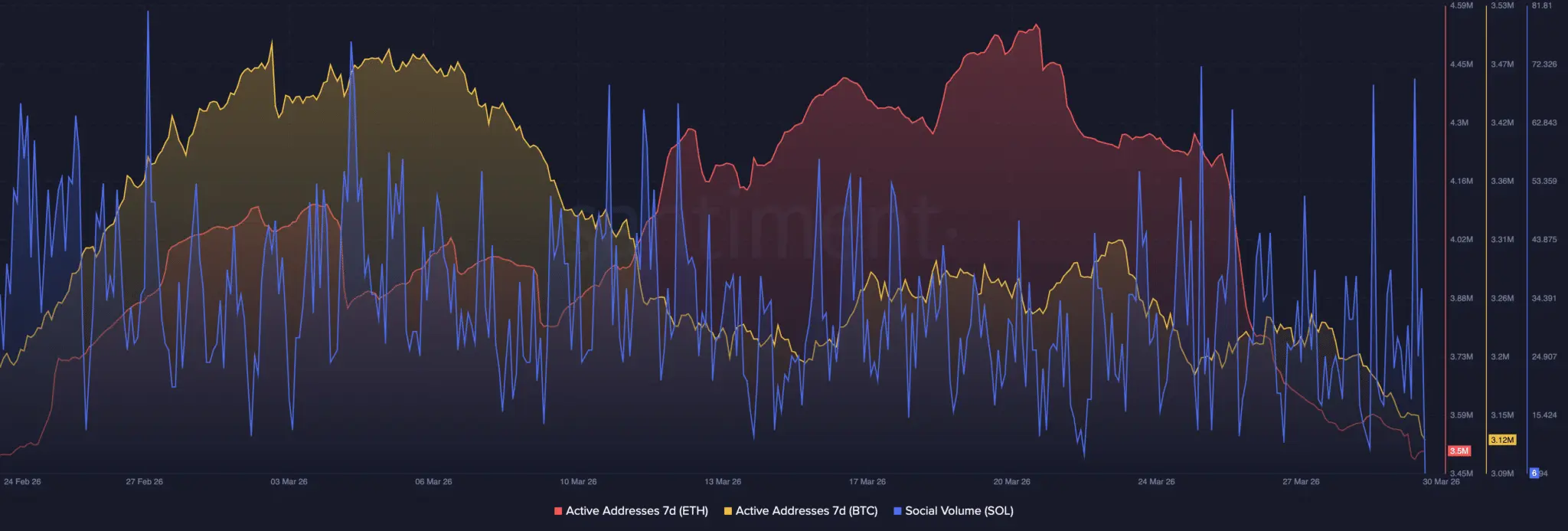 Source: SantimentAt the same time, Solana’s Social Volume index also fell, indicating a clear drop in community interest.
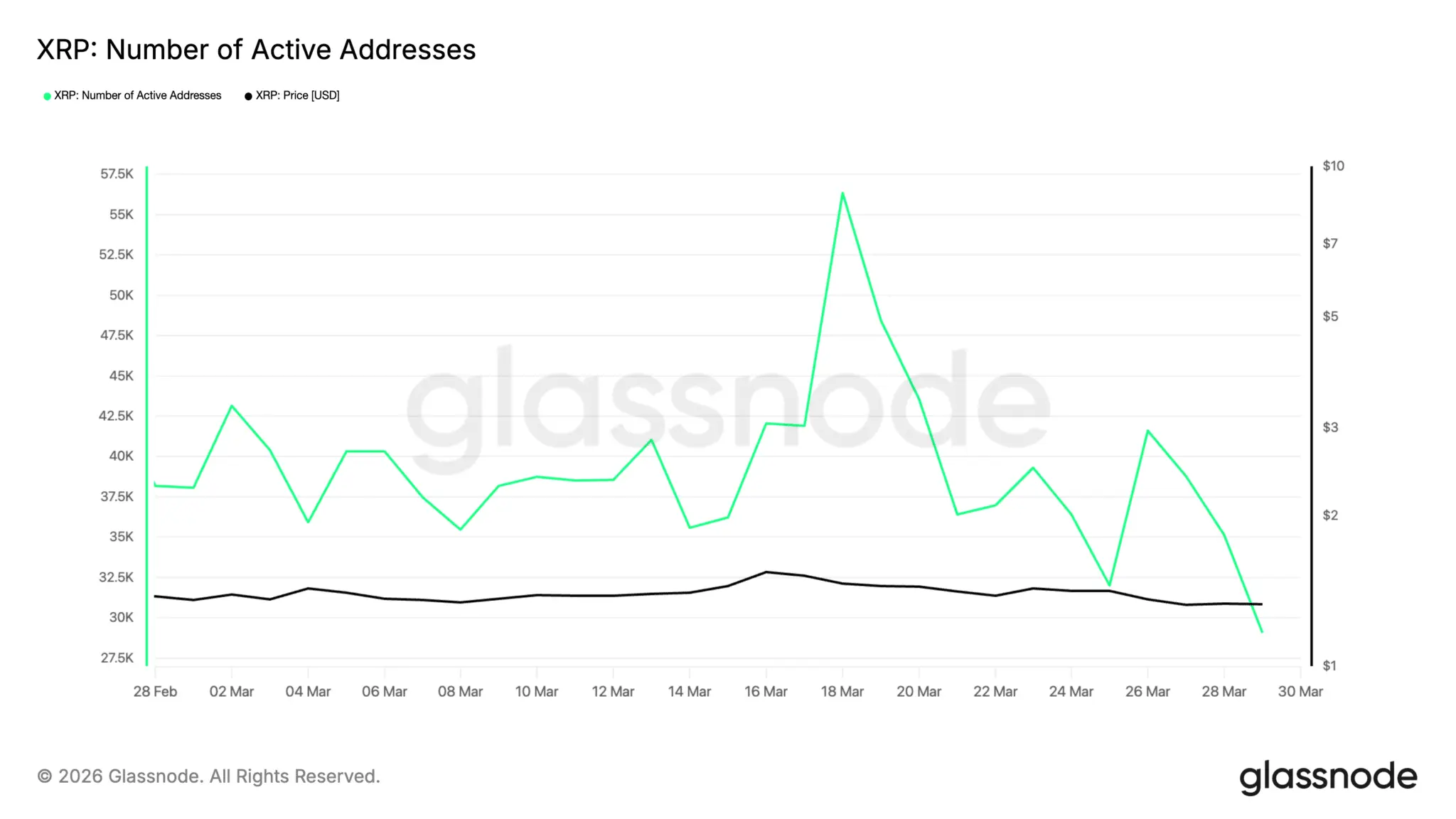
Even for XRP—which leads in money flows—network activity still sends warning signals as the number of active addresses dropped sharply by the end of the month.
 Source: Glassnode## Regional flows and warnings about “bull traps”
By region, the U.S. was the market with the largest outflows at $454 million, while Switzerland also saw $4 million withdrawn. In contrast, Canada and Germany recorded inflows of $15.9 million and $21.2 million, respectively, highlighting clear divergence across regions.
Stepping into the new week from 3/30, the market began to show signs of recovery as total cryptocurrency market capitalization returned to an upward state, reaching $2.34 trillion.
However, experts warn investors not to be overly optimistic about short-term rallies. In fact, right before the Fed meeting, the market had recorded inflows as high as $635 million, creating a positive outlook. But immediately after the meeting ended, $405 million was quickly withdrawn, causing an abrupt reversal.
With global macro risks still present, short-term fluctuations are likely just noise and are not enough to confirm the market’s long-term trend.
Disclaimer: The information on this page may come from third parties and does not represent the views or opinions of Gate. The content displayed on this page is for reference only and does not constitute any financial, investment, or legal advice. Gate does not guarantee the accuracy or completeness of the information and shall not be liable for any losses arising from the use of this information. Virtual asset investments carry high risks and are subject to significant price volatility. You may lose all of your invested principal. Please fully understand the relevant risks and make prudent decisions based on your own financial situation and risk tolerance. For details, please refer to
Disclaimer.


