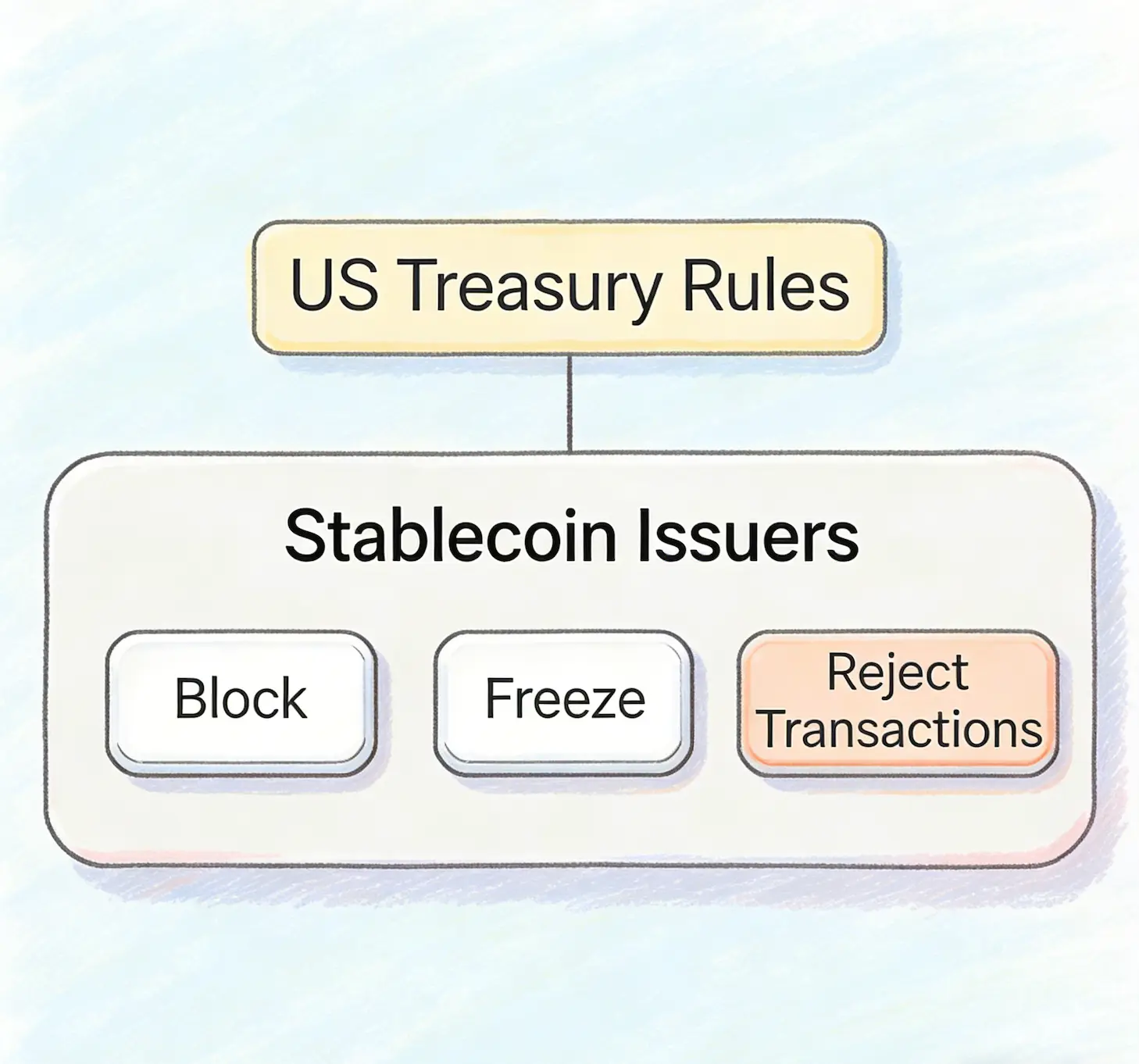
 The U.S. Department of the Treasury, through its Financial Crimes Enforcement Network (FinCEN) and Office of Foreign Assets Control (OFAC), proposed a joint rulemaking on April 8, 2026 that would require stablecoin issuers to establish anti‑money laundering (AML) and sanctions compliance programs, including technical capabilities to “block, freeze and reject” transactions.
The proposal implements key provisions of the GENIUS Act and formally classifies stablecoin issuers as financial institutions under the Bank Secrecy Act, while Treasury Secretary Scott Bessent said the rules aim to protect the financial system without hindering American innovation in the payment stablecoin ecosystem.
FinCEN and OFAC Set Out Tailored Compliance Obligations
The proposed rule defines specific obligations for stablecoin issuers regulated under the GENIUS Act. Issuers must establish and maintain an AML program, report suspicious activity, and maintain an effective sanctions compliance program. They must also offer tokens that allow transactions to be blocked, frozen, or rejected if they violate U.S. law, and must comply with lawful orders.
The Treasury’s summary states that the proposal is focused on effectiveness, recognizing that financial institutions are best positioned to identify and evaluate their money laundering, terrorist financing, and illicit finance risks. A firm that maintains appropriate AML safeguards would generally be safe from enforcement actions unless it shows a significant or systemic failure to maintain that program.
On the AML front, FinCEN would expect stablecoin issuers to halt specifically flagged transactions and devote more attention and resources toward higher‑risk customers and activities. When U.S. authorities pursue a specific target, issuers would have to scour their records for any activity tied to individuals or entities flagged by FinCEN. Issuers would also be expected to act as allies in the agency’s pursuit of entities identified as “primary money laundering concerns.”
Sanctions Compliance and Compliance Officer Requirements
On the sanctions front, OFAC would require stablecoin issuers to run risk‑based safeguards for stablecoin activity on both primary and secondary markets. The policies must spot and reject transactions that may violate or would violate U.S. sanctions.
The proposal also sets requirements for the compliance officer. Each stablecoin issuer must select an individual responsible for establishing adequate AML and counter‑terrorism financing systems. Individuals who are not located in the U.S. are precluded, as are those convicted of offenses such as insider trading, cybercrime, or financial fraud.
FinCEN stated that it generally would not take an enforcement action against a stablecoin issuer if adequate procedures are already in place, subject to the 60‑day public comment period before finalization.
Part of Broader GENIUS Act Implementation
The Treasury’s joint proposal is one of the most significant moves yet to implement the GENIUS Act, the first major crypto‑sector law for the United States, which is meant to go into full effect by 2027. Other regulators have also issued proposals. The Office of the Comptroller of the Currency (OCC) proposed its standards in February 2026. The Federal Deposit Insurance Corporation (FDIC) revealed a largely parallel proposal on April 7, 2026.
Treasury Secretary Scott Bessent said in a statement that the proposal will protect the U.S. financial system from national security threats without hindering American companies’ ability to forge ahead in the payment stablecoin ecosystem.
Industry Context and Outstanding Issues
The crypto industry and its stablecoin leaders, including Tether, Circle, Ripple, and World Liberty Financial, have been awaiting regulation that helps further establish their assets as safe and reliable. However, the decentralized finance (DeFi) sector remains unresolved, with illicit‑finance controls for that arena still under negotiation in the Digital Asset Market Clarity Act in the U.S. Senate.
The proposal would also require stablecoin issuers to police their business relationships. Recent scrutiny has focused on World Liberty Financial after reports that its AB DAO partner was involved in a project with potential ties to Cambodia’s Prince Group, which has been the target of major U.S. investigations and sanctions. Such relationships would be subject to stringent new industry‑managed controls under the Treasury’s proposal.
FAQ
What new obligations would stablecoin issuers have under the Treasury’s proposed rule?
Stablecoin issuers would be required to establish anti‑money laundering and sanctions compliance programs, report suspicious activity, and have the technical ability to block, freeze, or reject transactions that violate U.S. law. They must also designate a compliance officer (with no criminal background in certain offenses) and comply with lawful orders.
Do the rules apply to all stablecoin issuers?
The proposal applies to stablecoin issuers regulated under the GENIUS Act, which includes issuers that are subsidiaries of insured depository institutions or authorized by federal or state regulators. The rules formally classify these issuers as financial institutions under the Bank Secrecy Act.
What is the next step for the proposal?
The Treasury’s FinCEN and OFAC will open a 60‑day public comment period before finalizing the rule. The GENIUS Act is expected to be in full effect by 2027, and other regulators (OCC, FDIC) have issued or are issuing parallel proposals.
Disclaimer: The information on this page may come from third parties and does not represent the views or opinions of Gate. The content displayed on this page is for reference only and does not constitute any financial, investment, or legal advice. Gate does not guarantee the accuracy or completeness of the information and shall not be liable for any losses arising from the use of this information. Virtual asset investments carry high risks and are subject to significant price volatility. You may lose all of your invested principal. Please fully understand the relevant risks and make prudent decisions based on your own financial situation and risk tolerance. For details, please refer to
Disclaimer.


