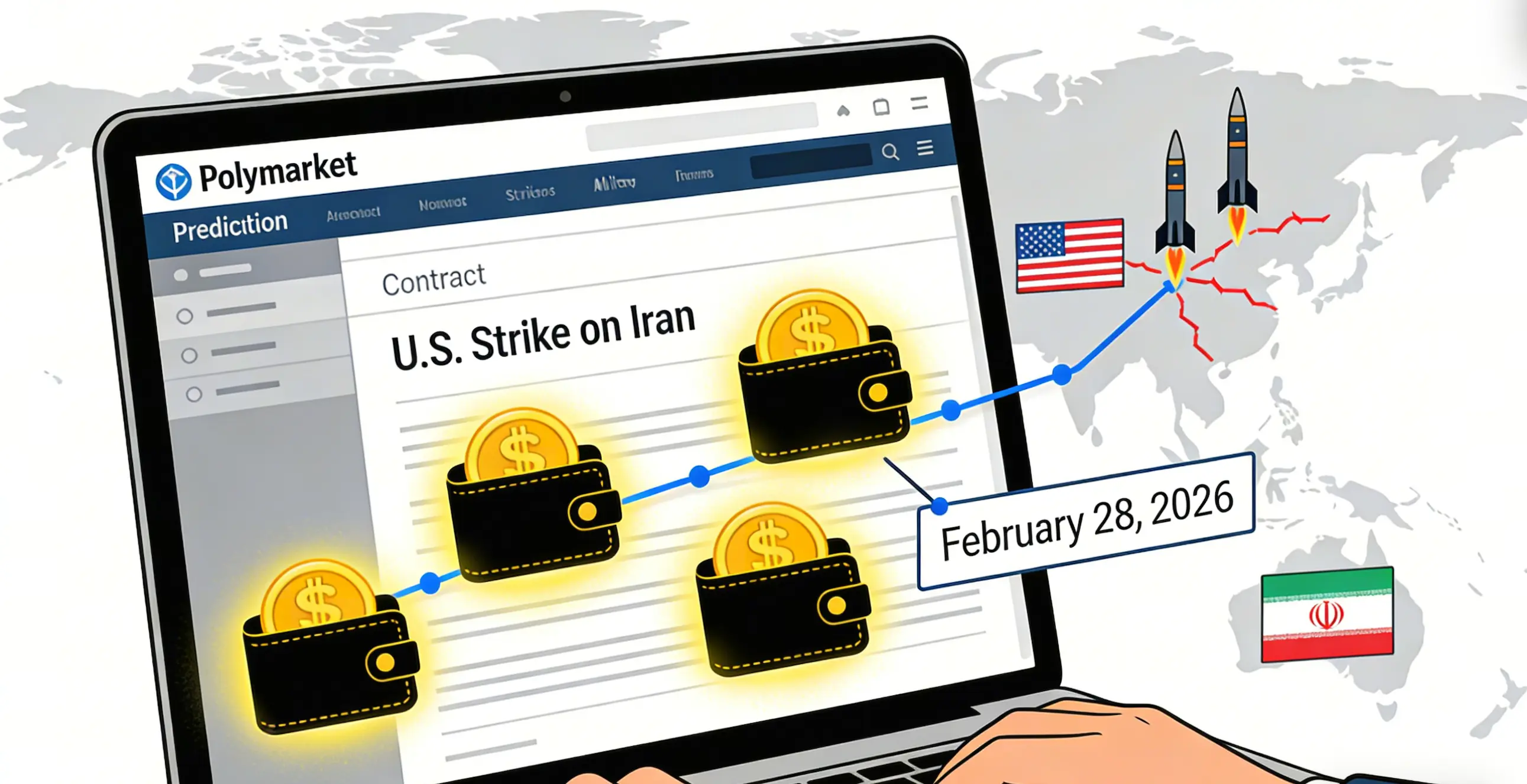
 Six newly created wallets on the prediction market platform Polymarket generated approximately $1.2 million in profits by correctly betting that the U.S. would strike Iran on February 28, 2026, with most positions opened within 24 hours of the attack.
Blockchain analytics firm Bubblemaps traced the accounts to a connected cluster that had previously predicted multiple U.S. and Israeli military actions with near-perfect accuracy, intensifying concerns about insider trading on geopolitical event contracts. The revelations follow the recent indictment of two Israeli citizens for allegedly using classified military information to place similar bets.
Suspicious Trading Patterns Identified
The February 28 Strike Bets
Six wallets flagged by blockchain analytics platform Bubblemaps were funded within 24 hours of placing their wagers, specifically targeting the “U.S. strikes Iran by February 28, 2026?” contract on Polymarket. The accounts purchased “Yes” shares just hours before explosions were reported in Tehran and other Iranian cities, following a televised address by U.S. President Donald Trump announcing “major combat operations” targeting the country’s missile, naval, and nuclear infrastructure.
One account purchased more than 560,000 “Yes” shares at approximately 10.8 cents each, a position that paid out nearly $560,000 after the market resolved at $1. Another account bought nearly 150,000 shares at 20 cents, turning a six-figure profit. All six profiles were created in February 2026 and had no activity beyond these predictions. In total, the six wallets earned roughly $1.2 million from the February 28 strike market.
Broader Network Discovery
Bubblemaps traced funds from one flagged wallet, identified as “nothingeverhappens911,” after it moved profits out of Polymarket. The trail led to another account, “Skoobidoobnj,” through a shared Binance deposit address. Skoobidoobnj had previously made $100,000 buying “Yes” contracts just before two separate surprise attacks on Iran in 2025: Israel’s Operation Rising Lion on June 13 and the subsequent U.S. entry into the conflict eight days later, when B-2 bombers struck Iranian nuclear facilities.
Further investigation identified two additional Polymarket accounts connected to Skoobidoobnj. One made $65,000 on the February 28 U.S. strike, while another made $10,000 on Israel’s June 13 attack. In total, four linked accounts made $240,000 predicting U.S. and Israeli strikes on Iran with what Bubblemaps described as near-perfect accuracy.
Additional Suspicious Activity
Beyond the six-wallet cluster, broader analysis revealed more extensive suspicious trading. According to market data, 12 suspicious accounts placed concentrated bets totaling approximately $67,000 in the days before the strike, ultimately profiting $330,000. Roughly half of these wagers occurred within six hours of the attack, with most accounts newly created and focused exclusively on Iran-related markets.
Analysis of trading patterns showed that over 150 accounts made hundreds of bets of at least $1,000 each on a February 28 strike during the single day before the attack, totaling approximately $855,000 in wagers. At least 16 accounts profited by more than $100,000 from the strike market, while 109 accounts earned over $10,000.
Trading volume on the February 28 contract reached nearly $90 million, part of more than $529 million wagered across related strike-date markets since December 2025.
Previous Incidents and Pattern Recognition
Israel Indictment
The latest findings arrive just weeks after Israeli authorities indicted two citizens—an army reservist and a civilian—for allegedly using classified military data to place bets on Polymarket. The indictment specifically included wagers on the timing of Israel’s opening strike on Iran during June 2025’s 12-day war, based on classified information accessed through their duties.
Venezuela Case
In January 2026, a cluster of newly created Polymarket wallets netted over $630,000 by betting on the capture of Venezuelan leader Nicolás Maduro. Six accounts established between December 30 and January 2 wagered exclusively on Venezuela-related contracts, converting approximately $9,807 into $133,900 in profits. Another account placed $32,000 in bets, earning $404,200. The wagers were placed hours before news of his capture broke publicly.
Axiom Investigation Case
More recently, traders profited approximately $120,000 by betting on the outcome of blockchain detective ZachXBT’s investigation into Axiom, which ultimately revealed employee involvement in insider trading activities. Twelve wallets heavily bet on Axiom being the named company before the investigation results were published.
Technology Company Predictions
Prediction markets have also seen suspicious activity around corporate announcements. In December 2025, a user earned $1.15 million by correctly predicting 22 of 23 outcomes in Google’s annual search trends before the company’s official announcement. Four users profited over $13,000 by betting that OpenAI would release a new model before December 13, 2025, which the company did on December 11.
Regulatory and Legislative Response
CFTC Position
The Commodity Futures Trading Commission has issued an advisory noting that insider trading on event contracts may violate U.S. law, with the agency calling exchanges the “first line of defense.” The CFTC recently filed an amicus curiae brief in support of prediction markets, asserting that event contracts are subject to federally regulated derivatives laws rather than state gambling statutes. However, the agency also maintains that it has “full enforcement authority” over illegal trading practices, including misuse of material non-public information, fraud, and market manipulation.
Congressional Action
Democratic Senator Chris Murphy of Connecticut announced on February 28 that he would introduce legislation to ban betting on military actions following the suspicious Iran strike trades. Murphy stated on X that people were “profiting off war and death” and that he would be drafting a bill “ASAP” to prevent markets from allowing wagers tied to armed conflict.
Murphy expressed deeper concern about potential conflicts of interest, warning that people making decisions about war could be placing bets in these markets and creating a financial interest in the outcome, which he characterized as even worse than insider trading.
Representative Mike Levin pointed to a Polymarket account that made more than $515,000 in a single day betting on the strike, with its first trade placed 71 minutes before news became public. Levin noted that President Trump serves on Polymarket’s advisory board and that his firm invested “double-digit millions” into the platform last year.
In January, Democratic Representative Ritchie Torres introduced legislation to prohibit government officials from using non-public information for prediction market profits following the Maduro betting incident.
State-Level Actions
Two U.S. federal court rulings have rejected arguments that the Commodity Exchange Act and CFTC oversight completely preempt state gaming laws, allowing Nevada to pursue civil enforcement actions against Polymarket parent company Blockratize and Kalshi in state court. The decisions expose prediction markets to potential injunctions barring Nevada residents from accessing event contracts.
Market Context and Industry Impact
Trading Volumes and Losses
The Iran strike contracts attracted enormous trading interest. Total trading volume on the February 28 strike date market reached approximately $90 million. While some traders profited handsomely, others suffered significant losses. One trader operating under a pseudonym lost over $6.4 million by systematically betting against the likelihood of U.S. military intervention.
Platform Response
Kalshi, a CFTC-registered designated contract market, recently suspended and fined two users for insider trading, including a visual effects editor for MrBeast’s “Beast Games” who allegedly traded on knowledge of show outcomes. Kalshi reported investigating approximately 200 cases with more than a dozen active probes.
Industry Self-Regulation
Robinhood and Coinbase have updated policies explicitly prohibiting employees from participating in prediction market trading. OpenAI and Anthropic have confirmed that employees are barred from using confidential information to profit on any platform, including prediction websites. Kalshi, Coinbase, and other companies recently formed a new industry organization to develop national standards for preventing insider trading in prediction markets.
Ethical Concerns
Critics argue that allowing wagering on military operations commodifies violence and creates perverse incentives. Dartmouth economics professor Eric Zitzewitz noted that the surge in last-minute bets before the Iran strike raises real questions about whether someone knew the exact timing of the attack. Former SEC official Amanda Fischer warned that if people can profit from predicting someone’s death, it creates dangerous incentive structures.
FAQ: Polymarket Iran Strike Betting Investigation
Q: How much money did the suspicious accounts make on the Iran strike bets?
A: Six wallets identified by Bubblemaps generated approximately $1.2 million from the February 28 U.S. strike on Iran. Broader market analysis found 12 accounts profited $330,000, while at least 16 accounts earned over $100,000 each and 109 accounts exceeded $10,000 in profits.
Q: What evidence suggests these were insider trades rather than lucky guesses?
A: Blockchain analysis revealed multiple suspicious patterns: accounts were newly created and funded within 24 hours of the strike; bets were placed just hours before the attack, with some purchased at approximately 10 cents before resolving at $1; the accounts traded exclusively on Iran strike contracts with no other activity; and funds were traced to a network that had correctly predicted multiple previous strikes with near-perfect accuracy.
Q: What regulatory actions are being taken in response?
A: Senator Chris Murphy announced plans to introduce legislation banning betting on military actions. The CFTC has issued advisories on insider trading enforcement authority. State-level actions in Nevada threaten to block prediction market access. Individual platforms like Kalshi have suspended and fined users for insider trading.
Q: Have similar incidents occurred on prediction markets before?
A: Yes. In January 2026, traders profited over $630,000 betting on the capture of Venezuelan President Nicolás Maduro hours before his arrest. Israeli authorities recently indicted two citizens for using classified military information to bet on Iran strike timing. Corporate prediction cases include $1.15 million in profits on Google search trends and $13,000 on OpenAI product release timing.


