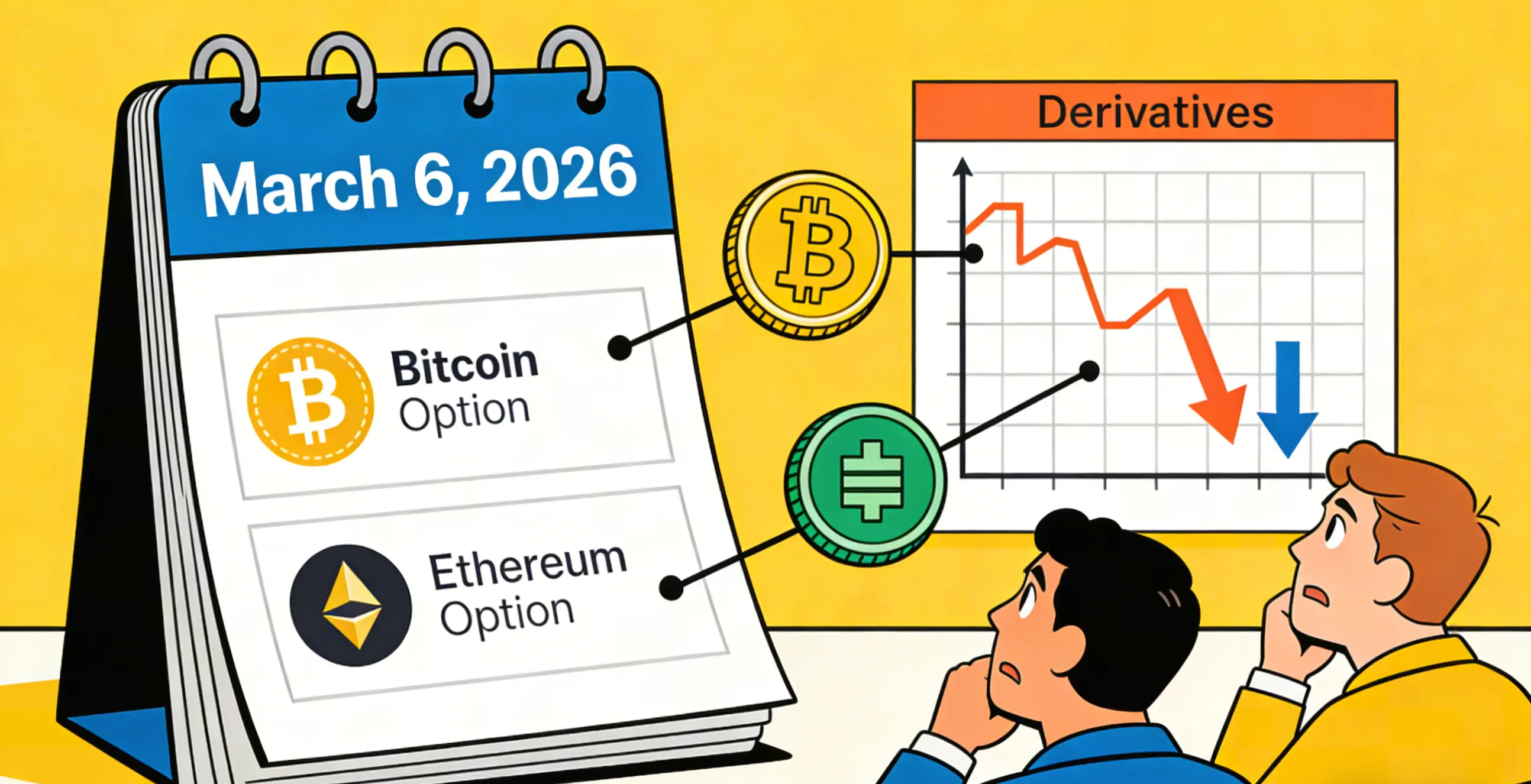
 Approximately $2.6 billion in Bitcoin and Ethereum options contracts are set to expire on March 6, 2026, with derivatives data revealing a pronounced bearish tilt despite recent price recovery across crypto markets.
Bitcoin options account for $2.23 billion of the expiry with a put-to-call ratio of 1.70, indicating strong demand for downside protection, while Ethereum’s $398 million expiry shows a more neutral 0.90 ratio, as implied volatility rises to 55 percent for BTC and 75 percent for ETH.
Options Expiry Overview
Bitcoin Expiry Metrics
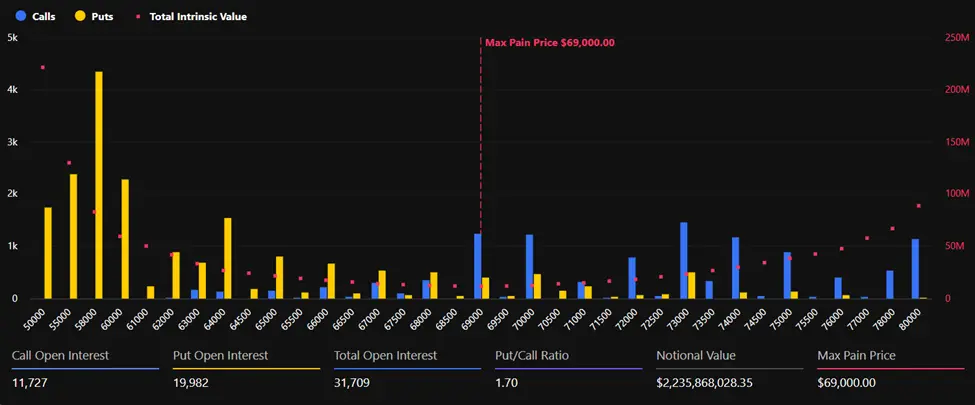
Today’s Bitcoin options expiry encompasses approximately 31,709 open contracts with a notional value of $2.23 billion, representing roughly 7 percent of total open interest across derivatives markets. The put-to-call ratio stands at 1.70, meaning put options—bets on lower prices—outnumber call options by a significant margin. Nearly 20,000 put contracts remain open compared to fewer than 12,000 calls.
 (Source: Deribit)
The maximum pain level for Bitcoin is calculated at $69,000, approximately $1,700 below current spot prices near $70,731. Maximum pain refers to the price at which the most options contracts expire worthless, often acting as a short-term gravitational pull around settlement time. As options approach the 08:00 UTC expiry on Deribit, traders anticipate potential price movement toward this level.
Ethereum Expiry Metrics
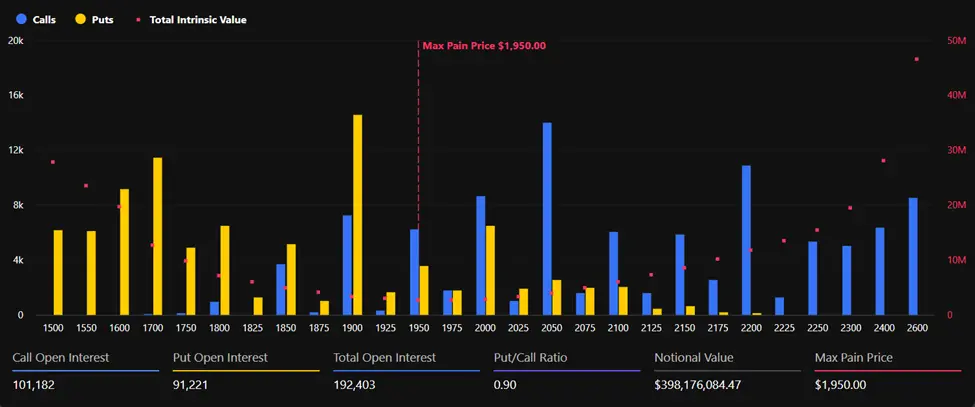
Ethereum options expiring today represent $398 million in notional value across 192,403 open contracts. The put-to-call ratio of 0.90 reflects more balanced positioning compared to Bitcoin, suggesting less pronounced bearish sentiment among ETH derivatives traders.
 (Source: Deribit)
Ethereum’s maximum pain level is $1,950, approximately $120 below current trading levels near $2,070. The narrower gap between spot price and max pain compared to Bitcoin may indicate less potential for expiry-driven volatility.
Options Market Sentiment Analysis
Call Selling Dominance
Despite this week’s price recovery, with Bitcoin reclaiming the $70,000 psychological level and challenging $75,000, options market data reveals a notable divergence between price action and derivatives positioning. Analytics platform Greeks.live reported that selling call options has dominated trading over the past two days, indicating limited conviction in sustained upside momentum.
Call selling typically reflects trader expectations that an asset will not rise significantly further. Traders who sell calls collect premium income while betting against a continued rally, suggesting that professional market participants view the current rebound with skepticism.
Put-to-Call Divergence
The elevated put-to-call ratio for Bitcoin stands in contrast to the asset’s price recovery, underscoring cautious sentiment among derivatives traders. Put options provide downside protection or speculative bearish exposure, and the current 1.70 ratio indicates that traders are positioning defensively despite recent gains.
Ethereum’s more balanced 0.90 put-to-call ratio suggests relatively neutral positioning, though this still reflects some caution given that a ratio below 1.0 typically indicates bullish sentiment. The divergence between the two assets may reflect differing expectations for their respective trajectories following recent network developments and market dynamics.
Volatility and Market Positioning
Implied Volatility Rise
Implied volatility has increased across both assets during this week’s rebound. Bitcoin’s main-term implied volatility stands at 55 percent, while Ethereum’s has reached 75 percent, reflecting heightened expectations for near-term price swings.
Higher implied volatility during a rally can indicate that options buyers are paying more to hedge against potential reversals rather than simply chasing gains. This interpretation aligns with the elevated put open interest on Bitcoin and the dominance of call selling activity.
Open Interest Concentration
Bitcoin’s share of total open interest across derivatives markets has reached a recent peak, underlining the asset’s outsized role in current options positioning. Today’s expiry representing approximately 7 percent of total open interest is described by Greeks.live as nearly the lowest level seen recently, suggesting that most positioning extends beyond this settlement date.
Market Outlook and Expiry Implications
Bearish Phase Assessment
Greeks.live analysts cautioned that despite this week’s recovery, the broader market remains in a bearish phase. “The current value proposition for chasing rallies is mediocre, and the bottom has yet to be confirmed,” they wrote, noting that momentum has slowed despite ongoing price gains.
This assessment aligns with derivatives data showing defensive positioning and limited conviction in upside continuation. The elevated put open interest on Bitcoin and call selling dominance suggest that professional traders view the rally with skepticism.
Post-Expiry Considerations
Whether today’s expiry triggers a short-term volatility spike or passes quietly may depend on how close Bitcoin and Ethereum prices remain to their respective maximum pain levels at settlement. A significant gap between spot price and max pain can produce sharper post-expiry moves as traders reposition following contract expiration.
Bitcoin’s $1,700 gap between current prices and the $69,000 max pain level creates potential for downward pressure as expiry approaches, while Ethereum’s narrower $120 gap suggests less pronounced expiry-driven dynamics.
FAQ: Options Expiry and Market Impact
Q: What is maximum pain in options trading and why does it matter for today’s expiry?
A: Maximum pain is the price level at which the most options contracts expire worthless, causing the greatest financial loss to options holders collectively. This level often acts as a short-term gravitational pull around expiry as market makers and large traders may push prices toward it to minimize their payout obligations. Bitcoin’s max pain is $69,000, about $1,700 below current prices, while Ethereum’s is $1,950, approximately $120 lower.
Q: What does a put-to-call ratio of 1.70 for Bitcoin indicate about market sentiment?
A: A put-to-call ratio above 1.0 means put options (bets on lower prices) outnumber call options (bets on higher prices). Bitcoin’s 1.70 ratio indicates strong demand for downside protection and bearish positioning among derivatives traders, despite the asset’s recent price recovery above $70,000. This divergence suggests cautious sentiment and limited conviction in sustained upside momentum.
Q: How do today’s options expiries compare to typical market activity?
A: The combined $2.6 billion expiry represents approximately 7 percent of total open interest across crypto derivatives markets, which Greeks.live describes as nearly the lowest level seen recently. This indicates that most options positioning extends beyond today’s settlement date, potentially reducing the market impact compared to larger expiry events.
Q: What is implied volatility and why has it risen during the price recovery?
A: Implied volatility reflects market expectations for future price swings based on options pricing. Bitcoin’s IV has risen to 55 percent and Ethereum’s to 75 percent during this week’s rebound. Higher IV during a rally can indicate that options buyers are paying more to hedge against potential reversals, consistent with the defensive positioning shown in put-call ratios and call selling activity.


