Crypto exchange-traded funds (ETFs) delivered a mixed but largely positive performance during the week of March 2–6. Bitcoin, ether, and solana funds finished with net inflows, while XRP ETFs ended the week slightly in the red.
Bitcoin, Ether ETFs Post Weekly Gains as XRP Slips
Institutional capital flowed in waves across crypto ETFs this week. Some days brought strong inflows. Others delivered sharp reversals. Yet by the closing bell on Friday, Mar. 6, the broader picture showed resilience in the market.
Between March 2 and March 6, bitcoin spot ETFs recorded $568 million in net inflows, maintaining their position as the dominant gateway for institutional crypto exposure.
Blackrock’s IBIT led the weekly charge with roughly $660 million in inflows, driven by massive contributions early in the week. Fidelity’s FBTC ended the week slightly negative after heavy late-week redemptions, finishing around -$153 million.
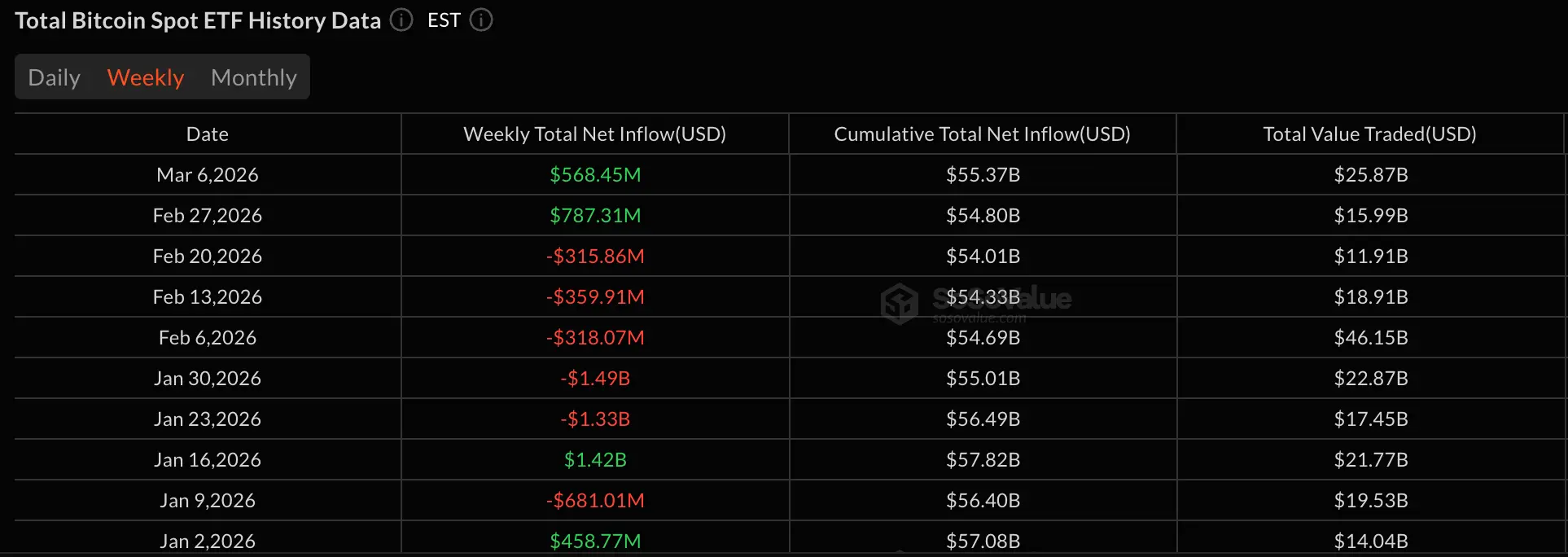 First consecutive inflow weeks for bitcoin ETFs in 2026.
Other funds showed mixed results. Grayscale’s Bitcoin Mini Trust added roughly $46 million, while Invesco’s BTCO and Franklin’s EZBC posted modest gains of about $15 million and $22 million, respectively. WisdomTree’s BTCW also ended positive near $16 million, Vaneck’s HODL added $10 million, while Valkyrie’s BRRR brought in around $17 million.
First consecutive inflow weeks for bitcoin ETFs in 2026.
Other funds showed mixed results. Grayscale’s Bitcoin Mini Trust added roughly $46 million, while Invesco’s BTCO and Franklin’s EZBC posted modest gains of about $15 million and $22 million, respectively. WisdomTree’s BTCW also ended positive near $16 million, Vaneck’s HODL added $10 million, while Valkyrie’s BRRR brought in around $17 million.
Several ETFs closed the week with net outflows. Bitwise’s BITB slipped roughly -$24 million, Ark & 21Shares’ ARKB lost about -$7 million, and Grayscale’s GBTC posted a -$35 million weekly decline.
Ether funds experienced a quieter but still positive week. Ether ETFs recorded $23.56 million in total net inflows during the five days. Blackrock’s ETHA stood out with $133 million in inflows, while Grayscale’s Ether Mini Trust added about $84 million. Grayscale’s ETHE also posted a modest gain of nearly $16 million.
However, heavy withdrawals from Fidelity’s FETH, which ended the week around -$218 million, dragged down the sector’s overall performance. Smaller outflows were also recorded in Vaneck’s ETHV and Bitwise’s ETHW, while Invesco’s QETH posted a minor inflow.
Altcoin ETF flows were more subdued. Solana ETFs recorded $24.05 million in weekly inflows, largely powered by Bitwise’s BSOL, which alone brought in roughly $34 million. Invesco’s QSOL and Franklin’s SOEZ also saw small additions, while Fidelity’s FSOL and Grayscale’s GSOL experienced modest withdrawals.
Meanwhile, XRP ETFs ended the week with a $4.08 million net outflow. Canary’s XRPC was the standout positive performer with about $6 million in inflows, while losses from 21Shares’ TOXR, Franklin’s XRPZ, Grayscale’s GXRP, and Bitwise’s XRP weighed on the category.
In the end, the week told a familiar story. Strong institutional demand early on lifted bitcoin and ether funds, but profit-taking later in the week cooled momentum. Even so, bitcoin remained firmly in positive territory, ether edged higher, solana quietly accumulated capital, and XRP closed slightly negative, highlighting a market still active, but increasingly selective.
FAQ 📊
- How did Bitcoin ETFs perform during the week of March 2–6?
Bitcoin spot ETFs recorded approximately $568 million in net inflows for the week, led primarily by Blackrock’s IBIT, despite heavy outflows during the final two trading days.
- Which Ether ETF attracted the most investor capital this week?
Blackrock’s ETHA generated the largest inflows among ether ETFs with over $100 million added, helping the sector finish the week with a net gain.
- Did any altcoin ETFs post strong weekly inflows?
Yes, solana ETFs recorded about $24.05 million in net inflows for the week, largely driven by strong contributions to Bitwise’s BSOL fund.
- Why did XRP ETFs end the week with net outflows?
Although Canary’s XRPC saw positive inflows, withdrawals across several other XRP ETFs outweighed those gains, resulting in a small weekly net outflow of $4.08 million.
Disclaimer: The information on this page may come from third parties and does not represent the views or opinions of Gate. The content displayed on this page is for reference only and does not constitute any financial, investment, or legal advice. Gate does not guarantee the accuracy or completeness of the information and shall not be liable for any losses arising from the use of this information. Virtual asset investments carry high risks and are subject to significant price volatility. You may lose all of your invested principal. Please fully understand the relevant risks and make prudent decisions based on your own financial situation and risk tolerance. For details, please refer to
Disclaimer.
Related Articles
Morgan Stanley Purchases 177.76 BTC Worth $13.75 Million
Gate News message, Morgan Stanley bought 177.76 BTC worth $13.75M three hours ago. The firm now holds 1,347.54 BTC worth $103.94M in total.
GateNews1h ago
BTC fell below 77000 USDT
Gate News bot message, Gate quotes show that BTC fell below 77000 USDT, trading at 76961.6 USDT.
CryptoRadar2h ago
NYSE Welcomes Morgan Stanley’s MSBT Launch as First Spot Bitcoin ETF Issued by a Major US Bank
Bank-backed bitcoin ETFs are accelerating institutional adoption and strengthening market credibility. The NYSE marked a new milestone as Morgan Stanley Investment Management rang the closing bell and celebrated the launch of MSBT, which the NYSE described as the first spot bitcoin ETF by a major
Coinpedia6h ago
BTC falls 0.49% in 15 minutes: fragile long leverage and active sell-off pressure resonate to weigh on the short term
From 18:00 to 18:15 (UTC) on 2026-04-17, the BTC price fluctuated and trended downward within the 77097.4 to 77573.2 USDT range. Over these 15 minutes, the return rate recorded -0.49%, and the amplitude reached 0.61%. During this period, market trading was active; short-term volatility was amplified, and trading attention increased significantly. The main driver behind this abnormal move is that the overall leverage structure is bearish and long positions are fragile. At present, the BTC perpetual contract funding rate has remained negative for 11 consecutive days, indicating that the bears have the upper hand in the market. In addition, futures open interest (OI) is about 628.3 billion USDT, which is at a historical high. During the anomaly window, trading volume increased noticeably. On-chain data shows large amounts of BTC flowing from long-term holder addresses to exchanges, suggesting that active sell orders may have triggered longs to passively reduce positions, amplifying downward price pressure. Moreover, institutional positioning enthusiasm in the mainstream contract market has cooled off; liquidity boundaries have tightened, causing large-trade activity to have an amplified effect on market volatility. In the options market, implied volatility rose to 39.81%, increasing demand for downside protection and reflecting a defensive posture among market participants. Macro-environment volatility and some capital flowing into safe-haven assets, together with the recent regulatory uncertainty-related historical events, reinforced the move, pushing overall market risk appetite lower. Current BTC leverage risks still remain. If, in the future, there are concentrated sell-offs, volatility may be further amplified. It is recommended to continue monitoring sustained high OI levels, the persistence of negative funding rates, and on-chain transfers of large amounts of funds, and to stay alert for whale behavior and any disruptions to market sentiment caused by macro-policy developments. For subsequent price action, please watch key support levels, institutional and whale on-chain moves, and relevant global market news, and guard against short-term risks.
GateNews7h ago
Bitcoin Liquidations Hit $815M as BTC Surges Above $78K Amid Iran Strait Opening
Over $815 million in leveraged cryptocurrency positions were liquidated recently, mainly due to short positions against Bitcoin. Markets improved as Iran reopened the Strait of Hormuz and Trump hinted at a deal with Iran, boosting Bitcoin prices significantly.
GateNews7h ago


