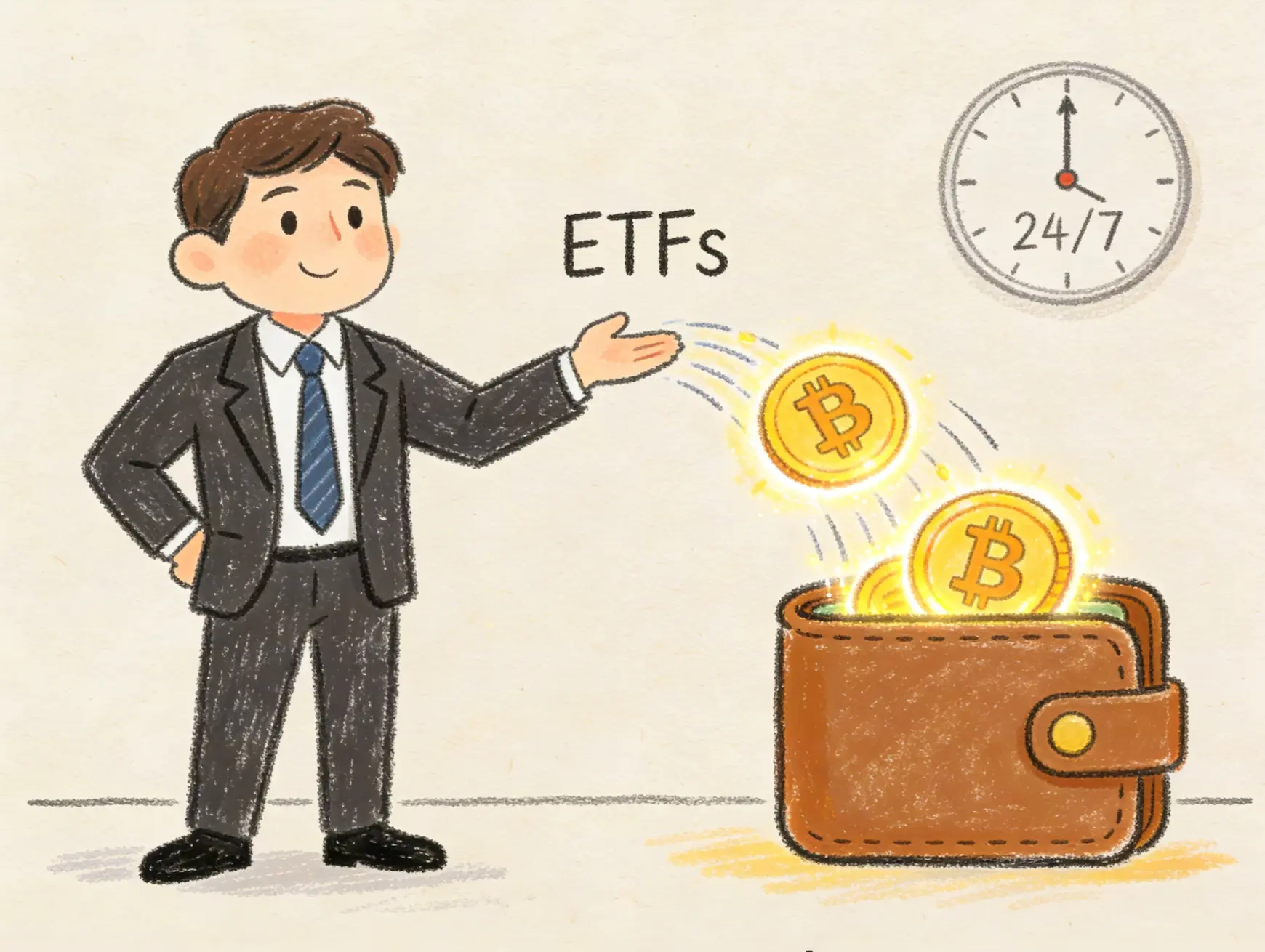
 Franklin Templeton announced on March 25, 2026, that it is partnering with Ondo Finance to offer tokenized versions of five exchange-traded funds (ETFs) that trade around the clock through crypto wallets, bypassing traditional brokerage accounts and limited trading hours.
The products—spanning US equities, fixed income, and gold—will initially be available in Europe, Asia-Pacific, the Middle East, and Latin America, with US availability depending on further regulatory clarity around on-chain distribution of registered funds. The tokenized structure allows investors to own rights to the return stream rather than underlying shares, enabling the tokens to be used as collateral or integrated into decentralized finance (DeFi) applications.
Partnership Structure and Product Design
Tokenization Mechanism
Under the arrangement, Ondo will purchase shares of the Franklin ETFs and issue tokens through a special-purpose vehicle that passes through the financial exposure to holders. Investors own rights to the return stream rather than the underlying shares—a structure that frees the tokens to be used as collateral or plugged into DeFi applications in ways that registered fund shares cannot. Ondo’s market makers will provide liquidity for the tokens, including during hours when stock and bond markets are closed.
Fund Offerings
The five funds slated for tokenization include:
FFOG: Growth-oriented US equity strategy
FLQL: Systematic large-cap equity fund
FGDL: Gold fund
FLHY: High-yield corporate bond fund
INCE: Income-focused US equity strategy
Franklin Templeton oversees approximately $1.7 trillion in assets as of February 2026. Ondo Finance, which has roughly $2.7 billion in tokenized assets outstanding, will serve as partner.
Strategic Rationale and Investor Reach
New Distribution Channel
Sandy Kaul, Franklin’s head of innovation, described the initiative as a new distribution channel: “These ETFs represent a good mix of different exposures. And it gives a good test case for us to see what is really striking the appetite to this new audience.” Franklin already offers international versions of its US strategies through conventional channels, but those still require brokerage accounts. The tokenized versions strip that requirement out, reaching investors who may have access to a crypto wallet but not to the cross-border brokerage infrastructure needed to buy a US-listed ETF.
Target Audience
The initiative is aimed at a growing class of investors who operate entirely through crypto wallets and stablecoins and have no interaction with traditional brokerages—an investor base that the two companies believe is large enough to justify building dedicated products for, rather than trying to pull into existing infrastructure.
Regulatory Context and Market Availability
Geographic Rollout
The tokenized ETFs will initially be available in Europe, Asia-Pacific, the Middle East, and Latin America. Franklin stated that US availability depends on further regulatory clarity around how third parties can distribute registered funds on-chain.
Regulatory Challenges
Ian De Bode, president of Ondo Finance, noted that regulatory uncertainty in the US has slowed adoption, as officials have yet to establish clear guardrails for tokenized ETFs. “This is an area where the US risks falling behind other jurisdictions,” De Bode said, adding that the new products would have a “meaningful” addressable market of millions of potential users.
Structural Hurdles
Several market participants point to the complexity of integrating blockchain-based ownership with the traditional ETF ecosystem, which relies on broker-dealers and authorized participants to create and redeem shares. Structuring such products in a way that accommodates non-KYC wallets while complying with securities laws also remains a significant hurdle.
Broader Implications and Industry Context
Market Growth
The market value for tokenized real-world assets has grown approximately 360% since 2025 to $26.5 billion, according to rwa.xyz, still a small fraction of the trillions held in mutual funds and ETFs. Tokenized ETFs may reduce settlement risk and counterparty exposure by enabling near-instant settlement, rather than the one- or two-day clearing cycles typical in traditional markets. They could also improve capital efficiency by allowing assets to be reused more seamlessly as collateral.
Industry Momentum
Wall Street firms have been tapping into tokenized structures. This week, the New York Stock Exchange announced a collaboration with tokenization platform Securitize to support tokenized securities. Nasdaq Inc. also teamed up with digital-asset technology firm Talos to connect crypto trading and risk-management tools. Last month, WisdomTree tokenized shares of a money-market mutual fund, allowing investors to buy and sell shares at a constant $1 throughout the day with instant settlement on blockchain rails. BlackRock Inc. and WisdomTree Inc. have also revealed plans for tokenizing ETFs in the US.
Frequently Asked Questions
What is a tokenized ETF?
A tokenized ETF is a blockchain-based representation of a traditional exchange-traded fund. Instead of holding shares through a brokerage account, investors hold tokens that represent rights to the return stream of the underlying ETF. These tokens can trade 24/7 and be used as collateral in decentralized finance applications.
How will the Franklin Templeton-Ondo tokenized ETFs work?
Ondo will purchase shares of Franklin’s ETFs and issue tokens through a special-purpose vehicle that passes through the financial exposure to holders. Investors own rights to the return stream rather than the underlying shares. Ondo’s market makers will provide liquidity for the tokens, including during off-market hours.
Where will these tokenized ETFs be available?
The products will initially be available in Europe, Asia-Pacific, the Middle East, and Latin America. US availability depends on further regulatory clarity around on-chain distribution of registered funds.
Disclaimer: The information on this page may come from third parties and does not represent the views or opinions of Gate. The content displayed on this page is for reference only and does not constitute any financial, investment, or legal advice. Gate does not guarantee the accuracy or completeness of the information and shall not be liable for any losses arising from the use of this information. Virtual asset investments carry high risks and are subject to significant price volatility. You may lose all of your invested principal. Please fully understand the relevant risks and make prudent decisions based on your own financial situation and risk tolerance. For details, please refer to
Disclaimer.


