AAVE vs IMX: Comparing Two Leading DeFi Protocols in the Crypto Space


Introduction: AAVE vs IMX Investment Comparison
In the cryptocurrency market, the comparison between AAVE and IMX has always been an unavoidable topic for investors. The two not only have significant differences in market cap ranking, application scenarios, and price performance, but also represent different cryptocurrency positioning.
AAVE (AAVE): Since its launch in 2020, it has gained market recognition for its decentralized lending protocol.
Immutable (IMX): Since its inception, it has been hailed as an L2 scaling solution for NFTs on Ethereum, offering instant transactions and zero gas fees.
This article will comprehensively analyze the investment value comparison between AAVE and IMX, focusing on historical price trends, supply mechanisms, institutional adoption, technological ecosystems, and future predictions, attempting to answer the question investors care about most:
"Which is the better buy right now?"
I. Price History Comparison and Current Market Status
AAVE and IMX Historical Price Trends
- 2020: AAVE launched its governance token, causing a significant price increase.
- 2021: IMX entered the market during the NFT boom, leading to rapid price growth.
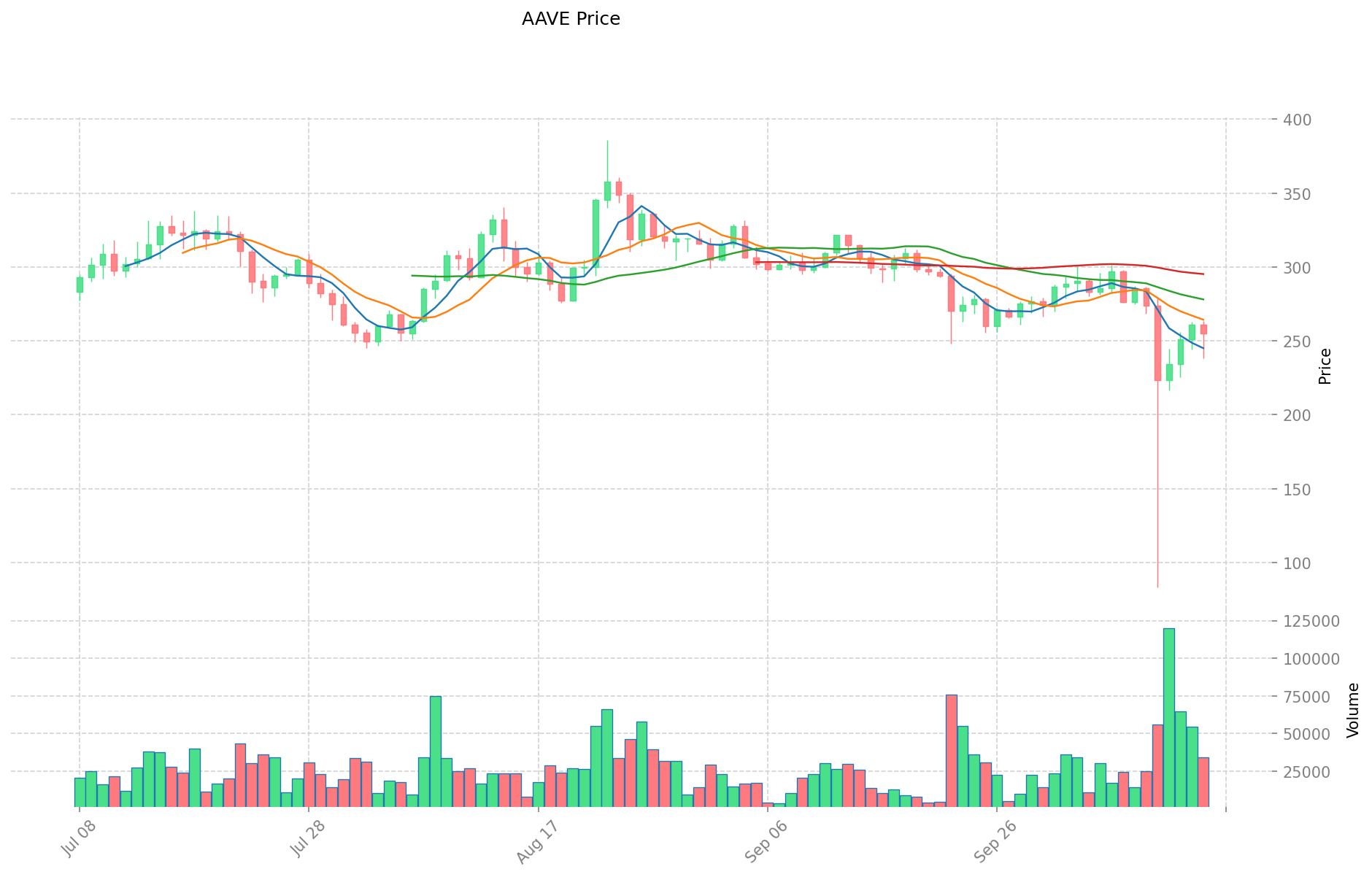
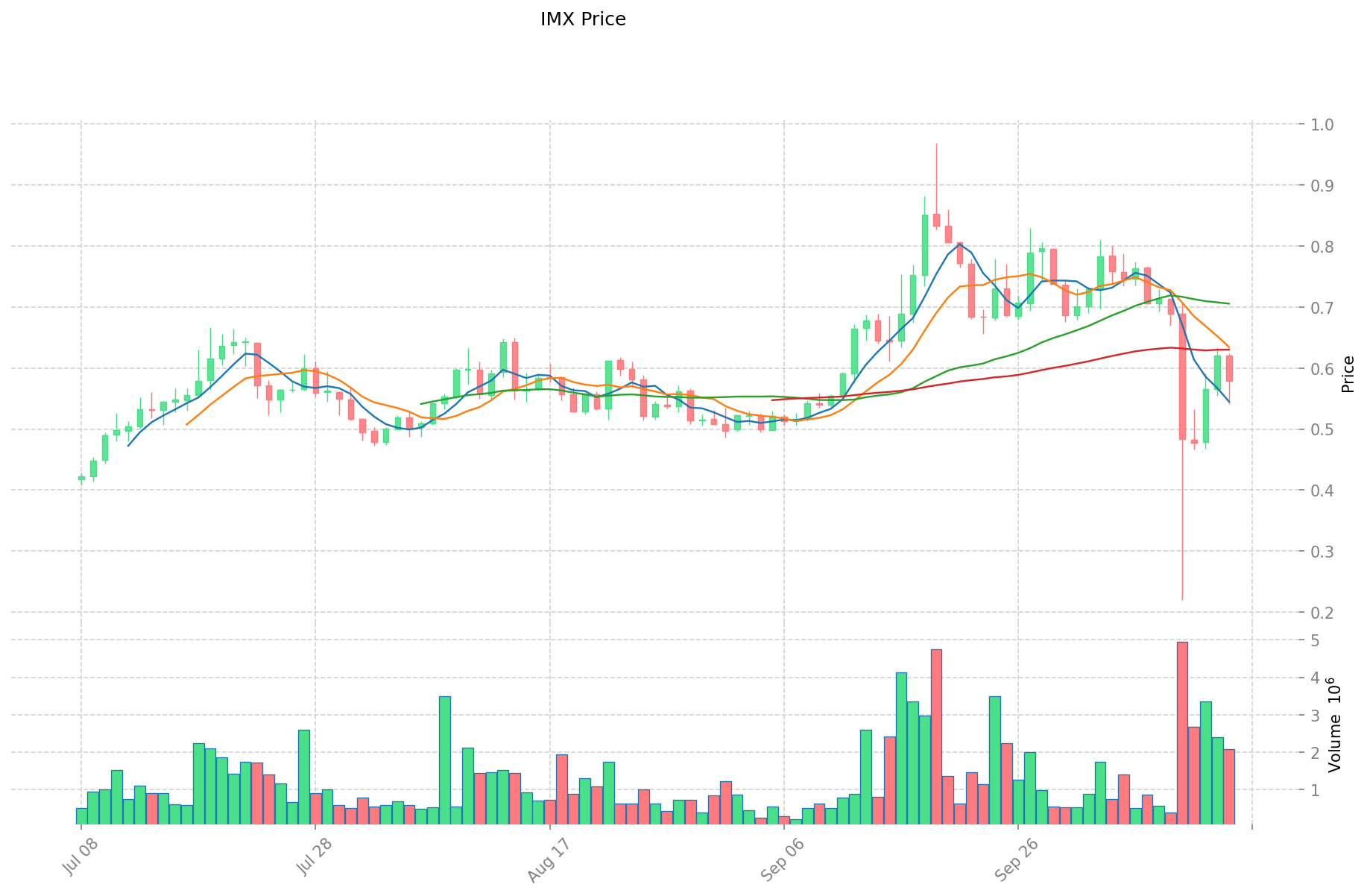
- Comparative analysis: During the 2022 bear market, AAVE dropped from its all-time high of $661.69 to a low of $26.02, while IMX experienced a similar downturn, falling from $9.52 to $0.334412.
Current Market Situation (2025-10-15)
- AAVE current price: $252.22
- IMX current price: $0.5861
- 24-hour trading volume: AAVE $8,113,814 vs IMX $1,034,753
- Market Sentiment Index (Fear & Greed Index): 34 (Fear)
Click to view real-time prices:
- View AAVE current price Market Price
- View IMX current price Market Price
II. Core Factors Affecting AAVE vs IMX Investment Value
Supply Mechanism Comparison (Tokenomics)
- IMX: Token supply dynamics include private investor allocations and scheduled token unlocks, with recent unlocks valued at approximately $12.42 million representing 1.277% of current circulating supply
- AAVE: Continues innovation with V3 version and various risk management features as a leading decentralized lending protocol
- 📌 Historical pattern: Token unlocking events for IMX have shown to potentially impact price performance, requiring attention from Web3 ecosystem participants
Institutional Adoption and Market Applications
- Institutional holdings: IMX has been gaining increased institutional interest according to market reports
- Enterprise adoption: AAVE has seen widespread adoption in European markets, alongside platforms like MakerDAO in the decentralized finance space
- Market perspective: European markets show particular interest in DeFi tokens including AAVE, with institutional investors focusing on tokenized real estate and bonds
Technical Development and Ecosystem Building
- AAVE technical upgrade: Launched AAVE V3 on Era mainnet, leveraging zkSync to enhance performance and capabilities
- IMX technical development: Positioned as an important player in the Layer 2 sector with ecosystem advancements
- Ecosystem comparison: IMX value is heavily dependent on platform transaction volume and activity, particularly in NFT and gaming sectors, while AAVE focuses on solving liquidity, risk management, and capital efficiency pain points
Macroeconomic Factors and Market Cycles
- Performance in market cycles: IMX token performance has shown significant volatility with recent reports of 22.64% weekly gains and increased 24-hour trading volume
- Market sentiment: Both tokens benefit from broader crypto market trends, with IMX particularly vulnerable to bearish sentiment in NFT or gaming markets
- Trading perspective: Investment in both tokens requires sufficient psychological preparation for volatility, with fundamental value being the recommended focus rather than short-term speculation
III. 2025-2030 Price Prediction: AAVE vs IMX
Short-term Prediction (2025)
- AAVE: Conservative $151.34 - $252.23 | Optimistic $252.23 - $285.02
- IMX: Conservative $0.32 - $0.59 | Optimistic $0.59 - $0.73
Mid-term Prediction (2027)
- AAVE may enter a growth phase, with expected prices $190.59 - $424.49
- IMX may enter a consolidation phase, with expected prices $0.44 - $0.77
- Key drivers: Institutional capital inflow, ETF, ecosystem development
Long-term Prediction (2030)
- AAVE: Base scenario $257.60 - $402.50 | Optimistic scenario $402.50 - $458.85
- IMX: Base scenario $0.59 - $0.81 | Optimistic scenario $0.81 - $1.04
Disclaimer: This analysis is based on historical data and projections. Cryptocurrency markets are highly volatile and unpredictable. This information should not be considered as financial advice. Always conduct your own research before making investment decisions.
AAVE:
| 年份 | 预测最高价 | 预测平均价格 | 预测最低价 | 涨跌幅 |
|---|---|---|---|---|
| 2025 | 285.0199 | 252.23 | 151.338 | 0 |
| 2026 | 308.9186925 | 268.62495 | 217.5862095 | 6 |
| 2027 | 424.4945772375 | 288.77182125 | 190.589402025 | 14 |
| 2028 | 413.69451112275 | 356.63319924375 | 324.5362113118125 | 41 |
| 2029 | 419.8286021497425 | 385.16385518325 | 373.6089395277525 | 52 |
| 2030 | 458.845700679805725 | 402.49622866649625 | 257.5975863465576 | 59 |
IMX:
| 年份 | 预测最高价 | 预测平均价格 | 预测最低价 | 涨跌幅 |
|---|---|---|---|---|
| 2025 | 0.728996 | 0.5879 | 0.317466 | 0 |
| 2026 | 0.78355312 | 0.658448 | 0.47408256 | 12 |
| 2027 | 0.7714705992 | 0.72100056 | 0.4398103416 | 23 |
| 2028 | 0.768622646988 | 0.7462355796 | 0.67161202164 | 27 |
| 2029 | 0.8710434802881 | 0.757429113294 | 0.54534896157168 | 29 |
| 2030 | 1.042222459892544 | 0.81423629679105 | 0.594392496657466 | 38 |
IV. Investment Strategy Comparison: AAVE vs IMX
Long-term vs Short-term Investment Strategies
- AAVE: Suitable for investors focused on DeFi ecosystem potential and institutional adoption
- IMX: Suitable for investors interested in NFT and gaming sectors with higher risk tolerance
Risk Management and Asset Allocation
- Conservative investors: AAVE: 70% vs IMX: 30%
- Aggressive investors: AAVE: 40% vs IMX: 60%
- Hedging tools: Stablecoin allocation, options, cross-currency portfolios
V. Potential Risk Comparison
Market Risks
- AAVE: Vulnerability to DeFi market fluctuations and liquidity risks
- IMX: High dependence on NFT and gaming market trends
Technical Risks
- AAVE: Scalability, network stability, smart contract vulnerabilities
- IMX: Layer 2 technology stability, potential security flaws
Regulatory Risks
- Global regulatory policies may have differing impacts on DeFi (AAVE) and NFT/gaming (IMX) sectors
VI. Conclusion: Which Is the Better Buy?
📌 Investment Value Summary:
- AAVE advantages: Established DeFi protocol, institutional adoption, continuous innovation
- IMX advantages: L2 scaling solution for NFTs, potential growth in gaming and NFT markets
✅ Investment Advice:
- New investors: Consider a balanced approach with a slight tilt towards AAVE for its established position
- Experienced investors: Explore a diversified portfolio including both AAVE and IMX based on risk tolerance
- Institutional investors: Focus on AAVE for its institutional-grade DeFi exposure, while monitoring IMX for emerging opportunities
⚠️ Risk Warning: Cryptocurrency markets are highly volatile. This article does not constitute investment advice. None
VII. FAQ
Q1: What are the main differences between AAVE and IMX? A: AAVE is a decentralized lending protocol in the DeFi space, while IMX is an L2 scaling solution for NFTs on Ethereum. AAVE focuses on lending and borrowing, whereas IMX specializes in NFT transactions and gaming.
Q2: Which token has shown better price performance historically? A: Both tokens have experienced significant volatility. AAVE reached an all-time high of $661.69 before dropping to $26.02 during the 2022 bear market. IMX, launched during the NFT boom, peaked at $9.52 before falling to $0.334412. As of 2025-10-15, AAVE is trading at $252.22, while IMX is at $0.5861.
Q3: How do their supply mechanisms differ? A: IMX has scheduled token unlocks, with recent unlocks valued at approximately $12.42 million. AAVE continues to innovate with its V3 version and various risk management features. IMX's token unlocking events may potentially impact its price performance.
Q4: Which token has greater institutional adoption? A: AAVE has seen widespread adoption in European markets and is often mentioned alongside platforms like MakerDAO in the DeFi space. IMX has been gaining increased institutional interest, particularly in the NFT and gaming sectors.
Q5: What are the long-term price predictions for AAVE and IMX? A: By 2030, AAVE is predicted to reach $257.60 - $402.50 in a base scenario, and $402.50 - $458.85 in an optimistic scenario. IMX is expected to reach $0.59 - $0.81 in a base scenario, and $0.81 - $1.04 in an optimistic scenario.
Q6: How should investors allocate their portfolios between AAVE and IMX? A: Conservative investors might consider allocating 70% to AAVE and 30% to IMX, while aggressive investors might opt for 40% AAVE and 60% IMX. However, individual allocations should be based on personal risk tolerance and investment goals.
Q7: What are the main risks associated with investing in AAVE and IMX? A: AAVE is vulnerable to DeFi market fluctuations and liquidity risks, while IMX is highly dependent on NFT and gaming market trends. Both face technical risks such as scalability issues and potential smart contract vulnerabilities. Regulatory risks also apply, with potentially differing impacts on DeFi and NFT/gaming sectors.
Share
Content
Introduction: AAVE vs IMX Investment Comparison
I. Price History Comparison and Current Market Status
II. Core Factors Affecting AAVE vs IMX Investment Value
III. 2025-2030 Price Prediction: AAVE vs IMX
IV. Investment Strategy Comparison: AAVE vs IMX
V. Potential Risk Comparison
VI. Conclusion: Which Is the Better Buy?
VII. FAQ
How to Buy Cryptocurrency


Trending Cryptocurrencies



STRK vs FLOW: Battle of the Blockchain Titans Shaping the Future of Decentralized Finance
What is OP: Understanding the Popular Internet Acronym and Its Various Meanings
What is POL: Proof of Location and Its Applications in Modern Blockchain Networks

L3 vs IMX: Comparing Layer 2 Scaling Solutions for Ethereum's Future

What is LINEA: Exploring Ethereum's Promising Layer 2 Scaling Solution

FARM vs IMX: Comparing Layer-2 Solutions for NFT Ecosystems

Is Aleo (ALEO) a good investment?: A Comprehensive Analysis of Price Potential, Technology, and Risk Factors in 2024
Is Bio Protocol (BIO) a good investment?: A Comprehensive Analysis of Market Potential, Risk Factors, and Investment Prospects

Is Holo (HOT) a good investment?: A Comprehensive Analysis of Price Potential, Market Fundamentals, and Risk Factors for 2024
BBT vs RUNE: A Comprehensive Comparison of Two Leading Blockchain Tokens in the DeFi Ecosystem

Is RaveDAO (RAVE) a good investment?: A Comprehensive Analysis of Token Fundamentals, Market Performance, and Future Potential