PERP vs LINK: Comparing Two Leading Decentralized Oracle and Perpetual Trading Tokens

Introduction: PERP vs LINK Investment Comparison
In the cryptocurrency market, the comparison between Perpetual Protocol (PERP) and Chainlink (LINK) represents two distinct segments of the decentralized finance ecosystem. Both assets have carved out significant niches, yet they operate under fundamentally different value propositions and market dynamics.
Perpetual Protocol (PERP): Launched in 2020, PERP powers a decentralized perpetual contracts protocol utilizing virtual automated market makers (vAMM). The token functions as a governance and staking mechanism, enabling traders to access unlimited asset derivatives without traditional counterparties.
Chainlink (LINK): Since its inception in 2017, LINK has established itself as the infrastructure backbone for blockchain oracle services. The token is used to compensate Chainlink node operators for retrieving off-chain data, formatting it into blockchain-readable formats, and ensuring network reliability.
This analysis will examine the investment characteristics of both assets across multiple dimensions including historical price performance, market positioning, tokenomics, market liquidity, and risk considerations, providing investors with a comprehensive framework for understanding the distinctions between these two projects:
"Which asset aligns better with your investment objectives?"
Perpetual Protocol (PERP) vs Chainlink (LINK): Comparative Market Analysis Report
I. Historical Price Comparison and Current Market Status
PERP and LINK Historical Price Trends
Perpetual Protocol (PERP):
- All-time high (ATH): $24.40 on August 30, 2021
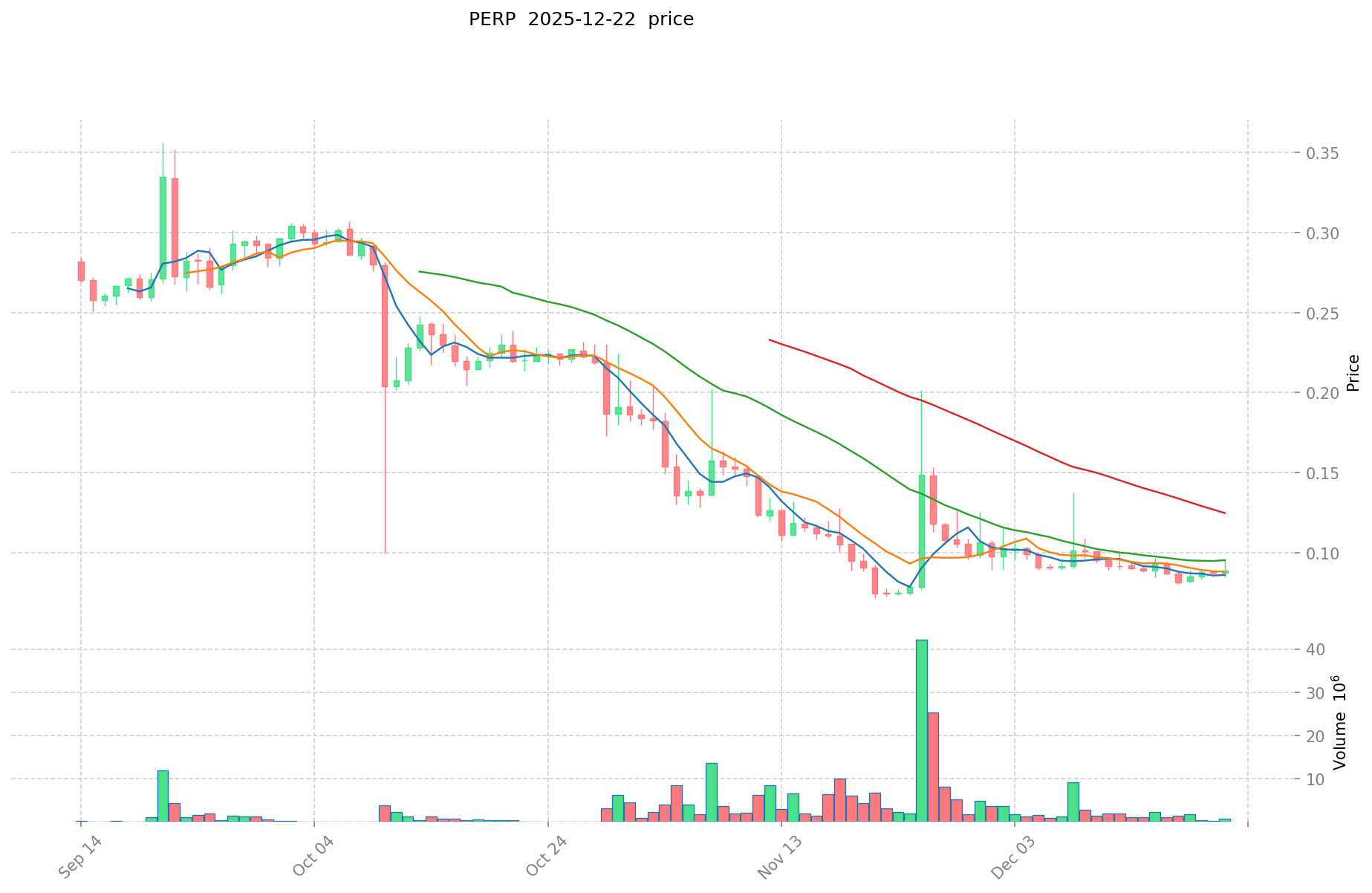
- All-time low (ATL): $0.072752 on November 22, 2025
- From peak to trough decline: approximately 99.7%
- Initial token price: $1.20
Chainlink (LINK):
- All-time high (ATH): $52.70 on May 10, 2021
- All-time low (ATL): $0.148183 on November 29, 2017
- Initial token price: $0.091429
Comparative Analysis: Both tokens experienced significant downturns from their 2021 bull market peaks. PERP declined from $24.40 to near its all-time low of $0.072752, representing an extreme devaluation. LINK, despite falling from its $52.70 peak, maintained higher absolute valuations and demonstrated greater market resilience relative to its all-time lows.
Current Market Status (December 23, 2025)
| Metric | PERP | LINK |
|---|---|---|
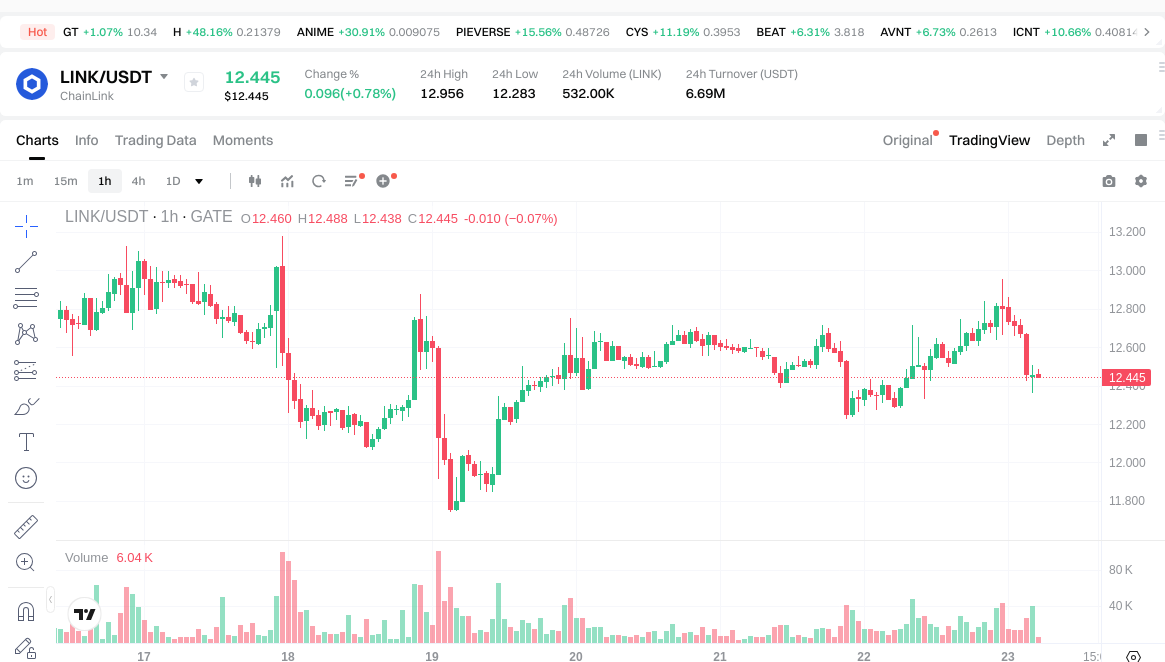
| Current Price | $0.09091 | $12.447 |
| 24-Hour Change | +2.09% | +0.85% |
| 1-Hour Change | -0.98% | -0.22% |
| 7-Day Change | -3.21% | -1.46% |
| 30-Day Change | +22.96% | +3.82% |
| 1-Year Change | -88.46% | -43.74% |
| Market Capitalization | $13.64 million | $12.45 billion |
| Circulating Supply | 72,609,864 PERP | 708,099,970 LINK |
| Total Supply | 150,000,000 PERP | 1,000,000,000 LINK |
| 24-Hour Trading Volume | $306,678 | $6,697,802 |
| Market Dominance | 0.00042% | 0.38% |
Market Sentiment Indicator:
- Crypto Fear & Greed Index: 25 (Extreme Fear)
Reference Links:
- View PERP current price: Market Price
- View LINK current price: Market Price
II. Project Overview and Functionality
Perpetual Protocol (PERP)
Perpetual Protocol is a decentralized perpetual futures protocol that enables traders to trade derivatives on any asset without requiring counterparties. The protocol operates through a virtual automated market maker (vAMM) mechanism.
Core Features:
- Supports perpetual contracts for any asset with reliable price data
- Price data sourced from oracles such as Chainlink, Uniswap, and other decentralized oracle providers
- Enables counterparty-free trading through vAMM
- Future roadmap includes permissionless contract market creation by community members
PERP Token Utility:
- Governance: Token holders vote on new asset listings and protocol development direction
- staking: Token holders earn staking rewards and a portion of trading fees
- Risk mitigation: Staked tokens provide market protection mechanisms
Chainlink (LINK)
Chainlink is a decentralized oracle platform that bridges real-world data with blockchain-based smart contracts.
Core Features:
- Decentralized oracle network connecting blockchain with external data sources, APIs, and off-chain systems
- Provides price feeds, reference data, and proof of reserves for smart contracts
- Node operators earn LINK token rewards for accurate data provision and network participation
- Multi-layer verification system ensuring data accuracy and integrity
LINK Token Utility:
- Node operator compensation for data retrieval and validation
- Off-chain computation incentivization
- Network security mechanism preventing bad actors
- Staking participation for enhanced network security and yield generation
- Potential future governance participation
III. Market Liquidity and Trading Activity
LINK demonstrates significantly higher market liquidity with a 24-hour trading volume of $6,697,802 compared to PERP's $306,678. LINK maintains 53 exchange listings, enabling broader market access. PERP's limited liquidity reflects its smaller market capitalization and reduced institutional adoption.
LINK's circulating supply represents 70.81% of its fully diluted valuation, while PERP's circulating supply comprises 48.41% of its fully diluted valuation, indicating different token release schedules and unlock dynamics.
IV. Price Volatility and Risk Metrics
PERP exhibited extreme volatility with an 88.46% annual decline, substantially outpacing LINK's 43.74% annual decline. Both tokens reflect broader market downturns from the 2021 bull market peak, yet LINK's more modest decline suggests stronger fundamental support or institutional confidence.
Short-term momentum shows both tokens declining in the 7-day period (PERP: -3.21%, LINK: -1.46%), while the 30-day metrics reveal divergent trajectories (PERP: +22.96%, LINK: +3.82%), suggesting potential short-term recovery in PERP but sustained weakness in LINK.
Data Current as of: December 23, 2025
Disclaimer: This report presents market data and project information derived from provided sources. This analysis does not constitute financial advice, investment recommendation, or endorsement of either asset. Cryptocurrency markets exhibit high volatility and carry significant risk. Readers should conduct independent research and consult qualified financial advisors before making investment decisions.
Comparative Analysis of PERP and LINK: Investment Value Assessment
I. Executive Summary
This report analyzes the investment value drivers of PERP (Perpetual Protocol) and LINK (Chainlink) based on available market research. Both projects operate in the decentralized finance ecosystem but serve distinct functional roles, with divergent tokenomics and value accrual mechanisms.
II. Core Factors Impacting Investment Value of PERP vs LINK
Tokenomics and Supply Mechanisms
-
PERP (Perpetual Protocol): Employs a deflationary model wherein protocol revenues are utilized for token buybacks and subsequent destruction, thereby reducing circulating supply over time and creating scarcity dynamics.
-
LINK (Chainlink): Operates as an inflationary token with a controlled release schedule designed to support decentralized finance integration and ecosystem development.
-
📌 Mechanism Implications: Deflationary models like PERP's create scarcity pressures that may support price appreciation in periods of sustained protocol adoption, while controlled inflation in LINK's structure enables flexible incentive distribution but requires robust demand growth to counteract dilution effects.
Institutional Adoption and Market Application
-
Institutional Positioning: LINK's value is driven substantially by its integration depth within decentralized finance infrastructure, supporting oracle-dependent applications across multiple blockchain ecosystems. PERP's institutional adoption remains contingent upon derivatives trading volume and risk management requirements.
-
Enterprise and Protocol Integration: LINK functions as critical infrastructure for price feed delivery across DeFi protocols, positioning it as a foundational component. PERP derives value from perpetual futures trading activity and platform adoption within decentralized derivatives markets.
-
Market Development: Both tokens benefit from institutional involvement, though through different mechanisms—LINK through oracle service dependencies and PERP through trading volume and liquidity provisioning.
Technological Development and Ecosystem Construction
-
Supply Mechanism as Value Driver: The core investment value for both tokens fundamentally depends on technological development, institutional participation, and mainstream market adoption as validated catalysts.
-
Ecosystem Integration: LINK's value accrual is linked to its expanding role across decentralized finance applications requiring reliable data feeds. PERP's ecosystem value depends on perpetual derivatives trading infrastructure maturation and institutional-grade execution quality.
III. Critical Value Drivers
-
Scarcity Mechanisms: PERP's deflationary token design creates inherent scarcity, contrasting with LINK's controlled-release inflationary structure.
-
Institutional Capital Flow: Both projects rely on institutional participation as a primary growth catalyst, though institutional demand manifests differently across use cases.
-
Macroeconomic Environment: Overall market conditions and technological developments remain essential determinants of long-term value realization for both assets.
-
Mainstream Adoption Trajectories: Widespread adoption across traditional and decentralized finance channels represents a critical threshold for sustainable value growth.
IV. Risk Considerations
- Tokenomics alone do not guarantee investment returns; sustained protocol utility and user adoption remain paramount.
- Institutional involvement, while supportive, depends on continued technological reliability and regulatory clarity.
- Macroeconomic factors including interest rates, USD strength, and risk asset appetite materially influence valuation multiples.
Report Date: December 23, 2025
Disclaimer: This analysis is based on available reference materials and reflects observed market conditions. This report does not constitute investment advice. Cryptocurrency assets carry substantial risk, and past performance does not guarantee future results.
III. 2025-2030 Price Forecast: PERP vs LINK
Short-term Forecast (2025)
- PERP: Conservative $0.0845649-$0.09093 | Optimistic $0.0963858
- LINK: Conservative $11.8237-$12.446 | Optimistic $13.31722
Mid-term Forecast (2027-2028)
- PERP may enter accumulation phase, with predicted price range of $0.08524742058-$0.15960275519265
- LINK may enter growth phase, with predicted price range of $10.39835763225-$24.4361404357875
- Key drivers: institutional capital inflows, ETF approvals, ecosystem development
Long-term Forecast (2029-2030)
- PERP: Base case $0.120974931342924-$0.145752929328825 | Optimistic case $0.195308925300625-$0.243859226060057
- LINK: Base case $10.85935148727975-$20.88336824476875 | Optimistic case $21.509869292111812-$31.582961964976019
Disclaimer: This analysis is based on historical data and predictive models. Cryptocurrency markets are highly volatile and subject to rapid changes. Past performance does not guarantee future results. This information should not be considered as investment advice. Please conduct your own research before making any investment decisions.
PERP:
| 年份 | 预测最高价 | 预测平均价格 | 预测最低价 | 涨跌幅 |
|---|---|---|---|---|
| 2025 | 0.0963858 | 0.09093 | 0.0845649 | 0 |
| 2026 | 0.136740534 | 0.0936579 | 0.058067898 | 3 |
| 2027 | 0.14860698993 | 0.115199217 | 0.08524742058 | 26 |
| 2028 | 0.15960275519265 | 0.131903103465 | 0.09365120346015 | 45 |
| 2029 | 0.195308925300625 | 0.145752929328825 | 0.120974931342924 | 60 |
| 2030 | 0.243859226060057 | 0.170530927314725 | 0.122782267666602 | 87 |
LINK:
| 年份 | 预测最高价 | 预测平均价格 | 预测最低价 | 涨跌幅 |
|---|---|---|---|---|
| 2025 | 13.31722 | 12.446 | 11.8237 | 0 |
| 2026 | 17.3901735 | 12.88161 | 8.7594948 | 3 |
| 2027 | 19.5253003575 | 15.13589175 | 13.016866905 | 21 |
| 2028 | 24.4361404357875 | 17.33059605375 | 10.39835763225 | 38 |
| 2029 | 21.509869292111812 | 20.88336824476875 | 10.85935148727975 | 67 |
| 2030 | 31.582961964976019 | 21.196618768440281 | 11.022241759588946 | 69 |
Perpetual Protocol (PERP) vs Chainlink (LINK): Investment Strategy Comparison Report
IV. Investment Strategy Comparison: PERP vs LINK
Long-term vs Short-term Investment Strategy
Perpetual Protocol (PERP): Short-term Trading & Speculative Recovery
- Suitable for traders focused on volatility arbitrage and recovery positioning
- PERP's extreme 88.46% annual decline positions it as a potential recovery play for risk-tolerant investors
- 30-day momentum of +22.96% suggests short-term accumulation phase
- Deflationary tokenomics create potential scarcity-driven appreciation if protocol adoption accelerates
Chainlink (LINK): Long-term Infrastructure Exposure
- Suitable for investors seeking exposure to decentralized finance infrastructure maturation
- LINK's integration depth across oracle-dependent protocols provides sustained utility demand
- Institutional adoption through DeFi ecosystem dependencies creates stable value floors
- Controlled-release tokenomics support ecosystem development without extreme volatility
Risk Management and Asset Allocation
Conservative Investors:
- PERP: 5-10% (concentrated allocation for high-risk positioning)
- LINK: 60-70% (core infrastructure exposure with relative stability)
- Remaining allocation: Stablecoins and lower-volatility crypto assets (20-35%)
Aggressive Investors:
- PERP: 25-35% (leveraged volatility exposure and recovery positioning)
- LINK: 35-45% (infrastructure backbone with institutional adoption trajectory)
- Alternative allocation: Emerging DeFi protocols and yield-generating derivatives (15-25%)
Hedging Mechanisms:
- Stablecoin reserves to capitalize on volatility-driven entry points
- Cross-exchange liquidity arbitrage between PERP and LINK market pairs
- Derivatives overlay strategies using options for downside protection on both positions
V. Comparative Risk Analysis
Market Risk
Perpetual Protocol (PERP):
- Extreme price volatility with 99.7% decline from all-time high ($24.40 to $0.072752)
- Illiquidity risk: 24-hour trading volume of $306,678 creates execution slippage for large orders
- Counterparty concentration risk: Limited exchange listing reduces market accessibility
- Recoverability uncertainty given severe market devaluation
Chainlink (LINK):
- Moderate volatility with 43.74% annual decline from institutional baseline
- Superior liquidity with $6,697,802 daily volume across 53 exchange listings
- Diversified institutional positioning reduces single-point-of-failure scenarios
- Greater market resilience relative to broader cryptocurrency downturns
Technology Risk
Perpetual Protocol (PERP):
- Virtual AMM mechanism dependency on oracle price feed accuracy creates cascading failure scenarios
- Smart contract vulnerability exposure in perpetual derivatives infrastructure
- Scalability constraints as trading volume increases
- Limited protocol upgrade history relative to established infrastructure projects
Chainlink (LINK):
- Decentralized oracle network architecture reduces single-point-of-failure vulnerabilities
- Multi-layer verification systems provide enhanced security resilience
- Established technology maturity with proven network performance across multiple blockchain ecosystems
- Data source reliability dependent on external API provider stability
Regulatory Risk
Global Regulatory Environment:
- Derivatives trading regulation: PERP faces potential restrictions if perpetual futures contracts are classified as regulated financial instruments, particularly in jurisdictions with strict derivatives licensing requirements
- Oracle service classification: LINK may face regulatory scrutiny regarding data provider responsibilities and liability frameworks, potentially affecting node operator economics
- Token classification ambiguity: Both tokens face emerging regulatory frameworks distinguishing utility tokens from securities, with differential impact based on governance voting mechanisms and cash flow distribution models
VI. Conclusion: Which Is the Better Buy?
📌 Investment Value Summary:
Perpetual Protocol (PERP) Advantages:
- Deflationary token economics create scarcity dynamics supporting long-term appreciation potential
- Early-stage recovery positioning from extreme valuation trough
- 30-day momentum of +22.96% indicates potential accumulation phase entry
- Governance participation opportunity in protocol development roadmap
Chainlink (LINK) Advantages:
- Established infrastructure role across decentralized finance ecosystem provides sustainable utility demand
- Superior market liquidity and institutional adoption through 53 exchange listings
- Controlled-release tokenomics enable ecosystem development without extreme dilution
- Proven technology maturity and multi-layer security verification systems
- Market dominance of 0.38% reflects institutional confidence relative to PERP's 0.00042%
✅ Investment Recommendations:
Beginner Investors:
- Recommend LINK allocation (60-70% of crypto holdings) for infrastructure exposure and relative stability
- PERP position limited to 5-10% as speculative, high-risk allocation only
- Maintain 20-35% stablecoin reserves for volatility-driven rebalancing opportunities
Experienced Investors:
- LINK: Core position (40-50%) as institutional-grade infrastructure exposure with DeFi ecosystem dependencies
- PERP: Tactical allocation (15-25%) as recovery play with defined risk parameters and exit strategies
- Implement cross-exchange arbitrage strategies between PERP-LINK correlation pairs
- Utilize options overlay for downside protection on both positions
Institutional Investors:
- LINK: Primary allocation (50-65%) reflecting oracle infrastructure criticality across DeFi protocols
- PERP: Derivative position (10-20%) for volatility management and protocol governance participation
- Implement multi-leg hedging strategies combining both tokens with broader cryptocurrency index exposure
- Monitor tokenomics unlock schedules and institutional capital flow indicators for rebalancing signals
⚠️ Risk Disclaimer: Cryptocurrency markets exhibit extreme volatility and carry substantial risk of total capital loss. This report presents market data and analytical frameworks derived from available information as of December 23, 2025, and does not constitute financial advice, investment recommendation, or endorsement of either asset. Past performance does not guarantee future results. Readers should conduct independent research and consult qualified financial advisors before making investment decisions. Regulatory environments remain in flux, and policy changes may materially impact both projects' value propositions. None
Perpetual Protocol (PERP) vs Chainlink (LINK): Frequently Asked Questions
VII. FAQ
Q1: What are the key differences in tokenomics between PERP and LINK?
A: PERP employs a deflationary model where protocol revenues are used for token buybacks and destruction, reducing circulating supply and creating scarcity dynamics. In contrast, LINK operates as an inflationary token with a controlled release schedule designed to support ecosystem development. PERP's circulating supply represents 48.41% of fully diluted valuation, while LINK's represents 70.81%, indicating different token unlock dynamics and supply strategies.
Q2: Which token demonstrates better market liquidity and why does this matter?
A: LINK significantly outperforms PERP in liquidity metrics, with 24-hour trading volume of $6,697,802 compared to PERP's $306,678. LINK is listed on 53 exchanges versus limited PERP listings. Superior liquidity is critical because it enables larger position entry and exit with minimal price slippage, reduces execution risk for institutional investors, and facilitates more efficient price discovery. PERP's limited liquidity creates challenges for significant capital deployment.
Q3: What explains PERP's extreme 88.46% annual decline compared to LINK's 43.74% decline?
A: PERP's steeper decline reflects multiple compounding factors: (1) smaller market capitalization ($13.64 million vs LINK's $12.45 billion) creates greater price volatility from position liquidations; (2) limited institutional adoption reduces capital stability; (3) derivatives market cyclicality amplifies downside pressure during risk-off market environments; (4) PERP declined from a higher peak ($24.40) to near all-time lows ($0.072752), representing 99.7% deterioration. LINK's more moderate decline suggests stronger fundamental support through established oracle infrastructure dependencies across decentralized finance protocols.
Q4: Is PERP suitable for conservative investors given its volatility profile?
A: PERP is not recommended for conservative investors. Its extreme volatility (88.46% annual decline) and illiquidity create substantial risk of significant capital loss. Conservative investors should limit PERP to 5-10% of cryptocurrency allocations as speculative positions only, while maintaining 60-70% allocation in LINK as infrastructure exposure. The remaining 20-35% should remain in stablecoins for rebalancing opportunities and capital preservation during market downturns.
Q5: What is the primary utility driver for each token's value?
A: PERP's value derives from perpetual derivatives trading activity, protocol governance participation, and staking rewards from protocol fees. LINK's value is driven by compensation mechanisms for node operators retrieving and validating off-chain data, oracle service integration across DeFi protocols, and staking participation for enhanced network security. LINK benefits from more tangible utility through established infrastructure dependencies, while PERP's value depends on trading volume growth and derivatives market adoption.
Q6: How do regulatory risks differ between these two projects?
A: PERP faces potential restrictions if perpetual futures contracts are classified as regulated financial instruments requiring derivatives licensing in major jurisdictions. LINK may face regulatory scrutiny regarding oracle provider responsibilities and liability frameworks, potentially affecting node operator economics. Both tokens experience uncertainty from evolving regulatory frameworks distinguishing utility tokens from securities. LINK's infrastructure role may provide some regulatory clarity advantage, while PERP operates in more heavily regulated derivatives markets.
Q7: What investment strategy should experienced traders employ with PERP and LINK?
A: Experienced traders should allocate 40-50% to LINK as a core infrastructure position with institutional-grade characteristics and DeFi ecosystem dependencies. PERP should represent 15-25% as a tactical recovery play with defined risk parameters and predefined exit strategies. Implement cross-exchange arbitrage strategies exploiting PERP-LINK correlation pair inefficiencies. Deploy options overlay strategies for downside protection on both positions. Use the 30-day momentum differential (PERP +22.96% vs LINK +3.82%) as potential rebalancing signals indicating short-term recovery dynamics in PERP.
Q8: What price appreciation potential exists for PERP and LINK through 2030?
A: According to long-term forecasts, PERP shows base-case appreciation to $0.121-$0.146 (range 33-60% from current $0.09091) by 2029-2030, with optimistic scenarios reaching $0.195-$0.244 (87-168% appreciation). LINK demonstrates base-case appreciation to $10.86-$20.88 (range -13% to 68% from current $12.447) by 2029-2030, with optimistic scenarios reaching $21.51-$31.58 (73-154% appreciation). These forecasts depend on institutional capital inflows, ecosystem development, ETF approvals, and regulatory clarity. PERP's higher percentage upside reflects recovery positioning from extreme valuation lows, while LINK's more modest range reflects established infrastructure maturity with institutional foundation already partially priced in.
Disclaimer: This FAQ provides informational content derived from market analysis as of December 23, 2025, and does not constitute financial advice, investment recommendations, or endorsement of either asset. Cryptocurrency markets exhibit substantial volatility and carry significant risk of capital loss. Past performance does not guarantee future results. Readers should conduct independent research and consult qualified financial advisors before making investment decisions.
Share
Content
Introduction: PERP vs LINK Investment Comparison
I. Historical Price Comparison and Current Market Status
II. Project Overview and Functionality
III. Market Liquidity and Trading Activity
IV. Price Volatility and Risk Metrics
I. Executive Summary
II. Core Factors Impacting Investment Value of PERP vs LINK
III. Critical Value Drivers
IV. Risk Considerations
III. 2025-2030 Price Forecast: PERP vs LINK
IV. Investment Strategy Comparison: PERP vs LINK
V. Comparative Risk Analysis
VI. Conclusion: Which Is the Better Buy?
VII. FAQ
How to Buy Cryptocurrency


Trending Cryptocurrencies



How Do Derivatives Market Signals Like Futures Open Interest, Funding Rates, and Liquidation Data Predict Crypto Price Movements?

What are the key derivatives market signals for crypto trading in 2025? Futures open interest, funding rates, and liquidation data explained

What Do Derivatives Market Signals Reveal About AVAX's Future Price Movements?

How Do ICP Derivatives Market Signals Affect Future Price Trends?

What are the key derivatives market signals: futures open interest, funding rates, and liquidation data?

What Are Derivatives Market Signals and How Do Futures Open Interest, Funding Rates, and Liquidation Data Predict Crypto Price Movements?

Exploring AXS Coin: Future Prospects and Market Insights

2025 KYVE Price Prediction: Expert Analysis and Market Forecasts for the Year Ahead

Exploring the Ownership Structure of a Major Cryptocurrency Platform

2025 CEEK Price Prediction: Expert Analysis and Market Outlook for Virtual Reality Token

2025 CRWN Price Prediction: Expert Analysis and Market Forecast for Crown Token Investment