As DeFi applications continue to expand across multiple chains, users are often required to navigate several steps—such as cross-chain bridging, asset swaps, approvals, and protocol interactions—to complete a single on-chain transaction. These complex workflows not only raise the barrier for retail investors but also demand significant resources from developers to manage the underlying execution logic.
This has led to a growing demand in the marketplace for a more efficient execution method—one that abstracts multi-step operations into automated workflows where users simply express their goals. The Intent execution mechanism introduced by Enso directly addresses this need by converting user intent into automated execution paths, streamlining multi-chain DeFi operations.
What Is Enso’s Intent Execution Mechanism?
The core principle of the Intent execution mechanism is to allow users to specify “what outcome they want” rather than “how to achieve it.” For example, a user can state their desire to bridge assets to another chain and deposit them into a return protocol, and the system will automatically handle bridging, swapping, and depositing.
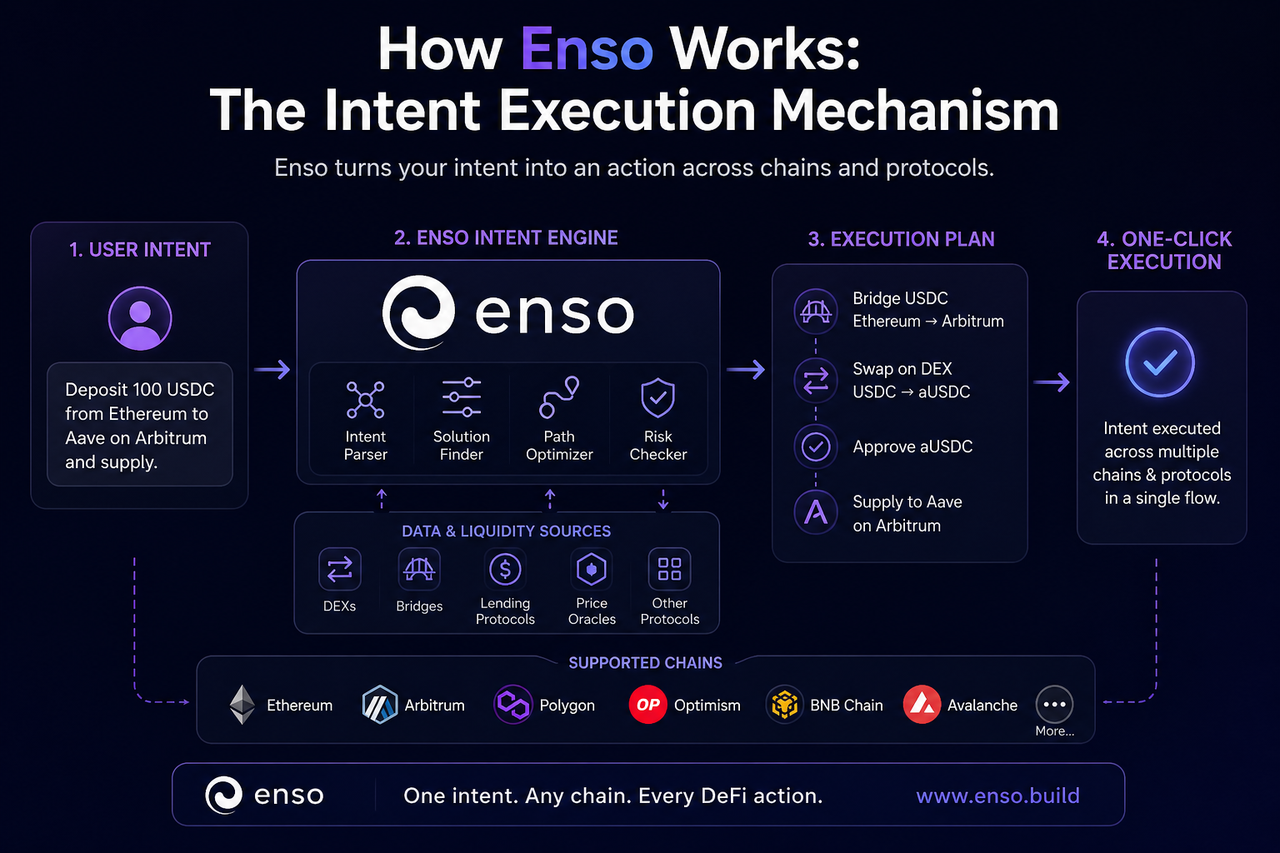
Enso leverages this mechanism to transform complex on-chain interactions into automated execution flows. It generates the optimal route in the background and orchestrates interactions across multiple protocols, enabling users to accomplish tasks that would normally require several trades with a single action. This significantly reduces the complexity of multi-chain DeFi usage.
How Does Enso’s Execution Process Work?
Enso’s execution process consists of three main stages: user goal submission, system path generation, and on-chain execution. First, the user submits a clear objective, such as transferring a specific asset to a target chain and participating in a protocol. Next, Enso automatically decomposes the task, selecting the most suitable bridge, swap path, and protocol interaction strategy.
Once the path is planned, the system consolidates all steps into a single on-chain execution task. Users no longer have to manually operate multiple protocols to complete complex transactions. This automated approach reduces intermediary steps and improves trade efficiency.
Why Is the Intent Execution Mechanism More Efficient Than Traditional Aggregators?
Traditional aggregators focus primarily on optimizing trade routes, aiming for the best swap prices, but they cannot handle complex cross-protocol operations. Users must still manually execute multiple steps for cross-chain or protocol interactions.
Enso’s Intent execution mechanism extends beyond path optimization to full task automation, seamlessly handling cross-chain bridging, protocol interactions, and multi-step task integration. This reduces the number of user actions required and enables developers to implement sophisticated features more efficiently, making it ideal for multi-chain DeFi environments.
What Value Does Enso’s Intent Execution Bring to DeFi?
Enso’s execution mechanism delivers substantial value to DeFi by transforming complex operations into a streamlined experience. For users, this means cross-chain and protocol interactions no longer require manual, step-by-step completion—lowering entry barriers. For developers, it reduces the need for intricate backend logic, accelerating the development of automated products.
As DeFi scenarios become increasingly complex, execution efficiency and automation are emerging as key competitive advantages. Enso’s Intent execution mechanism empowers protocols to offer highly efficient, one-stop on-chain services, establishing its significance within multi-chain infrastructure.
Summary
Enso’s Intent execution mechanism integrates complex multi-chain DeFi operations into a single transaction by automating task decomposition, path planning, and on-chain execution. Compared to traditional aggregators, this approach not only optimizes transaction routes but also delivers full task automation, enabling both users and developers to engage with multi-chain DeFi more efficiently.
As DeFi evolves toward greater automation and modularity, the importance of Intent execution mechanisms continues to grow. As a leading infrastructure project in this domain, Enso is driving the evolution of DeFi interactions toward simplicity and higher efficiency.
FAQs
What does Enso’s Intent Execution Mechanism mean?
Enso’s Intent execution mechanism is an automated system where users simply state their goals, and the platform automatically plans the route and completes cross-chain, swap, and protocol interactions.
How does Enso simplify multi-chain DeFi operations?
Enso consolidates cross-chain bridging, asset swapping, and protocol interactions into a single execution workflow, reducing manual steps for users and enhancing both efficiency and user experience.
What distinguishes Enso from traditional aggregators?
Traditional aggregators only optimize transaction routes, while Enso optimizes routes and automates entire tasks—including cross-chain and multi-protocol interactions.
Why is the Intent Execution Mechanism important?
As multi-chain DeFi operations become increasingly complex, the Intent execution mechanism reduces development complexity and improves user experience, making it a critical foundation for DeFi automation.