As blockchain technology moves into enterprise finance, supply chain collaboration, and real-world asset digitization, traditional high-energy, low-throughput consensus mechanisms are struggling to meet institutional requirements. XDPoS is specifically designed to lower transaction costs, increase confirmation efficiency, and enhance network stability, making it a core technology for powering XDC Network in trade finance and cross-border payment infrastructure.
What Is a Blockchain Consensus Mechanism?
A blockchain consensus mechanism defines the foundational rules that allow distributed networks to verify transaction authenticity and maintain ledger consistency. Since there is no centralized server in blockchain systems, network nodes must use consensus mechanisms to collectively determine which transactions are valid and which blocks are added on-chain.
Different public blockchains use different consensus approaches. For instance, Bitcoin employs Proof of Work (PoW), Ethereum currently uses Proof of Stake (PoS), and some enterprise blockchains implement BFT or DPoS variants to boost performance.
Consensus mechanisms directly impact network security, transaction speed, decentralization, and operational costs, making them a key metric for evaluating public blockchain technology.
How Does XDPoS Work?
XDPoS is an enhanced version of Delegated Proof of Stake (DPoS). In this model, the network elects a set number of validator nodes responsible for block production and transaction validation.
Nodes must stake a specific amount of XDC to participate in the validation process. Some nodes earn validator status through community voting or delegation and actively participate in ongoing block production.
When a user initiates a transaction, validator nodes first verify the transaction’s signature, balance, and Gas fee. Once validated, the transaction is packaged into a new block and confirmed by other validators.
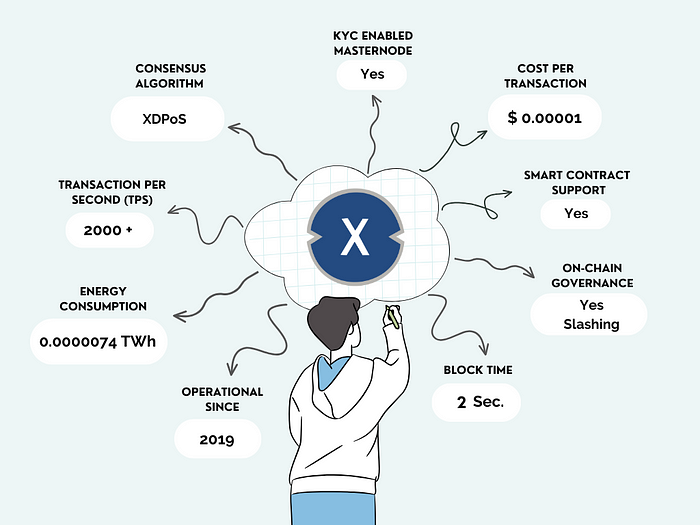
Unlike traditional PoW, XDPoS eliminates the need for energy-intensive computation, reducing both energy usage and transaction costs. It also achieves shorter block confirmation times, making it ideal for high-frequency payments and enterprise financial environments.
How Is XDPoS Different from Traditional DPoS?
While XDPoS is built on the DPoS framework, it incorporates enterprise-grade performance improvements and robust security features.
Conventional DPoS networks focus on high throughput and community governance, while XDPoS places greater emphasis on financial stability, rapid finality, and efficient node coordination. The integration of Byzantine Fault Tolerance (BFT) enhances resilience against malicious actors.
Additionally, XDPoS optimizes block confirmation logic and network synchronization to better suit enterprise needs, including trade finance, cross-border payments, and other applications that require stable transaction confirmation.
| Comparison Dimension |
DPoS |
XDPoS |
| Core Objective |
High Throughput |
Enterprise Performance |
| BFT Support |
Partial |
Enhanced |
| Finality |
Fast |
Faster |
| Enterprise Compatibility |
Moderate |
Strong |
| Application Area |
General Public Chain |
Enterprise Finance / Real World Assets (RWA) |
What Is the Role of Validator Nodes in XDPoS?
Validator nodes anchor the XDPoS network, maintaining ledger integrity and ensuring network security.
These nodes must run a full network client and remain online to validate transactions and produce blocks. Core responsibilities include:
- Validating user transactions
- Creating new blocks
- Broadcasting block data
- Maintaining network synchronization
- Participating in BFT consensus
Nodes that behave abnormally or remain offline risk losing validator status or facing network penalties.
Compared to open mining models, XDPoS operates with fewer validator nodes, which streamlines network efficiency. However, this also raises expectations for node quality and governance.
How Does XDPoS Achieve Fast Transaction Confirmation?
Rapid transaction finality is a hallmark of XDPoS.
Traditional PoW networks require multiple block confirmations to secure transactions due to the risk of on-chain forks. XDPoS leverages BFT to minimize fork risk, dramatically improving transaction finality.
Once a new block is created, validators quickly reach consensus, confirming the block’s validity. After confirmation, transactions are generally difficult to roll back.
This is especially valuable for cross-border payments, supply chain finance, and institutional settlements, where businesses demand certainty and fast settlement times.
Why Is XDPoS a Strong Fit for Enterprise Financial Applications?
Enterprise financial systems prioritize:
- Transaction confirmation speed
- Network stability
- Cost predictability
- Data consistency
- Compliance and privacy support
XDPoS is engineered to meet these demands.
With fewer validator nodes, the network maintains high performance and low latency. Low Gas fees further reduce enterprise batch settlement and on-chain data processing costs.
For trade finance, cross-border payments, and RWA scenarios, transaction efficiency and system stability often outweigh extreme decentralization, positioning XDPoS as purpose-built enterprise blockchain infrastructure.
How Does XDPoS Compare to PoW and PoS?
XDPoS, PoW, and PoS are all consensus mechanisms, but their operational models differ:
- PoW depends on hash power competition among miners, offering strong security but high energy use and limited throughput.
- PoS relies on token staking for network validation, reducing energy consumption and improving performance.
- XDPoS builds on PoS with delegation and BFT consensus, further enhancing confirmation speed and network coordination.
| --- | --- | --- | --- |
| Energy Consumption | High | Low | Low |
| Block Confirmation Speed | Slow | Fast | Faster |
| Validation Method | Hash Power Competition | Staking | Delegation + Staking |
| Enterprise Adaptability | Moderate | Strong | Strong |
| Example Network | Bitcoin | Ethereum | XDC |
What Are XDPoS’s Potential Limitations?
Despite its performance advantages, XDPoS has some debated limitations.
Because it uses fewer validator nodes than large public chains, some critics see it as less decentralized. The validator governance model can also influence power dynamics within the network.
Additionally, compared with major networks like Ethereum, XDC Network’s developer ecosystem and application scale are still expanding, so XDPoS’s long-term competitiveness is closely linked to network adoption.
Conclusion
XDPoS is the cornerstone consensus mechanism of XDC Network, combining Delegated Proof of Stake (DPoS) and Byzantine Fault Tolerance (BFT) to deliver rapid transaction confirmation, low operating costs, and enterprise-grade blockchain performance.
Compared to PoW networks, XDPoS is better suited for trade finance, cross-border payments, and real-world asset (RWA) applications that require efficiency and stability. Its low energy use, high throughput, and EVM compatibility set XDC Network apart in enterprise blockchain infrastructure.
As institutional finance and the RWA sector continue to grow, XDPoS stands out as a leading consensus mechanism for enterprise public blockchains.
FAQs
What Does XDPoS Stand For?
XDPoS stands for XinFin Delegated Proof of Stake, the consensus algorithm powering XDC Network.
Is XDPoS Considered PoS?
Yes. XDPoS is built on the PoS architecture and further enhanced with delegation and BFT consensus.
Why Is XDPoS Faster?
With fewer validator nodes and the use of BFT, XDPoS achieves quicker transaction confirmation and block finality.
Does XDPoS Support Smart Contracts?
Yes. XDC Network is fully EVM-compatible and supports Solidity smart contracts.
How Does XDPoS Differ from Ethereum PoS?
Ethereum PoS prioritizes ecosystem openness and decentralization, while XDPoS is tailored for enterprise performance and rapid transaction confirmation.
Is XDPoS Energy Efficient?
Yes. XDPoS eliminates PoW mining, resulting in significantly lower energy consumption than traditional mining networks.
What Are the Primary Use Cases for XDPoS?
XDPoS is mainly deployed in trade finance, cross-border payments, supply chain finance, real-world asset (RWA), and enterprise blockchain applications.







