In Layer2 networks, tokens do more than facilitate payments. They also play a central role in resource allocation and governance design. Whether users are executing transactions, interacting with protocols, or providing liquidity, tokens are deeply embedded in these processes, making them essential to understanding how the network operates.
This topic generally involves three key dimensions: fee mechanisms, incentive structures, and governance systems. Together, they define how MNT functions within the Mantle ecosystem.
What Is the MNT Token
MNT can be understood as the native utility token of the Mantle network, designed to link network usage with economic incentives.
Mechanically, MNT is used to pay transaction fees, participate in governance voting, and support ecosystem incentives. Nearly every interaction on the network involves the use or circulation of MNT.
Structurally, MNT is not just a payment token. It also acts as a medium for value transfer and governance, making it an integral part of the system rather than an optional asset.
This positioning allows Mantle to operate as a token-driven economic system, where technical infrastructure and financial incentives are closely aligned.
How MNT Is Used for Transaction Fees
Transaction fees are the most direct use case for MNT.
Mechanically, users pay Gas fees in MNT when submitting transactions on the Mantle network. These fees compensate for execution layer resources, including computation, storage, and bandwidth.
Structurally, the fee model is similar to Ethereum. However, because Mantle processes transactions on Layer2 and uses an independent data availability layer, overall costs are typically lower. Fees vary depending on transaction complexity and network conditions.
This mechanism helps regulate resource usage while ensuring the network remains stable and economically sustainable.
How Incentive Mechanisms Drive the Network
Incentives determine participation levels and long-term sustainability.
Mechanically, MNT is used to reward network participants, including infrastructure providers, ecosystem projects, and contributors. These rewards are typically funded through transaction fees or ecosystem treasury allocations.
Structurally, the incentive system aligns with Mantle’s modular architecture, allowing different roles to be rewarded based on their contributions. For example, execution layer participants and application developers occupy different positions within the reward structure.
This design encourages broader participation, increasing both network activity and functional diversity.
What Role MNT Plays in Governance
Governance gives MNT its role as a decision-making tool.
Mechanically, MNT holders can vote on proposals related to protocol upgrades, parameter adjustments, and fund allocation. These decisions are typically executed through on-chain governance processes.
Structurally, governance often follows a DAO model, where voting power is proportional to token holdings. This distributes decision-making authority across the community rather than centralizing it.
This mechanism enables Mantle to evolve over time in a decentralized and transparent manner.
How the Treasury Works in Mantle
The Treasury is a central component of Mantle’s ecosystem funding structure.
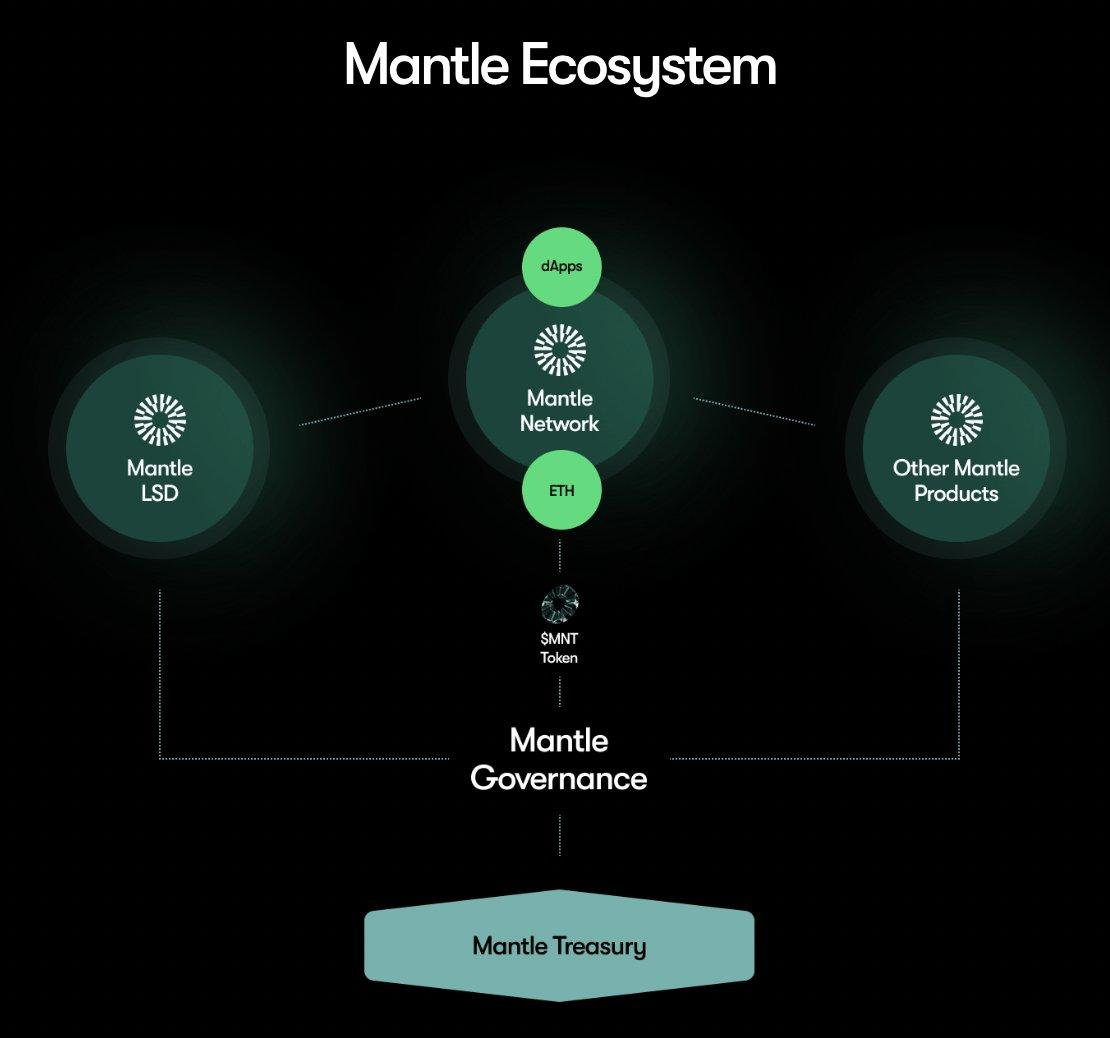
Mechanically, the Treasury is controlled by the community and used to fund ecosystem development, grants, and long-term initiatives. Its resources come from token allocations and network-generated revenue.
Structurally, the Treasury is closely tied to the governance system. Funding decisions typically require voting approval, ensuring transparency and accountability.
| Component |
Function |
| Treasury Pool |
Stores ecosystem funds |
| Governance Mechanism |
Determines fund allocation |
| Funded Projects |
Supports ecosystem growth |
| Revenue Sources |
Fees and token allocations |
This structure ensures continuous funding for ecosystem expansion while reducing the risk of centralized control.
MNT Supply and Distribution Model
MNT’s supply structure plays a key role in its economic design and long-term incentives.
Mechanically, MNT has a fixed total supply of 6,219,316,795 tokens, derived from Mantle’s initial allocation and ecosystem integration.
Structurally, a significant portion of tokens is allocated to community governance and ecosystem development, with the Mantle Treasury holding a dominant share to support long-term growth and capital allocation.
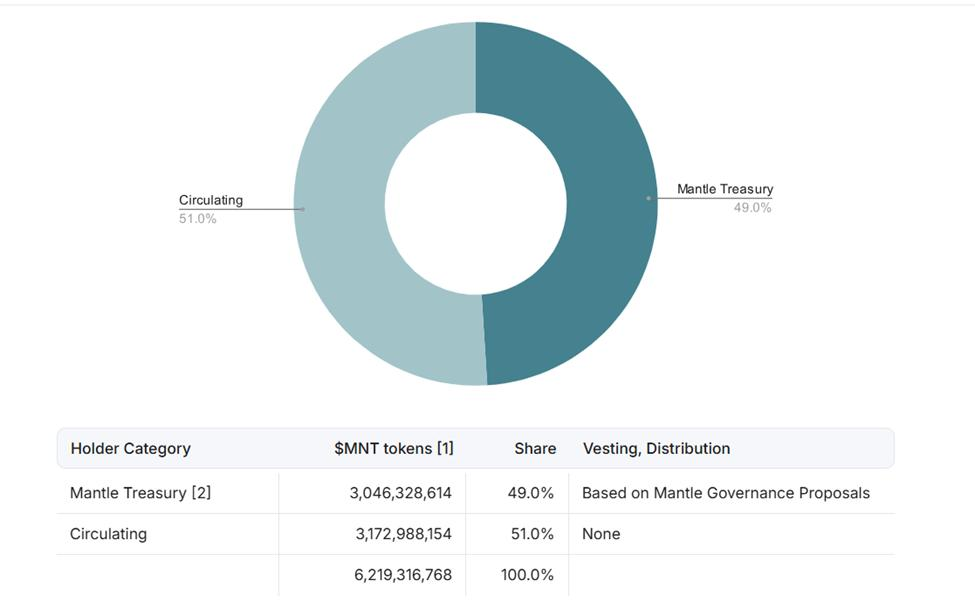
This allocation approach centralizes resources within the Treasury, allowing them to be distributed dynamically through governance rather than released all at once.
Use Cases of MNT Within the Ecosystem
MNT is used across multiple layers of the ecosystem.
Mechanically, beyond transaction fees, the token is involved in DeFi activities, liquidity provision, and protocol interactions. It can serve as a medium of exchange or as an incentive asset in lending, trading, and yield strategies.
Structurally, MNT flows between users, applications, and infrastructure, connecting different parts of the ecosystem into a coordinated system.
This multi-purpose design increases both the utility of the token and overall ecosystem engagement.
Conclusion
Through its roles in fee payment, incentive distribution, and governance participation, combined with a Treasury-centered allocation model, MNT forms the backbone of Mantle’s economic system.
FAQ
What is the total supply of MNT?
The total supply is approximately 6.22 billion tokens, based on a fixed supply model.
Where is most of the MNT allocated?
A large portion is allocated to the Mantle Treasury, which supports ecosystem development and governance funding.
Is MNT inflationary?
The current design is based on a fixed supply, with circulation managed through allocation and release mechanisms.
How can users obtain MNT?
Users can acquire MNT through trading, participating in ecosystem activities, or receiving incentives.
How is MNT used in DeFi?
It can be used for liquidity provision, collateral in lending, and as rewards within various DeFi protocols.