Exchange tokens are fundamental to the crypto trading platform ecosystem, typically serving roles such as trading fee discounts, user incentives, governance, and on-chain utility. As the crypto industry evolves from centralized exchanges to public chains, Layer2 solutions, and Web3 infrastructure, the function of exchange tokens is also continually transforming.
OKB, BNB, and GT are currently three of the most prominent exchange tokens on the market. Although all three are assets within trading platform ecosystems, they differ significantly in terms of on-chain positioning, ecosystem expansion strategies, tokenomics, and real-world applications.
Overview of OKB, BNB, and GT
OKB, the exchange token for the OKX ecosystem, is primarily used for trading fee discounts, ecosystem incentives, on-chain services, and Web3 applications. As OKX expands into Layer2 and Web3 infrastructure, OKB’s use cases now extend across wallets, on-chain interactions, and ecosystem collaboration.
BNB was originally introduced by the Binance ecosystem, initially serving as a trading fee discount token. With the development of BNB Chain, BNB has evolved into a core gas asset and the foundational token for its public chain ecosystem.
GT (GateToken) is the exchange token within the Gate ecosystem, used for trading fee reductions, VIP privileges, on-chain ecosystem participation, and specific functions on the GateChain network. GT acts as both a trading platform asset and an on-chain ecosystem asset.
While all three are exchange tokens, their roles have expanded from simple “platform credit systems” to encompass on-chain infrastructure and Web3 applications.
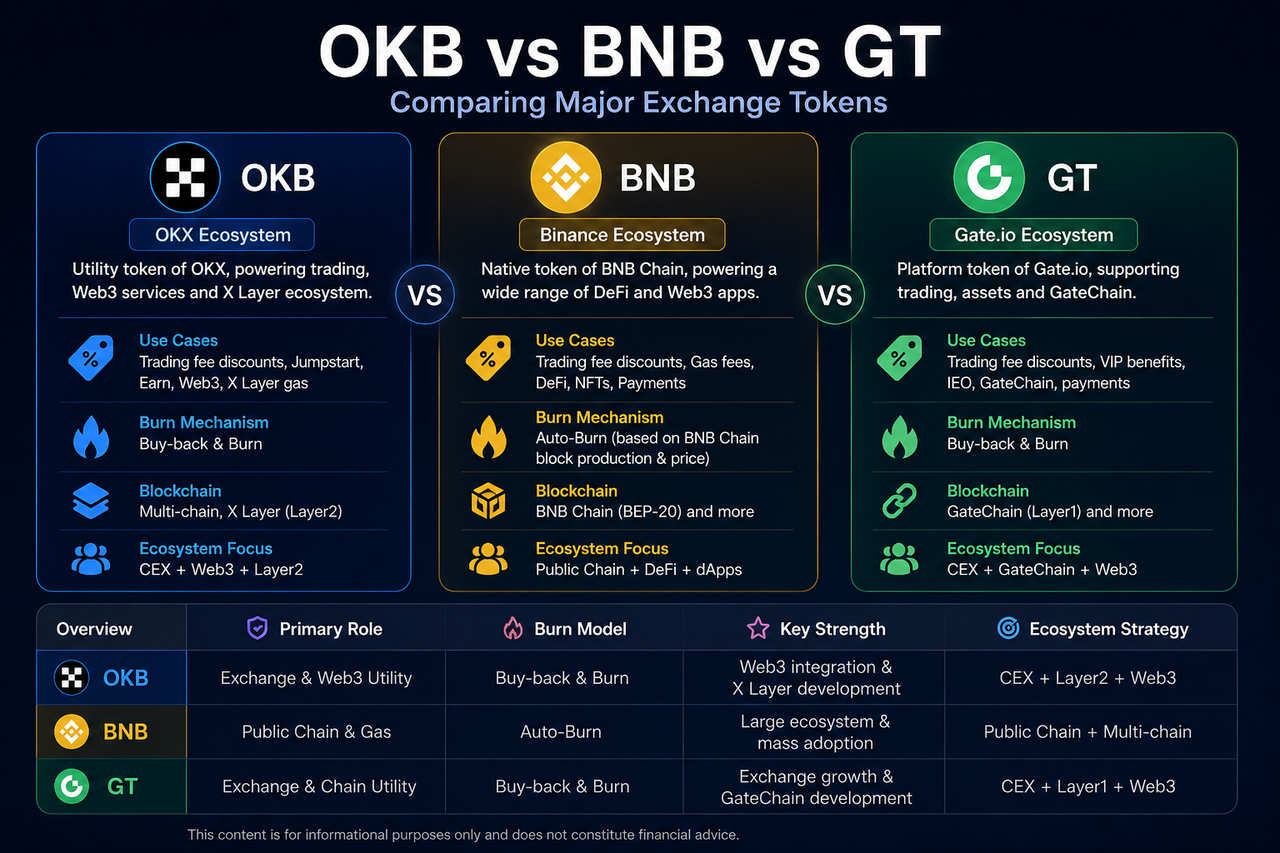
How Do the Core Use Cases of OKB, BNB, and GT Differ?
All three exchange tokens offer trading fee discounts, but their ecosystem utilities are distinctly different.
OKB places a strong emphasis on the synergy between the trading platform and Web3 services. For instance, OKB is used for trading fee tiers, Jumpstart, Earn products, and X Layer ecosystem scenarios.
BNB’s use cases are more focused on the public chain ecosystem. Beyond trading discounts, BNB is the core gas asset for the BNB Chain network and is widely used in on-chain trading, DeFi, and NFT applications.
GT’s ecosystem is centered around Gate and GateChain, with typical use cases including platform equity, on-chain asset management, and select ecosystem services.
| Exchange Token |
Core Ecosystem |
Main Use Cases |
On-Chain Positioning |
| OKB |
OKX |
Trading Fees, Web3, X Layer |
Ecosystem Coordination Asset |
| BNB |
Binance |
Gas, DeFi, Trading |
Core Public Chain Asset |
| GT |
Gate |
Platform Equity, GateChain |
Platform + On-Chain Asset |
How Do the Burn Mechanisms of OKB, BNB, and GT Differ?
The burn mechanism is a key element of exchange token tokenomics, designed to reduce circulating supply.
OKB uses a long-term buy-back and burn model, where the platform periodically repurchases and destroys a portion of tokens.
\$\$S_{t+1}=S_t-B_t \$\$
BNB implements an auto-burn mechanism, with the burn amount generally linked to on-chain activity and market conditions.
GT also follows a buy-back and burn model, reducing circulating supply and supporting long-term ecosystem sustainability.
While all three utilize deflationary models, their specific mechanisms and underlying ecosystem logic differ. Some exchange tokens are more dependent on on-chain activity, while others prioritize platform business growth and ecosystem expansion.
On-Chain Ecosystem Differences Among OKB, BNB, and GT
BNB’s role in the on-chain ecosystem is the most prominent. As BNB Chain has grown, BNB has become a foundational asset across DeFi, GameFi, NFT, and multi-chain applications.
OKB’s on-chain expansion is largely driven by the OKX Web3 strategy and X Layer, with a focus on integrating the centralized trading platform, wallet, and Layer2 networks.
GT’s on-chain ecosystem is primarily based on GateChain, which prioritizes digital asset security, asset management, and on-chain transfers.
What Differentiates the Value Logic of OKB, BNB, and GT?
The value proposition of exchange tokens is typically linked to user base, trading activity, ecosystem expansion capability, and on-chain application scenarios.
BNB’s value is largely derived from public chain ecosystem demand, including gas utility, DeFi applications, and on-chain interactions.
OKB’s value structure is closely tied to trading platform services, Web3 products, and Layer2 ecosystem integration.
GT’s value logic is more aligned with the growth of the Gate ecosystem and GateChain network applications.
What Common Risks Do Exchange Tokens Share?
Despite differences in ecosystem structure, exchange tokens share several common risks.
First, exchange tokens are closely tied to trading platform operations, so changes in platform management, market cycles, or regulatory environments can impact their ecosystems.
Second, exchange tokens are often highly volatile, with market performance easily influenced by industry sentiment and on-chain activity.
Additionally, as Web3 and DeFi ecosystems continue to advance, exchange tokens face increasing competition from native public chain assets and new protocol tokens.
Summary
While OKB, BNB, and GT are all exchange tokens, their development paths and ecosystem structures have clearly diverged.
BNB places greater emphasis on public chains and on-chain infrastructure; OKB focuses on trading platforms, Layer2, and Web3 integration; GT centers on the trading platform ecosystem and GateChain network.
As the crypto industry shifts from centralized trading to multi-chain ecosystems and Web3 infrastructure, exchange tokens are evolving from “trading discount tools” to “ecosystem assets.” The differences among exchange tokens fundamentally reflect the strategic direction and ecosystem layout of different trading platforms in the Web3 era.
FAQs
Why is BNB often considered a public chain token?
Because BNB is the core gas asset of BNB Chain and is widely used for on-chain trading and DeFi applications.
What are the main use cases for OKB?
OKB is mainly used for trading fee discounts, Jumpstart, Web3 services, and the X Layer ecosystem.
What is the relationship between GT and GateChain?
GT is the exchange token within the Gate ecosystem and is directly linked to the GateChain network.
Why do exchange tokens have burn mechanisms?
Platforms use buy-back and burn mechanisms to reduce circulating supply, establishing a deflationary model and supporting the ecosystem cycle for exchange tokens.
Are exchange tokens classified as DeFi assets?
Exchange tokens are essentially assets within trading platform ecosystems, but some have expanded into DeFi and on-chain ecosystem scenarios.







