As the DeFi market evolves, more blockchain protocols are adopting community governance models. Unlike traditional internet platforms where companies make centralized decisions, decentralized protocols emphasize the joint participation of users, developers, and liquidity providers in governance. In this context, governance tokens have become a core element of DeFi protocols, serving to align community interests and guide protocol development.
As one of the most prominent decentralized trading protocols in DeFi, Uniswap has built an on-chain governance framework through UNI. UNI not only influences protocol upgrades and parameter changes but also stands as a landmark example of DeFi governance. As Uniswap’s impact on the on-chain liquidity market grows, UNI’s governance mechanism has become a key reference point for understanding how decentralized autonomous organizations (DAOs) operate.
What Is UNI?
UNI is the governance token of the Uniswap protocol, primarily used for community governance and protocol decision-making. Holders of UNI can engage in proposal discussions, on-chain voting, and protocol upgrades as part of the governance process.
UNI was launched in 2020 and distributed to early protocol users via airdrop, a model that strengthened community engagement and advanced decentralized governance.
Unlike most exchange tokens, which are typically used for trading fee payments or discounts, UNI is focused on governance rights rather than direct financial returns.
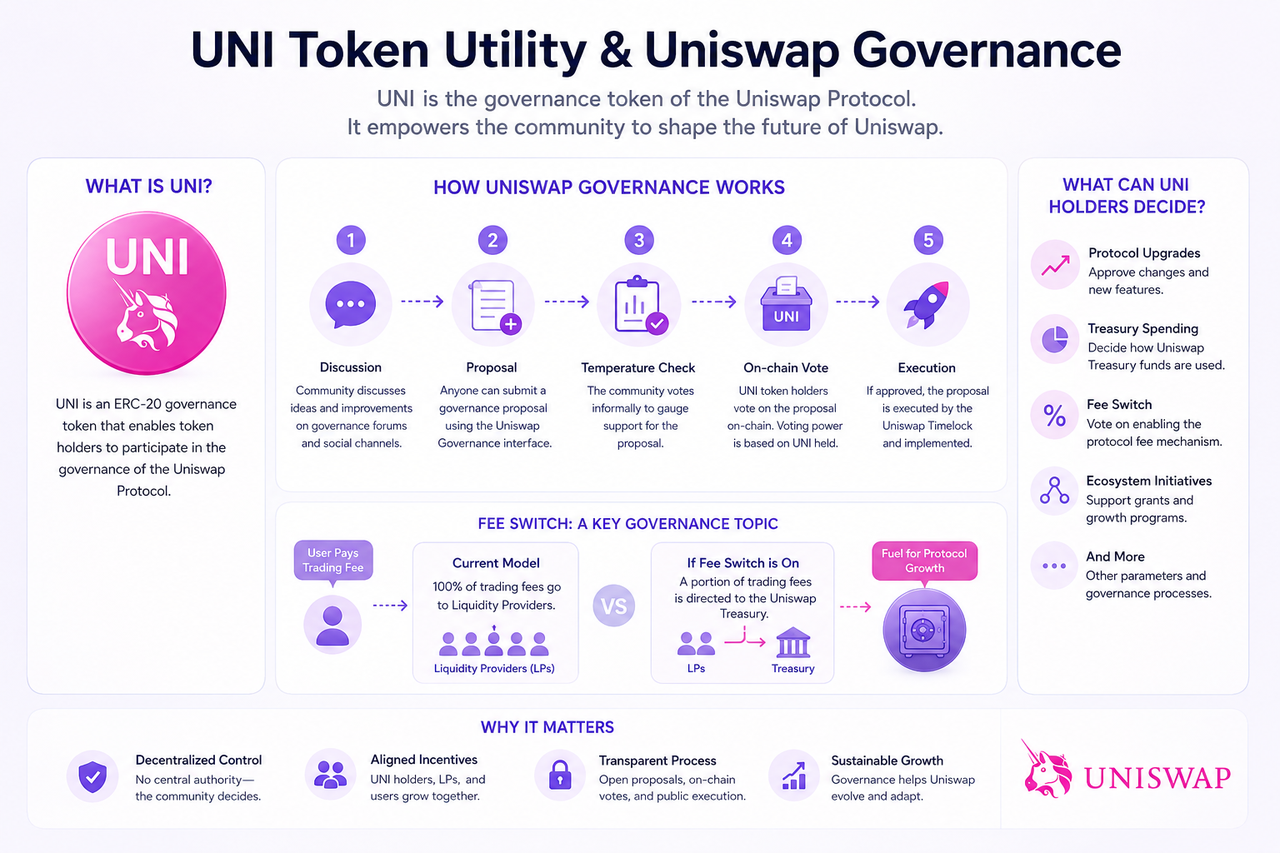
How Does UNI’s Governance Mechanism Work?
Uniswap’s governance operates through an on-chain proposal and voting system. UNI holders can submit governance proposals and vote on critical changes to the protocol.
The governance process generally includes:
- Community discussion
- Proposal submission
- Temperature check vote
- On-chain formal vote
- Proposal execution
Once a proposal receives sufficient support, related protocol upgrades or parameter changes are automatically executed via Smart Contracts.
This governance model enables Uniswap to evolve continuously without the need for centralized management.
What Decisions Can UNI Holders Make?
UNI holders participate in several major governance topics, including:
- Protocol upgrades
- Liquidity incentive programs
- Treasury fund allocation
- Layer2 deployment decisions
- Governance structure adjustments
- Fee Switch discussions
Fee Switch is one of the community’s most closely watched topics. This mechanism concerns whether a portion of trading fees should be allocated to the protocol or governance system, making it a central issue in DeFi governance discussions.
What Is Fee Switch?
Fee Switch is a potential feature in Uniswap’s governance system that determines whether to activate the “protocol fee” mechanism.
Currently, most trading fees go to liquidity providers (LPs). The core idea of Fee Switch is that the protocol could take a portion of trading fees for the Treasury or to support the governance ecosystem.
Supporters argue that this mechanism could enhance the protocol’s sustainability, while critics are concerned it might disrupt LP incentives and market liquidity.
Because it affects the protocol’s economic model, Fee Switch remains a central topic in UNI governance.
How Does UNI Differ from Exchange Tokens?
UNI is fundamentally different from traditional centralized exchange tokens.
Most exchange tokens are used for trading fee discounts, platform privileges, and buyback-and-burn programs. In contrast, UNI centers on protocol governance and community decision-making. Its value derives mainly from governance rights and ecosystem influence—not from a centralized platform’s business model.
This contrast highlights the structural differences between DeFi and traditional crypto platforms.
What Is UNI’s Significance in DeFi Governance?
UNI’s introduction has propelled the development of DeFi governance systems. Through on-chain governance, protocol upgrades and critical decisions no longer depend on a single company but are increasingly managed by the community.
This approach has influenced a wide range of subsequent protocols, including lending platforms, stablecoin protocols, and on-chain infrastructure projects, all of which have adopted governance token models.
Summary
UNI is not only Uniswap’s governance token but also a symbol of DeFi protocols’ shift toward community governance. Through on-chain proposals and voting, UNI holders can participate in key decisions on protocol upgrades, fund management, and ecosystem development.
As Uniswap’s presence in the on-chain liquidity market continues to expand, UNI’s governance structure is shaping the design of other DeFi protocols and driving the further evolution of decentralized governance.
FAQs
What are the uses of the UNI token?
UNI is primarily used for Uniswap protocol governance, including proposals, voting, and protocol upgrade decisions.
Can UNI be used to pay trading fees?
UNI’s main function is governance, not payment of trading fees.
What is Uniswap Governance?
Uniswap Governance is an on-chain system based on UNI, used to decide protocol upgrades and community proposals.
What is Fee Switch?
Fee Switch is a potential protocol fee mechanism that determines whether a portion of trading fees will be allocated to the protocol Treasury.
How is UNI different from exchange tokens?
UNI is focused on governance rights and community decision-making, while traditional exchange tokens typically emphasize trading benefits and platform operations.
Does UNI represent Uniswap equity?
UNI does not represent company equity; its primary function is participation in protocol governance.