The role of the META token usually centers on three key questions: how it participates in governance, whether the token has a fixed supply cap, and how issuance and Treasury execution are constrained by the market.
This can be understood from six angles: governance functions, issuance process, supply structure, Treasury management, decision markets, and governance incentives. Among them, the Futarchy mechanism is what sets the META token model apart from traditional DAO tokens.
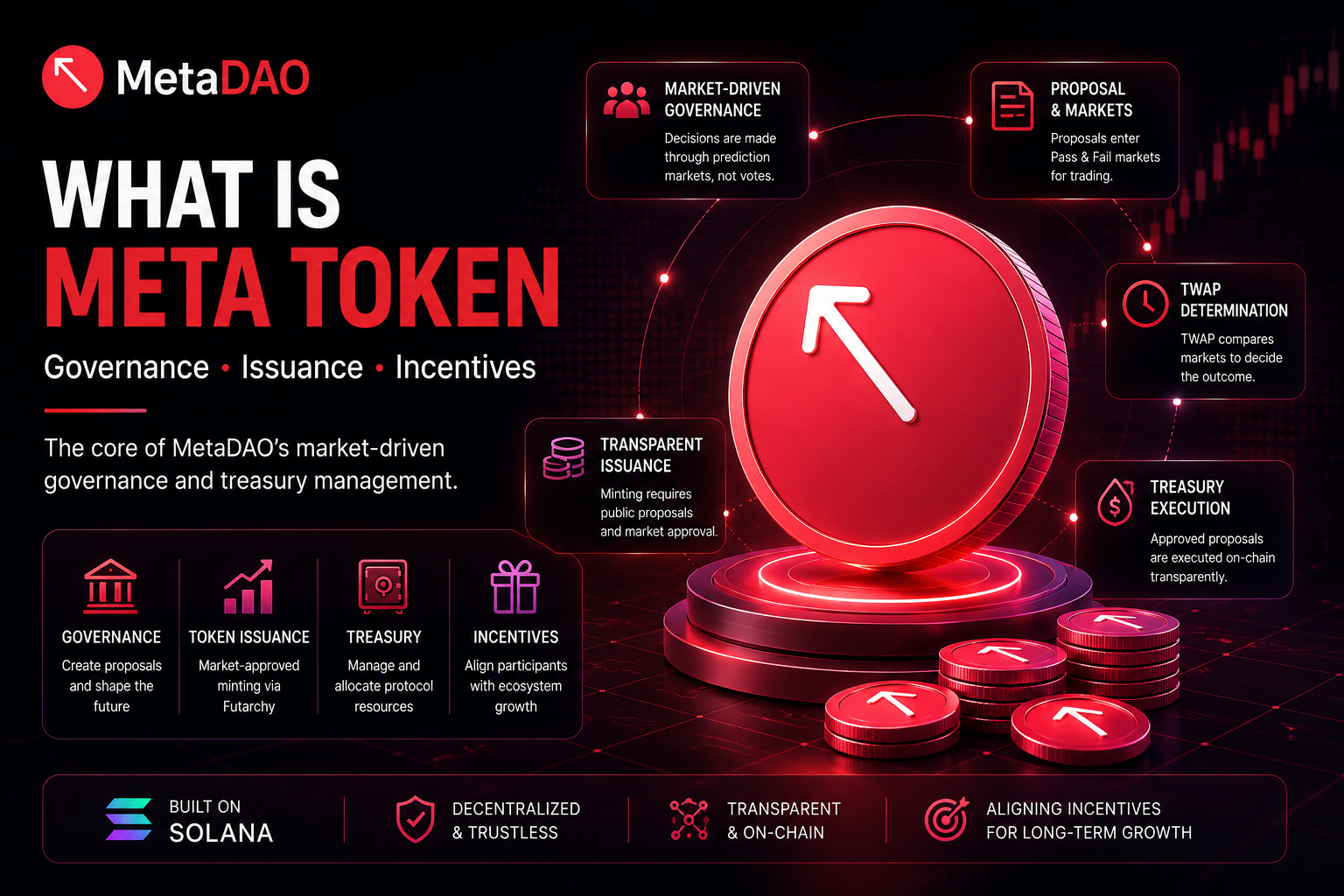
The META token serves governance and utility functions within the MetaDAO protocol. It can be understood as the core asset that connects decision markets, Treasury management, and protocol control. The official documentation defines META as MetaDAO’s governance and utility token, and explains that its token page covers supply, allocation, and issuance mechanisms.
Structurally, META is not just a DAO token used for ordinary voting. First, users can create proposals related to the protocol or Treasury. The proposal then enters the staking and decision market process. Next, the market forms price signals through trading in Proposal Pass and Proposal Fail markets. Finally, the governance program executes or rejects the proposal based on the market result.
The importance of this design is that META’s governance function is tied to market judgment. Compared with traditional governance tokens, META’s value does not come only from token holder voting rights. It also comes from its role in Futarchy based decision making, Treasury control, and token issuance.
META’s core governance function is to have proposals evaluated through a market based process, rather than relying simply on token holder voting. The key point is that governance participants need to express judgment through proposals, staking, and trading.
In the specific process, users can first create governance proposals involving protocol resources, fund usage, or token issuance. The proposal then needs to receive a certain amount of META staked before it can enter the market trading stage. Next, traders buy and sell in conditional markets, using prices to express their judgment about the proposal’s impact on value. Finally, the system decides whether to execute the proposal based on the market result.
The effect of this mechanism is that governance participation is no longer just a low cost expression of opinion. It becomes a judgment process with economic constraints. The official documentation explains that MetaDAO’s Futarchy governance emphasizes “Vote on values, bet on beliefs,” meaning the community decides the goals, while the market judges the path to achieve them.
The META issuance mechanism essentially depends on governance proposals and decision markets, rather than automatic inflation or free minting by the team. It can be understood as a token issuance process controlled by market approval.
In practice, anyone can first create a proposal that includes new issuance, publicly specifying the mint amount, recipient address, and purpose. The proposal then needs to receive 200,000 META staked before it can enter the conditional market trading stage. Next, the market enters a three day trading period, during which traders express their judgment in the Pass and Fail markets. Finally, if the TWAP of the Pass market is higher than the TWAP of the Fail market, the tokens are minted and sent to the address specified in the proposal.
| Process Stage |
User Action |
System Action |
Result |
| Create proposal |
Submit an issuance plan |
Publicly record proposal details |
Specify amount and purpose |
| Stake support |
Stake META |
Check launch requirements |
Filter invalid proposals |
| Market trading |
Trade Pass or Fail |
Form price signals |
Assess the impact of issuance |
| TWAP finalization |
Wait for market result |
Compare average prices |
Decide whether to execute |
| On chain execution |
View the result |
Governance program mints tokens |
Complete or reject issuance |
This table shows that META issuance is not a hidden action. It is a public, tradable, and verifiable on chain governance process.
The core way META participates in Treasury management is by using proposals and decision markets to decide whether funds should be used. In other words, Treasury spending authority is placed within the Futarchy governance framework, rather than controlled directly by a single team.
Structurally, users can first submit proposals involving the Treasury, such as fund spending, liquidity adjustments, token issuance, or ecosystem support. The proposal then enters the staking stage. Next, conditional market traders judge whether the proposal will increase protocol value. Finally, if the market result supports the proposal, the governance execution program completes the on chain operation according to the public proposal content.
The importance of this mechanism is that it shifts Treasury management from “who has voting power” to “whether the market recognizes this use of funds.” The official documentation notes that proposals can be used for Treasury spending, issuing new tokens, updating metadata, or adjusting liquidity provided by the Treasury.
META’s supply structure has one core feature: there is no token program level hard cap, but there is also no automatic inflation or hidden issuance. The official documentation states that META does not have a hard cap enforced by the token contract, and that mint authority is controlled by the governance program rather than a human operator.
Mechanically, META’s initial supply is 10 million tokens and was launched through a fair issuance mechanism. Any later increase in supply must be initiated through a governance proposal. Next, all issuance details must be publicly displayed and go through Futarchy conditional market trading. Finally, tokens are minted only when the market determines that the issuance would benefit protocol value.
The impact of this supply design is that META does not follow a fixed total supply model. Instead, it uses a governance constrained issuance model. This gives the protocol flexibility for financing and operations, but it also requires the market mechanism to effectively constrain unreasonable issuance.
The META token model affects governance incentives mainly in three ways: market trading involves risk, new issuance requires public approval, and Treasury execution depends on market judgment. The key point is that governance participants must take part in decision making through price based judgment, rather than only expressing preferences through voting.
In the governance process, proposal creators first need to publicly explain their plans. Token holders then stake META to allow the proposal to enter the market. Next, traders take on price risk in the Pass and Fail markets. Finally, the market result determines proposal execution and affects the Treasury, supply structure, and protocol resource allocation.
The importance of this incentive structure is that it shifts governance from “costless expression” to “costly judgment.” If participants judge incorrectly, they may face trading losses. If they judge accurately, they may earn market returns. As a result, META’s governance model places more emphasis on information discovery and economic responsibility than on token holding weight alone.
Conclusion
The META token serves functions in MetaDAO such as governance participation, Treasury management, token issuance control, and market incentives. Its core process includes creating proposals, staking META, entering conditional markets, finalizing results through TWAP, and completing on chain execution through the governance program.
Overall, META is not a traditional fixed supply governance token. It is a governance asset tied to Futarchy decision markets. Changes in supply, fund usage, and protocol control all need to go through public proposals and market trading processes.
FAQs
The META token is mainly used for MetaDAO governance, Treasury management, proposal staking, decision market participation, and token issuance control. It is the core functional asset in the Futarchy governance mechanism.
META does not have a fixed hard cap at the token contract level, but it does not have automatic inflation. All new issuance must go through a public proposal and be approved by Futarchy decision markets.
Issuance first requires a public proposal, followed by 200,000 META staked support. The proposal then enters a three day conditional market trading period, and TWAP ultimately determines whether minting is executed.
Proposals involving Treasury spending, liquidity adjustments, or resource allocation must go through decision markets. If the market judges the proposal to be beneficial, the governance program executes the on chain operation according to the public proposal content.
Ordinary DAO tokens are mostly used for voting, while META places greater emphasis on market based governance. Proposal outcomes are judged by Pass and Fail market prices, and participants need to take on trading risk.