Lighter Launches the LIT Token: Mixed Reactions from the DeFi Community and Price Performance Analysis
Overview of Lighter and LIT
Source: https://lighter.xyz/
Lighter is a decentralized perpetual contract trading platform built on Ethereum Layer-2 architecture. Its primary goal is to offer users a non-custodial trading experience for perpetual contracts, featuring low latency and minimal fees. By leveraging Layer-2 technology, Lighter significantly reduces gas costs and enhances transaction execution efficiency, seeking to balance high performance with decentralization.
At the end of 2025, Lighter officially launched its native token, the Lighter Infrastructure Token (LIT), which serves as the core asset for ecosystem incentives and governance. The introduction of LIT marks a pivotal transition for Lighter, evolving from a single trading protocol into a comprehensive ecosystem.
LIT functions not only as a user incentive mechanism but also as a crucial tool for increasing protocol engagement, strengthening community participation, and improving governance efficiency. Lighter distributes a portion of tokens directly to early active users through points redemption and airdrop campaigns, accelerating user onboarding and solidifying its community foundation.
Token Distribution Structure and Airdrop Mechanism
According to publicly available information, LIT has a fixed total supply (e.g., 1 billion tokens) and a straightforward allocation model divided into two primary categories: ecosystem incentives and internal incentives:
- 50% allocated to the ecosystem, used for community rewards, points redemption, liquidity incentives, and future ecosystem partnerships;
- 50% allocated to the team and early investors, subject to a one-year cliff, followed by a three-year linear vesting period.
Within the ecosystem allocation, approximately 25% of tokens have already been distributed as airdrops to eligible users through Points Season 1 and 2 programs. These airdrops are automatically credited—no manual claim is required. The remaining ecosystem tokens will support future seasonal incentives and collaborative projects.
This distribution model, while balancing early user rewards with long-term ecosystem growth, has inevitably become a focal point of community debate.
Diverging Perspectives in the DeFi Community
Supporters’ Perspectives
Some DeFi community members view LIT’s tokenomics as transparent, with clear incentive structures. Specifically, distributing tokens to early, genuine users via a points-based airdrop is seen as a relatively fair value return. Additionally, the extended lock-up for team and investor tokens helps mitigate short-term selling pressure.
Supporters generally argue that for infrastructure-focused DeFi projects, reasonable team and capital incentives are essential for ensuring long-term development resources and continuous product evolution, thereby supporting sustainable protocol growth.
Critics’ Perspectives
Conversely, some community members question LIT’s allocation model. They contend that allocating 50% of tokens to the team and investors is excessive and could create persistent selling pressure during future unlock periods. Some critics see this structure as favoring internal interests, rather than representing a genuinely “fair launch.”
Critics also note that in the DeFi sector, which emphasizes decentralized governance, a highly concentrated token distribution could undermine protocol decentralization and erode long-term community trust.
Market Price Performance and Short-Term Trading Activity
Source: https://www.gate.com/trade/LIT_USDT
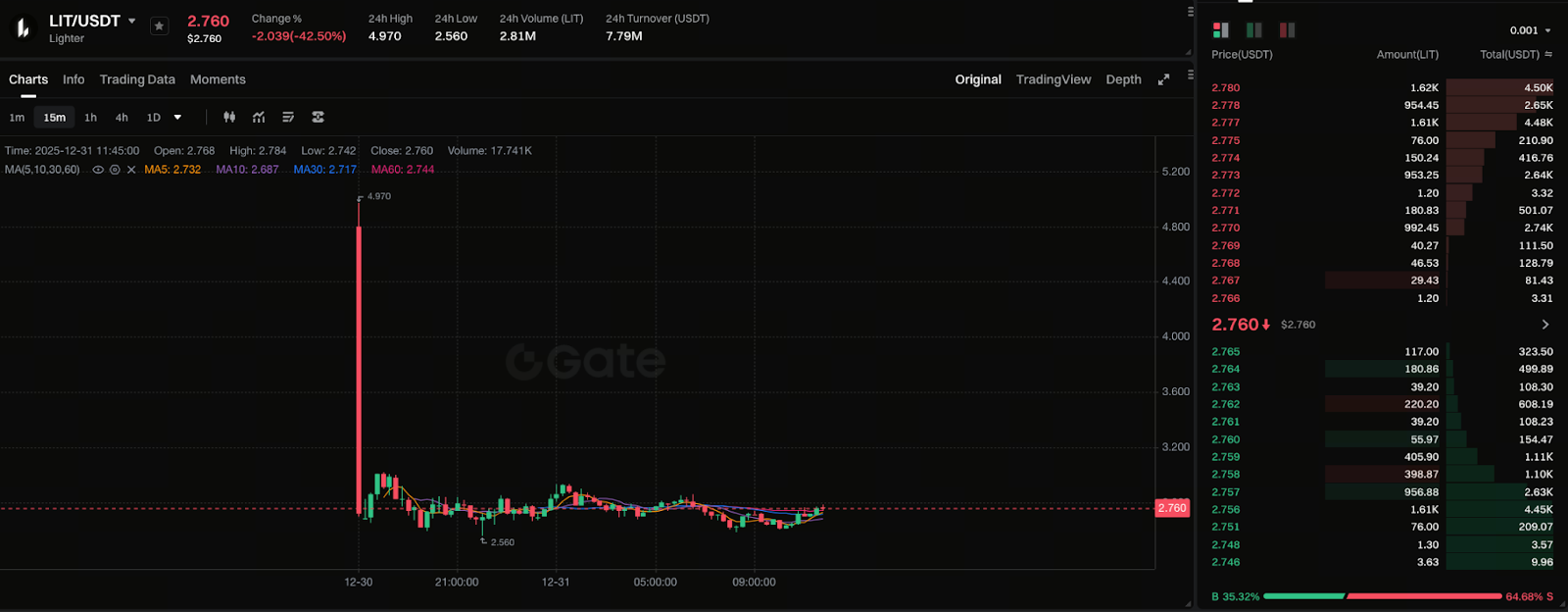
Following the airdrop, LIT experienced notable short-term price volatility. Data indicates that during pre-market or early trading, LIT’s price dropped by over 10% at one point, reflecting that some airdrop recipients opted for immediate profit-taking, leading to concentrated selling pressure.
This pattern aligns with the typical “sell the news” scenario, where markets see short-term profit-taking after major events. Similar trends have appeared in past airdrop projects and are not uncommon.
Importantly, limited liquidity in a token’s early stages can amplify trading activity and lead to price swings that far exceed those in mature markets.
Outlook: Potential Opportunities and Key Risks
Opportunities
- Ecosystem incentive potential: As the Lighter trading ecosystem grows, LIT is positioned to become a primary credential for trading incentives, liquidity provision, and governance participation.
- Transparent vesting schedule: The one-year lock-up followed by three years of linear release allows the market to anticipate changes in token supply and reduces the likelihood of sudden shocks.
- Rising attention from major exchanges: Several leading exchanges have listed or are monitoring LIT, which could enhance market liquidity and accessibility in the future.
Risks
- High internal token allocation: The substantial share held by the team and investors may exert persistent downward pressure on prices during future unlock periods.
- Market sentiment sensitivity: The DeFi sector is highly volatile, and LIT’s price could experience sharp swings due to macroeconomic factors and on-chain events.
- Intense sector competition: The perpetual contract DEX market is fiercely competitive, and innovative protocols could divert users and trading volume.
Conclusion: The Significance and Key Takeaways from LIT’s Launch
Lighter’s launch of the LIT token marks a critical evolution from a trading product to a full-fledged ecosystem. The token addresses user incentive needs and establishes a foundation for protocol governance and long-term incentive mechanisms.
While the DeFi community remains divided on the allocation structure, this debate reflects the sector’s ongoing struggle to balance fairness, incentive efficiency, and sustainable growth. Looking ahead, the market should closely monitor LIT’s post-listing price performance, the token’s vesting schedule, and shifts in community and ecosystem activity to fully assess its long-term value as an infrastructure token.
Share
Content


Related Articles

2025 BTC Price Prediction: BTC Trend Forecast Based on Technical and Macroeconomic Data

Flare Crypto Explained: What Is Flare Network and Why It Matters in 2025

Pi Coin Transaction Guide: How to Transfer to Gate.com

How to Use a Crypto Whale Tracker: Top Tool Recommendation for 2025 to Follow Whale Moves

What is N2: An AI-Driven Layer 2 Solution