Source: Blockworks; Compiled by: Tao Zhu, Jinse Finance
Looking back at the official record of the five-hour secret meeting between Julian Assange and then-Google CEO Eric Schmidt, published this week 12 years ago, is equally chilling.
Schmidt collaborated with Jared Cohen, a senior global affairs mediator and the then head of the internal think tank Google Ideas (now Jigsaw), to co-author a book titled “The New Digital Age,” which discusses the intersection of American global power and social media.
The meeting was held under the pretext of studying the book, with Schmidt and Cohen visiting several tech leaders at the same time. Assange published his account of the meeting in his 2014 book “When Google Met Wikileaks.”
In mid-2011, despite Assange being placed under house arrest in rural England for opposing extradition to Sweden, WikiLeaks remained very active. Assange wrote, “Schmidt dug deep, directly asking me about the organizational and technical foundations of WikiLeaks.” After a high-profile bank blockade severed WikiLeaks’ connections with American banks, MasterCard, Visa, Western Union, and PayPal, WikiLeaks had just started accepting Bitcoin donations.
Assange did not have much of an impression about the visit at the time, and believed that Schmidt was “a Silicon Valley engineer with no political ambitions, a relic of the good old days of West Coast computer science graduate culture.”
But after gaining a deeper understanding of the integration of Google and U.S. foreign policy, he has a different perspective. “When WikiLeaks was deeply involved in releasing internal documents from the U.S. State Department, the U.S. State Department had actually infiltrated the WikiLeaks command center and asked me for a free lunch.”
During lunch, Bitcoin was mentioned several times. The first was a bit awkward: when Assange inquired, Schmidt, who had previously served as the software engineering director at Sun Microsystems, curiously stated that he had never heard of Bitcoin (Cohen then remarked that he “just read the article yesterday”).
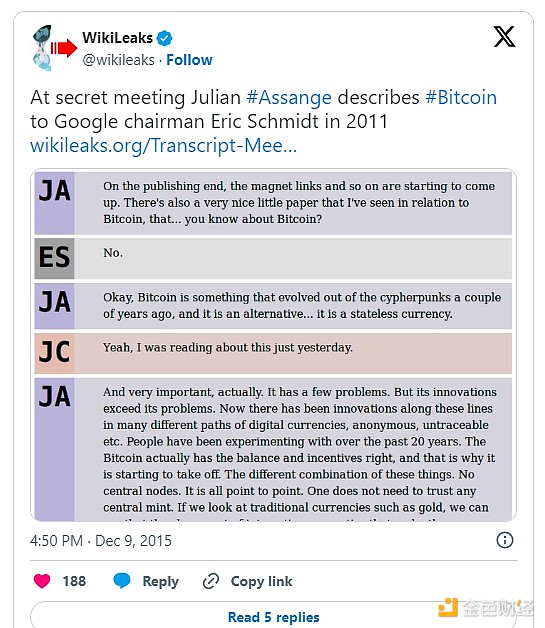
For Schmidt and Assange, the deepest impression about Bitcoin seems to be that it is merely a manifestation of this technology.
Perhaps a complete reform of the global DNS system can be carried out, making its operation similar to that of Bitcoin, thereby freeing the internet from central control, censorship, and manipulation. Like traditional financial institutions, DNS providers are vulnerable to state censorship. Assange told Schmidt that the Chinese government is actively filtering WikiLeaks content from the internet in the country.
Therefore, an internet routing system built on a globally distributed ledger can allow the distribution of content published by WikiLeaks to be assigned to cryptographic hash values that are always accessible on the blockchain, just like Bitcoin.
This system is particularly effective during uprisings because governments often suppress citizens’ resistance by cutting off internet access. If a truly peer-to-peer communication network is sufficiently decentralized, it will become a technology for the freedom of information, just as Bitcoin is a technology for the freedom of currency.
Assange was describing Namecoin at the time, which is an early fork of Bitcoin based on the BitDNS concept originally proposed by Satoshi Nakamoto.
“I think we should do more research on this so that we can have a general understanding of it… that way we might have more questions about it,” Schmidt told Assange, then wondered whether it would be possible to crack the encryption of the system and completely break it.

Assange and WikiLeaks detail the connection between Google and U.S. foreign policy.
Schmidt has shown interest in Bitcoin’s proof of work and the scarcity of currency, largely thanks to Assange’s clear explanation of difficulty settings.
“As time goes by, scarcity will increase. What does this mean for people’s incentive to join the Bitcoin system? It means you should join the Bitcoin system now. The sooner, the better. You should become an early adopter,” Assange said. “Because one day your Bitcoin will be worth a lot of money.”
Of course, Assange is right. Since the secret meeting with the CEO of Google, Bitcoin has risen 5,000 times (five hundred thousand percent).
A year later, Assange arrived in London and sought asylum at the Ecuadorian embassy, where he was detained for seven years to avoid extradition to Sweden on rape charges. Assange subsequently served five years in a London prison, while his team consistently opposed his extradition to the United States. In June of last year, Assange was released as part of a plea agreement with the federal government.
At the same time, the internet is now subject to strict scrutiny by governments and businesses around the world, and in many cases, it is even controlled by Google itself, while Bitcoin remains free. We can only hope that the time Assange spends in prison will ultimately have some significance.
Disclaimer: The information on this page may come from third parties and does not represent the views or opinions of Gate. The content displayed on this page is for reference only and does not constitute any financial, investment, or legal advice. Gate does not guarantee the accuracy or completeness of the information and shall not be liable for any losses arising from the use of this information. Virtual asset investments carry high risks and are subject to significant price volatility. You may lose all of your invested principal. Please fully understand the relevant risks and make prudent decisions based on your own financial situation and risk tolerance. For details, please refer to
Disclaimer.


