Key Summary
- Katana Network is a Layer-2 blockchain focused on DeFi, aimed at integrating decentralized liquidity and providing sustainable returns.
- The native token KAT is used for governance voting, fee sharing, and liquidity incentives, with a total supply of 10 billion and a lock-up period of 9 months.
- Core on-chain applications include spot trading Sushi, lending protocol Morpho, and perpetual contract platform Vertex, all supported by on-chain self-operated liquidity.
- Users can obtain KAT through Polygon POL airdrops, early Krates deposits, or ongoing vaults; however, they should be aware of the risks associated with contract complexity and unlocking volatility.
 Katana Network (KAT) is a Layer-2 blockchain designed specifically for DeFi, jointly developed by Polygon Labs and GSR, aimed at solving the liquidity fragmentation issue on Ethereum. Imagine: an integrated AMM like Sushi, a unified lending protocol like Morpho, and a perpetual contract-focused platform like Vertex, all sharing the same liquidity pool. This means lower slippage, more stable sources of yield, including sequencer fees, VaultBridge strategies, and revenues from core protocols.
KAT is the native token of Katana, driving platform governance, fee distribution, and incentive mechanisms. Want to understand what Katana Network is, the uses of the KAT token, and how to participate? Keep reading!
Directory:
Katana Network Project Introduction
KAT Token Economic Model, Distribution and Destruction Mechanism
Katana Network core applications and ecological projects
How to participate in the Katana ecosystem and obtain KAT
Katana Network Competitive Landscape Analysis
KAT Token Risks and Precautions
Future Prospects of the Katana Project
Katana Network (KAT) Project Overview
Katana Network is a Layer-2 network focused on DeFi, jointly created by Polygon Labs and GSR. Its core philosophy is: no longer allowing liquidity to be dispersed across dozens of protocols, but instead concentrating it into three key modules:
- Sushi v3 for spot trading
- Morpho provides lending features
- Vertex focuses on perpetual contract trading
This “liquidity concentrated” architecture brings deeper capital pools, lower slippage, and a more stable trading experience.

Image Credit: Katana Network dApp Interface
Core design concept:
- Unified Liquidity: One AMM (Sushi v3), one lending protocol (Morpho), one perpetual contract DEX (Vertex), to avoid liquidity fragmentation.
- On-chain self-operated liquidity (CoL): The fees from the sorter and the revenue from core applications are unified into the on-chain fund pool, ensuring sufficient liquidity even during market fluctuations.
- Embedded Earnings (VaultBridge): Before bridging assets into Katana, you can first earn yields in the Yearn or Morpho vaults on Ethereum, achieving “earn interest upon deposit.”
At the underlying architecture level, Katana utilizes Polygon’s AggLayer for seamless cross-chain bridging, and accelerates transaction finality and asset withdrawal speed through Optimism-based Rollup combined with Succinct Labs’ zero-knowledge proof technology. Each transaction fee and part of the core protocol revenue will be injected into the on-chain fund pool, providing volatility protection for the market. Meanwhile, VaultBridge allows bridged assets to start “working” before entering Katana, helping you earn money as soon as it goes live.

Image Credit: Katana Network Blog
Katana launched its private mainnet in May 2025 and plans to fully open by the end of June. The native token KATANA has been distributed to POL stakers and early liquidity providers, primarily for governance voting, fee sharing, and ecosystem incentives. Katana uses ETH as Gas, and its governance mechanism is more aligned with long-term interests, aimed at serving DeFi traders, liquidity providers, and dApp developers who wish to obtain sustainable returns.

Image Credit: Katana Network Blog
Katana (KAT) Token Economic Model, Distribution and Destruction Mechanism
Total Supply and Use
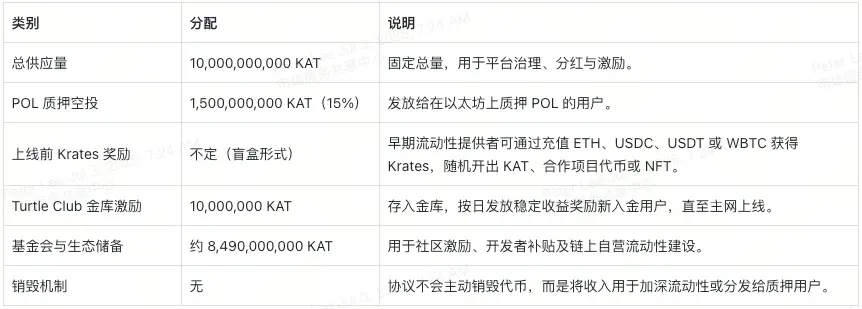
The total supply of KATANA (token abbreviation: KAT) is 10 billion, mainly used for governance voting, fee dividends, and ecological incentives.
Distribution Method
- 15% airdrop to POL stakers: Approximately 1.5 billion KAT will be distributed to users who stake POL on Ethereum.
- Krates Reward Program: Users who provide liquidity before the launch can obtain KAT, partner project tokens, and NFTs through the “Krates Blind Box”.
- Continuous Incentive Program: 10 million KAT is reserved in the Turtle Club treasury to provide a fixed daily return for new funds.
- Ecological reserves and foundations: The remaining tokens mainly support developer incentives, community subsidies, and market liquidity maintenance.
Lockup Period Explanation
All KAT distributed at the launch will be locked for 9 months to avoid initial selling pressure and encourage users to participate in the ecosystem long-term. It is expected to be unlocked as early as February 2026, and may be opened earlier if the community reaches a consensus.
Token Use and Governance Mechanism
- vKAT Governance Voting: Locking KAT can be exchanged for vKAT, which is used to participate in governance proposals and voting based on the ve( 3, 3) model.
- Fee Dividend: Users who stake vKAT can receive a share of the platform’s transaction fees, lending interest spread, and treasury income.
- Incentive Flow Decision: Community governance can determine how KAT rewards are distributed to protocols such as Sushi, Morpho, and Vertex.
Destruction Mechanism Explanation
Katana does not have a native burn mechanism. The project team emphasizes that this is not a project that maintains value through a “deflationary narrative,” but rather achieves the so-called Real Yield model by reinvesting protocol revenue into liquidity or rewarding staked users.
Katana Network Core Applications and Ecosystem dApp Analysis
Three Core Applications
The design philosophy of Katana is to concentrate liquidity into three flagship applications, rather than having the protocols compete with each other and dilute the liquidity pool.
Sushi v3 (Spot AMM)
- The only automated market maker (AMM) on Katana, where trading pairs such as KATANA/USDT, ETH, USDC, WBTC, etc. are aggregated.
- Deep liquidity, small slippage, users get better buying prices, and liquidity providers can earn exchange fees more steadily.
Morpho (Lending Protocol)
- Provides optimized lending rates through a combination of peer-to-peer matching and shared capital pools.
- A single market brings together borrowers and lenders, resulting in more stable interest rates and stronger market depth.
Vertex (Perpetual Contract DEX)
- Provides high-leverage perpetual contract trading, supporting a comprehensive margin management and risk control system.
- With the same set of on-chain self-operated liquidity support, ensure that even high-leverage trading can enjoy deep liquidity.
 Image Credit: Katana Network Blog
Native Asset Protocol
In addition to core dApps, Katana natively supports multiple asset types:
- AUSD (Agora USD): A stablecoin backed by real assets, with stability fees returned to users.
- LBTC (Lombard Bitcoin): A BTC wrapped asset that earns interest, allowing your Bitcoin to “work and make money.”
- Liquid staking assets: such as Ether.fi’s stETH and Jito’s stSOL, which can bring staking rewards from Ethereum and Solana into the Katana network to achieve cross-chain yield integration.
Yield Infrastructure
- VaultBridge bridging strategy: Before users’ cross-chain assets arrive at Katana, they can first be deposited into Ethereum’s Yearn or Morpho vaults, earning returns as soon as they are deposited.
- On-chain Proprietary Liquidity (CoL): Protocol fees and treasury income are automatically injected into the core liquidity pool to maintain market stability and alleviate volatility.
Ecological Integration Project
Katana is integrating with multiple top projects to build a robust DeFi infrastructure:
- Turtle Club: Provides a transparent treasury strategy, continuing to reward users with KATANA.
- Chainlink and The Graph: Providing price oracle and data indexing support.
- Den: Used for governance interface front-end; Blockworks provides media exposure to continuously expand Katana’s market awareness.
Katana builds a connected and focused DeFi ecosystem, where all applications and assets converge into the same “liquidity flywheel,” allowing users to experience greater efficiency, more predictability, and higher profit potential.

Image Credit: Katana Network
How to Participate in the Katana Ecosystem and Obtain KAT Tokens
There are several ways to obtain KAT tokens. Whether you are an early supporter or a later user, there is a suitable path for you:
- POL Airdrop Claim
- Stake your POL on Ethereum before the snapshot date to automatically receive 15% of the total supply of KAT proportionally.
- Krates Event Before Launch (Ended)
- Early users will deposit ETH, USDC, USDT, or WBTC into Katana’s Krates contract to receive “blind box” rewards.
- Each Krate contains KAT and tokens from cooperative projects, which will be unlocked upon the mainnet launch, with a token lock-up period of 9 months.
- Turtle Club Vault
- Before the mainnet launch, users can still deposit the above assets into the Katana vault provided by Turtle Club.
- The vault yield is open and transparent, and KAT rewards can be claimed daily after the mainnet goes live.
- Free trading after going live
- After KAT is unlocked for transfer, it can be traded as KAT/USDT on Sushi and can also be bought and sold on centralized exchanges (such as XT.com).
- – You can also add liquidity to KAT, earning exchange fees and incentive rewards.
- Staking for Governance
- – Lock up transferable KAT to mint vKAT.
- vKAT can be used to participate in community governance proposal voting and enjoy platform fee dividends.
Whether you are a DeFi player or an ecosystem builder, KAT is your important pass to participate in the Katana network.
Competitive Landscape Analysis of Katana Network
In the context of increasingly fierce competition in the DeFi and Layer-2 sectors, Katana Network takes a different approach, focusing on “unified liquidity” and “real yield,” distinguishing itself from the incentive logic and liquidity architecture of current mainstream projects. The following is a comparison of the main competing projects:

General Type Layer-2 Project:
Mainstream models: Such as Arbitrum, Optimism, zkSync, and Base, typically integrate multiple AMM and lending protocols, with liquidity being divided among various platforms and tokens, resulting in lower capital efficiency.
Advantages of Katana: Katana only offers one AMM (Sushi), one lending protocol (Morpho), and one perpetual contract platform (Vertex), concentrating liquidity to form deeper capital pools. At the same time, through on-chain self-operated liquidity (CoL) and the VaultBridge cross-chain yield mechanism, it provides users with a more sustainable real yield experience.
DeFi-oriented public chain:
- Canto: Incentives are distributed based on an inflation model, integrating only AMM and lending, lacking a long-term yield model.
- Sei: A high-performance order book DEX, but without native yield distribution.
- Katana: Integrating spot trading, lending, perpetual contracts, and cross-chain yield, it packages all core DeFi needs in one place.
Comparison of the protocol’s self-operated liquidity model:
- OlympusDAO: Focuses on OHM self-custody liquidity, but limited to a single protocol scope.
- Katana: Expanding “protocol self-operated liquidity” to “chain-level self-operated liquidity” to continuously inject depth into core applications across the entire network.
Cross-Chain Liquidity Aggregation:
- LayerZero and Thorchain: Provide cross-chain asset exchange, but liquidity remains dispersed across the original chains.
- Katana: Bridge cross-chain assets into the ecosystem through VaultBridge, achieving liquidity accumulation and efficient utilization.
Polygon ecosystem synergy effect:
Katana, as a strategically supported project by Polygon Labs, airdropped 15% of its tokens to POL stakers. Additionally, it complements the functional shortcomings of other Rollup projects like Polygon zkEVM, becoming a DeFi hub within the Polygon ecosystem.
Risks and Precautions of Katana (KAT) Token
When participating in the Katana network and its tokens, users should be aware of the following key risks:
- Security Complexity
- Katana integrates multiple protocols (VaultBridge, Sushi, Morpho, Vertex). Although it has been audited, the overall attack surface is relatively large.
- A portion of the system’s revenue comes from off-chain vaults such as Yearn and Morpho. If an external protocol has a vulnerability, it may affect asset security.
- Insufficient degree of decentralization
- The current sorting service is provided by Conduit, and the cross-chain bridge relies on Polygon’s AggLayer, which has certain centralization and single point of failure risks.
- The project team has planned for full decentralization in the future, but it has not been achieved yet.
- Liquidity and Withdrawal Issues
- User assets may earn interest off-chain, and in the event of a large-scale withdrawal, it may put pressure on the reserve pool and on-chain self-operated liquidity (CoL).
- Withdrawals may be delayed in extreme market conditions.
- Economic and Market Risks
- The returns depend on DeFi activities and the performance of external strategies. If the market is sluggish, the returns will be compressed.
- KAT tokens from airdrops and treasury rewards are locked for 9 months (expected to be unlocked in February 2026), and unlocking may cause price fluctuations.
- Regulatory Uncertainty
- – Katana manages liquidity and yield at the chain level, and may be considered as securities or banking business in some regions, potentially facing regulatory pressure.
Katana (KAT) Development Prospects
Positive signal
- Polygon Labs and GSR support: bringing funding, resources, and early liquidity to the project.
- POL airdrop establishes a basic user group: a natural community foundation helps the network to launch quickly.
- Real Yield Mechanism: Combining VaultBridge and on-chain self-operated liquidity (CoL), if it can continuously provide competitive annual yields, it will become a core advantage of Katana.
![katana-homepage-2]###https://img-cdn.gateio.im/webp-social/moments-f0383306eff3e30ac5de62bd01a370fd.webp(
Image Credit: Katana Network
Future challenges
- Unlocking period volatility: After unlocking in early 2026, a large circulation of KAT may trigger price fluctuations.
- Security and Execution: The system integration is complex, and it is necessary to ensure safety and stability while advancing the development milestones according to the roadmap.
- Competitive pressure: Other Layer-2 projects may replicate its incentive mechanisms, continuous innovation is crucial.
Summary
The market’s overall attitude towards Katana is cautiously optimistic. If it can maintain stable returns, ensure liquidity depth, and strengthen governance mechanisms, it is expected to attract TVL from the Ethereum mainnet, neutral Rollups, and other DeFi public chains. The ultimate success or failure of the project depends on execution capability, security assurance, and community governance participation.
) Frequently Asked Questions about Katana (KAT)
Q1: What is Katana Network (KATANA)?
Katana Network is a Layer-2 blockchain focused on DeFi, jointly created by Polygon Labs and GSR. It integrates Sushi’s spot trading, Morpho’s lending features, and Vertex’s perpetual contracts, while providing on-chain self-operated liquidity and built-in yield strategies, aiming to build deeper market liquidity and more stable return mechanisms.
Q2: What is the KATANA token? What is it used for?
KATANA (abbreviated as KAT) is the native token of the platform, with a fixed total supply of 10 billion. Users can lock KAT to generate vKAT, which can be used to participate in community governance voting, receive protocol fee sharing, and determine the incentive direction for Sushi, Morpho, and Vertex. All tokens are distributed through airdrops or early liquidity incentives, with no private placement rounds or institutional allocations.
Q3: How can I check the real-time price of KATANA?
After KAT is tradable, you can view the real-time market of KATANA/USDT on Katana’s Sushi DEX or centralized exchanges like XT.com. Data platforms such as CoinGecko and CoinMarketCap will also synchronize to display price charts and historical trends.
Q4: How to trade KATANA/USDT on Katana? Visit the official website app.katana.network, connect your wallet (supports MetaMask, WalletConnect), and after importing assets through the AggLayer cross-chain bridge, you can perform the exchange operation between KAT and USDT on Sushi.
Q 5: Where can I follow Katana’s official updates?
You can follow the official account @katana on X (formerly Twitter), read the project’s blog, or join the Discord community through the link on katana.network to get first-hand information and updates.


