
What is APRO Oracle? APRO Oracle (AT) is the first AI-driven oracle project in the Binance ecosystem, designed as a decentralized oracle network tailored for the Bitcoin ecosystem, which has received strategic funding from institutions including YZI Labs, with participation from Gate Labs. It was personally named “Expert” by CZ and has a significant amount of community ownership and trading activity.
What is APRO Oracle? CZ Named Bitcoin Oracle Revolution
What is APRO Oracle? APRO Oracle is a decentralized oracle network specifically designed for the Bitcoin ecosystem. It enhances the performance of blockchain applications by providing secure and accurate off-chain data verification for on-chain systems. This innovation not only addresses the data gap in Bitcoin's decentralized finance (DeFi) but also introduces efficiency and security when handling various blockchain application data.
What is the origin of the name APRO Oracle? It was even personally named “Expert” by CZ and has a large community ownership and trading activity. The triangle in the avatar resembles a watching eye, hinting at the core feature of the oracle, which is “insight into the future.” The overall design is simple yet striking. CZ, as the founder of Binance, has unparalleled influence in the cryptocurrency industry; he personally named the project and endorsed it, greatly enhancing the market recognition of APRO Oracle.
The development of APRO Oracle stems from the demand for reliable data services within the Bitcoin ecosystem, which has long lacked professional oracle services. The original intent of Bitcoin's design was to serve as a store of value and a payment network, and its scripting language (Script) deliberately limits complex functionalities, making it impossible to directly access external data on the Bitcoin chain. However, with the rise of Bitcoin DeFi, NFTs, and other applications, the demand for reliable data sources has surged.
By providing targeted solutions such as Lightning Network, RGB++, and Rune protocol support, APRO Oracle ensures fast and accurate data processing, which is crucial for emerging Bitcoin DeFi and other blockchain applications. The Lightning Network requires real-time liquidity and routing information, RGB++ needs off-chain state verification, and the Rune protocol requires accurate market data; APRO Oracle offers a unified data solution for these scenarios.
Previously, @APRO_Oracle announced the completion of a new round of strategic financing, with the specific amount undisclosed. This round of financing was led by @yzilabs through the EASY Residency program, with participation from Gate Labs, WAGMI Venture, and TPC Ventures. This lineup of investors shows that APRO Oracle has gained recognition from exchanges, VC, and professional investment institutions.
ATTPs Protocol: Five-layer Architecture for Secure Transmission by AI Agents
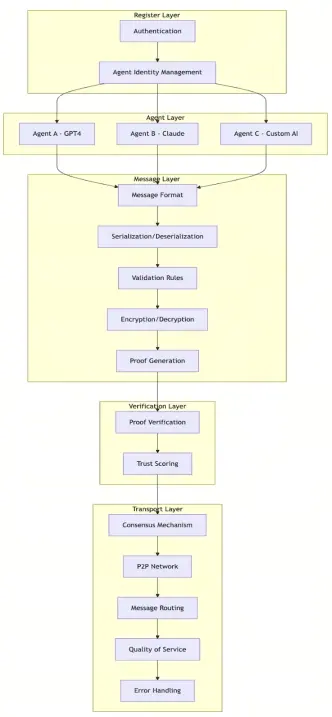
What is the core technology of APRO Oracle? ATTPs (AgentText Transfer Protocol Secure) is an AI agent secure data transmission protocol released by APRO Research in December 2024, aimed at addressing the lack of standardized verification mechanisms for communication between AI agents. This protocol is the foundation of the APRO Oracle technology system.
Existing AI agent communication has three major flaws: lack of verification, external data sources cannot verify authenticity and can only conduct local verification; the trust model is too simplistic, with only binary judgments of “trust/not trust”, lacking historical records and confidence levels; scalability is difficult, as the system throughput is inversely proportional to verification complexity, making it hard to balance performance and security. The security threats resulting from these issues include data tampering attacks (with detection probabilities close to zero), identity spoofing (malicious entities impersonating legitimate agents), price manipulation, and misinformation poisoning.
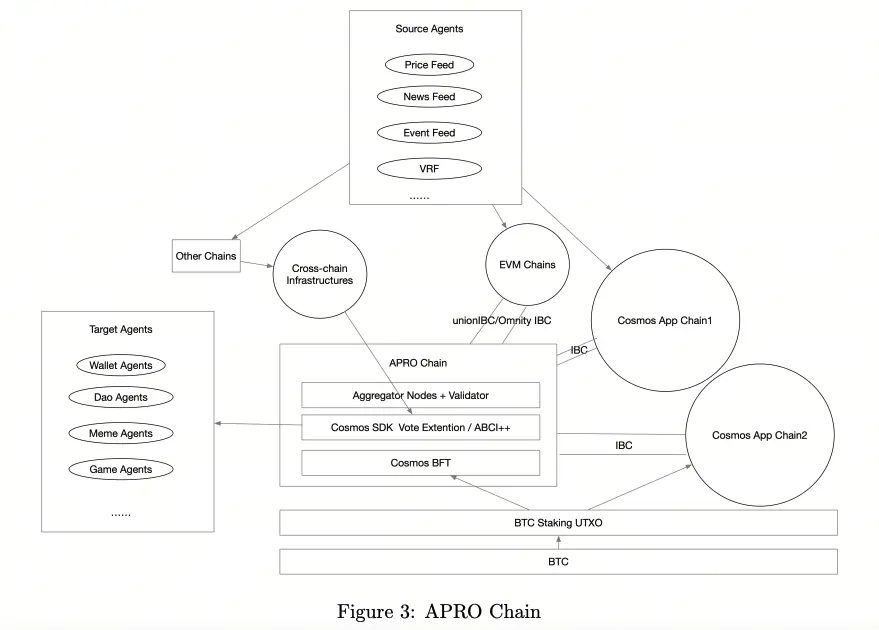
ATTPs solve these problems through a five-layer architecture design. The transport layer is based on the APRO Chain built on the Cosmos ecosystem, utilizing a BTC staking + POS hybrid consensus mechanism, and implements data consensus through the voting expansion feature of ABCI++. Malicious nodes will have one-third of their staked tokens slashed. The verification layer combines zero-knowledge proof (ZKP) + Merkle tree + trust scoring, with a multi-stage verification process that includes proof submission, node validation, consensus voting, and target delivery.
The message layer uses end-to-end encryption (AES-256-GCM + Ed25519 signature), and the message format includes header information, encrypted payload, zero-knowledge proof, and Merkle proof, with adaptive routing optimizing transmission based on reliability, speed, and cost. The proxy layer provides high-level APIs for data validation and business logic execution, responsible for state management and error handling. The registration layer manages the proxy lifecycle and permissions, deploys validator contracts, and conducts protocol governance and performance monitoring.
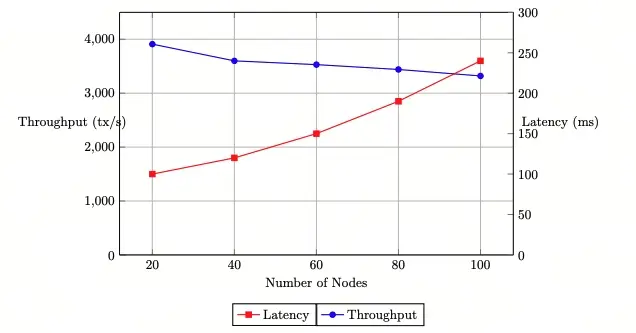
4000 TPS and 240 milliseconds latency performance breakthrough
The platform employs a hybrid node approach, combining on-chain and off-chain computing resources. This enhances computational efficiency and overall performance, while the multi-centralized network communication scheme reduces the risk of single points of failure. In addition, the APRO Oracle integrates a self-managed multi-signature mechanism to enhance security against malicious activities.
In a stress test conducted over 3 months with 200 nodes across 5 geographical regions, the APRO Oracle demonstrated impressive performance metrics: a throughput of 4000 tx/s, latency of only 240 ms, and a storage growth of 75 GB/day (50 GB for transactions + 20 GB for proofs + 5 GB for state), with network traffic of 180 GB/day/node.
Comparison of ATTPs Protocol Performance:
Traditional BFT System: 1200 tx/s throughput, 500 ms latency, high resource consumption
Decentralized Oracle: 2500 tx/s throughput, 300 ms latency, high resource consumption
ATTPs Protocol: 4000 tx/s throughput, 240 ms latency, moderate resource consumption
This performance advantage allows APRO Oracle to support high-frequency trading, instant settlement, and large-scale application scenarios. For Bitcoin DeFi, fast and reliable data verification is a prerequisite for implementing complex financial products. What is the attack defense capability of APRO Oracle? DDoS attack success rate is 99.9%, recovery time is less than 2 seconds; man-in-the-middle attack 100% defense (end-to-end encryption); replay attack 100% defense (timestamp verification).
Complete Ecosystem of Source and Target Agents
What is the role of the APRO Oracle ecosystem? It is divided into source agents (data providers) and target agents (data consumers). Source agents include verifiable price sources (aggregated exchange data that provides cryptographically proven price information), verifiable news sources (cross-validated news authenticity from multiple sources providing sentiment analysis), condition monitoring sources (monitoring the state of the blockchain and the real world), and verifiable random number sources (providing VRF services for games and fair selection). The revenue model includes subscription fees, pay-per-query, and staking collateral.
Target agents include smart trading wallets (executing automated trades based on verification data), Meme token generators (automatically creating tokens by analyzing social sentiment trends), DAO governance automation (executing governance proposals based on on-chain conditions), and GameFi smart characters (ensuring game fairness using verifiable randomness). This bilateral market design creates network effects for APRO Oracle; the more data providers there are, the more choices for consumers; the more consumers there are, the greater the income opportunities for providers.
Historical data storage utilizes a DAG (Directed Acyclic Graph) structure along with various distributed storage options: IPFS is used for content-addressable storage, suitable for temporary data; Arweave offers permanent storage for critical historical records; BNB Greenfield provides high-performance storage, supporting geographically distributed replication. This multi-layered storage strategy balances cost, performance, and permanence requirements.


