Despite the Pi Network’s token supply reaching up to 100 billion, it maintains a steady rank of 47rd, becoming one of the most intriguing mysteries in the cryptocurrency space. On November 11, 2025, renowned analyst Dr. Altcoin gave high praise to Pi Network, noting that even without significant changes from its core team, the network still enjoys community trust and recognition.
The Paradox of 100 Billion Supply and Top 50 Ranking
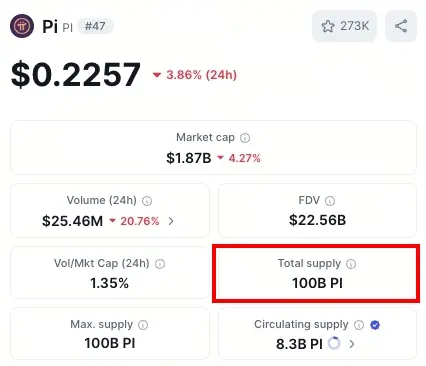
(Source: CoinMarketCap)
The cap of 100 billion tokens for Pi Network has sparked widespread controversy. In the crypto world, supply is often seen as a key indicator of scarcity and value. Bitcoin’s limit of 21 million, Ethereum’s unlimited supply with deflationary mechanisms, stand in stark contrast to Pi’s hundred-billion supply. Many analysts question how such a large supply can support token value. However, Pi Network defies this skepticism with its actual ranking.
According to the latest data from CoinMarketCap, Pi is currently ranked 47th, with a price of $0.2296. The token has increased by 1.03% in the past 24 hours and 2.06% over the past 7 days, with a trading volume of approximately $218 million. This performance indicates that even before the mainnet is fully launched, Pi tokens demonstrate strong resilience. More importantly, during bear markets and market volatility, Pi’s ranking remains relatively stable, which is rare for projects with such a large supply.
The underlying logic behind this paradox is community strength. Pi Network boasts a large international community of tens of millions of members, which is the core reason it remains popular. Unlike many projects that rely solely on speculation, Pi’s user base mainly comes from mobile mining apps, with users emotionally connected and committed long-term. Even amid delays in the mainnet launch and transparency concerns, most community members continue to hold and support the project.
Due to its stable performance, Pi has not been significantly affected by market fluctuations. The token’s 24-hour trading volume remains high at around $218 million, indicating strong market interest, but its price volatility is less than that of mainstream assets like Bitcoin and Ethereum. This stability reflects the long-term mindset of the Pi community rather than short-term speculation.
Origin at Stanford and Energy-Efficient Mining Innovation
In 2019, Stanford graduates Dr. Nicholas Kokkalis and Dr. Chengdiao Fan founded Pi Network. Their goal was clear: enable ordinary users to participate in cryptocurrency mining via mobile devices. This vision was revolutionary at the time, as Bitcoin mining had evolved into an industrial activity requiring specialized ASIC miners and massive electricity consumption, excluding ordinary users.
Pi’s consensus mechanism allows users to mine directly on their phones without consuming large amounts of electricity and data, avoiding reliance on mining hardware. This “social mining” model uses security circles and referral systems to build trust networks, enabling network verification without draining phone batteries or data plans. Technologically, Pi employs a variant of the Stellar Consensus Protocol, a more energy-efficient consensus mechanism than Bitcoin’s proof-of-work.
The project’s cap of 100 billion tokens has caused controversy. However, its large international community of tens of millions keeps it active. Stanford’s background lends academic credibility, although the project is not an official Stanford research initiative; the founders’ educational backgrounds still provide early users with a trust foundation.
Core Innovations of Pi Network
Mobile Mining: Lowers participation barriers, no need for specialized equipment or high electricity costs
Social Mining: Builds trust networks via security circles and referral systems, improving mining efficiency
Energy-Efficient Consensus: Uses a variant of Stellar Consensus Protocol, consuming far less energy than Bitcoin
Large User Base: Tens of millions worldwide provide network effects and long-term support
OpenMind AI Collaboration Opens New Narratives
Recent collaborations with AI projects like OpenMind indicate that Pi Network is moving toward AI-enhanced blockchain solutions. This integration allows node operators to run AI models and earn rewards, representing an innovative combination of decentralized computing and AI. Analysts believe this will help Pi develop into a crowdsourced AI computing marketplace, securing a position in next-generation blockchain applications.
This AI integration offers Pi Network a value proposition beyond traditional blockchains. Currently, many AI computations rely on centralized cloud providers like AWS, Google Cloud, or Azure. The partnership with OpenMind enables Pi’s 350,000 active nodes to contribute idle computing resources for training and running AI models, creating a decentralized AI computing market. Node operators can earn Pi tokens by providing computing power, while AI developers can access resources at lower costs.
The team is developing smart contracts, a decentralized exchange (PI DEX), and new developer tools for token creation. These infrastructure developments show Pi Network’s ambition to build a comprehensive blockchain ecosystem beyond just a payment network. The launch of PI DEX will enhance liquidity and trading scenarios for Pi tokens, while developer tools aim to attract more projects to deploy on Pi Chain.
Experts believe that if the mainnet launches and the ecosystem develops as planned, the large user base could translate into real-world value. So far, Pi’s story is about an ambitious new project that balances innovation with expectations. The AI integration narrative opens new possibilities for Pi Network, potentially attracting investors and developers interested in the intersection of AI and blockchain.
Mixed Community Feedback and Transparency Concerns
Dr. Altcoin’s posts express a cautiously optimistic and pragmatic attitude. He notes that there seem to be no major developments at present but admits that even without hype, the project can maintain its ranking. On X (formerly Twitter), user feedback is mixed—some praise the stability of Pi’s core team, while others complain about delays in the full mainnet release and lack of transparency regarding the Global Token Value (GCV).
Not all community voices are positive. Critics like @Masters_Picoin argue that Pi’s development has stagnated due to long intervals between version releases. The phased rollout of the mainnet has taken years, with no clear timeline for full deployment. These delays have disappointed early supporters and raised questions about the team’s execution and the project’s actual progress.
Some claim that ambassadors and influencers have exaggerated unrealistic expectations. Discussions around GCV are especially contentious; some unofficial documents suggest Pi could reach high values, but these lack official endorsement and sound economic models. The spread of such misinformation damages the project’s credibility.
Transparency remains an issue. Unlisted crypto assets are under scrutiny by regulators in the US, EU, and elsewhere. As Pi Network has not yet fully launched its mainnet, it faces regulatory challenges. The core team needs to balance user privacy with compliance, which is no easy task.
Despite delays, the fundamentals remain encouraging. Pi’s emphasis on energy-efficient mining and AI integration could position the team favorably in the next wave of decentralized technologies. Ultimately, whether the project can fulfill its promises depends on delivering tangible results. To date, Pi Network remains one of the most captivating mysteries in the crypto world.


