Author: Techub Hotspot Express Written by: J1N, Techub News
The US government shutdown over the past month has already had negative impacts across multiple industries, prompting several US officials to sound alarms about economic downturns, and even affecting overseas US military bases.
The longest US government shutdown in history is finally coming to an end.
November 9 marks the 40th day of this “shutdown” crisis that began on October 1.
The 40-day fiscal deadlock has left global markets feeling suffocated: US stocks fluctuated, gold retreated, and Bitcoin briefly fell below $100,000. Investors are anxiously waiting amid uncertainty.
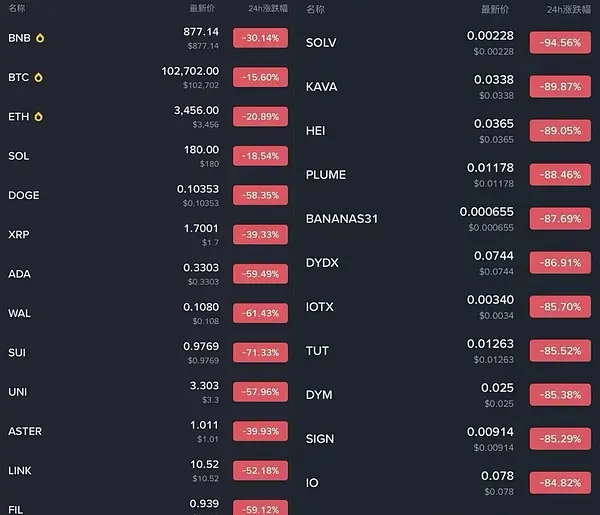
Source: Binance
Until Sunday, the US Senate finally voted on a temporary funding bill proposed by the Republicans, passing it with a 60-40 result. If the bill passes the House and is signed by the President, the government can reopen.
According to the latest developments, a group of moderate Democrats reached a preliminary consensus with Republicans: as long as Republicans promise to hold a vote on healthcare subsidies before December, Democrats will support the government reopening. The bill also includes a clause prohibiting federal agencies from firing employees before January 30, which is seen as a key victory for federal unions.
Eight Democrats defected, pushing through a bill that had previously been rejected 14 times, and market sentiment has begun to improve.
A “Shutdown” That Drags the Nation Down
The past 40 days of “shutdown” have nearly paralyzed American society.
Food safety inspections have been halted, research projects suspended, and core agencies like NASA and the Department of Homeland Security have entered “minimal operations.” Logistics at some overseas US military bases have been delayed, affecting military operations abroad.
Many US officials warn that if the shutdown continues, the risk of recession will rise sharply, with millions of federal employees on unpaid leave or forced to work with pay, frequent flight delays, increased food safety risks, national parks closed, and tax refunds delayed.
This is not just an administrative shutdown but a “chain reaction” in the economic system.
The overseas impact is also evident: supply chain delays, canceled corporate orders, and limited US military logistics weaken America’s global deployment capabilities.
Behind what appears to be a political standoff, the entire economic machinery is being forced to slow down.
The consumer confidence index has declined for three consecutive weeks, and manufacturing PMI has fallen below the growth/decline threshold. Some state governments have had to dip into emergency reserves due to funding stalls. The liquidity coverage ratio (LCR) of US small and medium-sized banks has fallen to its lowest since October last year. Goldman Sachs warned in its latest report that if the shutdown persists until the end of the year, US quarterly GDP growth could be dragged down by 1.2%, and the unemployment rate could rise to 4.5%. Financial markets’ risk premiums have risen rapidly, causing the US yield curve to invert further, with some market expectations of a “technical recession.”
Why Does the US Government Keep “Shutting Down”?
The reason for “government shutdown” is that Congress fails to reach an agreement on the new fiscal year’s budget.
On the surface, it’s a budget disagreement; in essence, it’s a reflection of the deep political polarization in the US. Since 1976, the US government has shut down 21 times. Whenever Congress fails to pass a budget or temporary funding bill before the fiscal year ends (September 30), the government falls into “partial paralysis.”
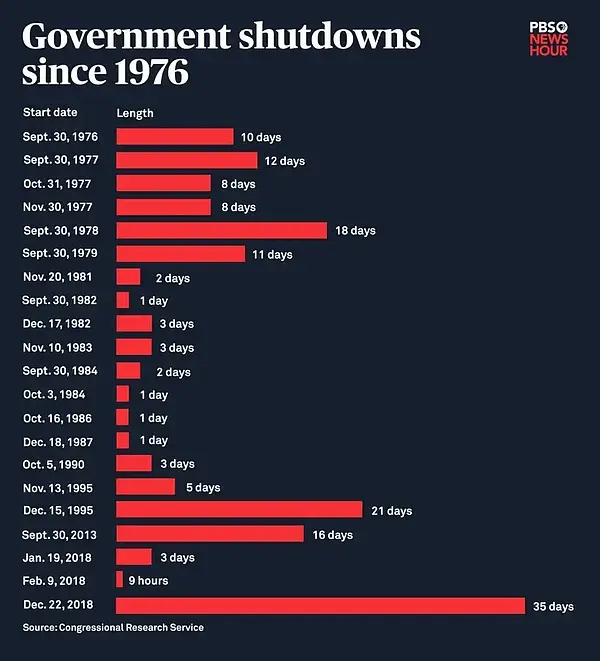
Summary of federal government shutdowns since 1976 by PBS
From Reagan to Biden, nearly every president has experienced shutdowns.
1981: Reagan’s first shutdown lasted only 1 day but marked the beginning of long-term partisan conflicts over fiscal and social policies.
1995–1996: During Clinton’s presidency, due to disagreements over healthcare reform and deficit reduction, there were two shutdowns totaling 27 days, nearly halting federal services.
2013: During Obama’s administration, Republicans blocked the Affordable Care Act, leading to a 16-day shutdown, during which the Dow Jones fell 2.6%, and US GDP shrank by about $24 billion.
2018–2019: Trump’s longest shutdown at 35 days over the border wall budget, setting a record at the time. During this period, major US stock indices declined, with the Nasdaq dropping over 10%, and GDP shrank by about $11 billion.
Now, that record has been broken by the 2025 shutdown. This deadlock stems from disagreements over healthcare subsidies, debt ceiling, and fiscal priorities. The 40-day shutdown has plunged the US into an unprecedented administrative freeze. FDA inspections paused, NASA missions delayed, border controls restricted, and flight delays became common. The economic losses alone have exceeded $50 billion.
This recurring fiscal deadlock is undermining global confidence in the “American model.” Bloomberg notes that over the past decade, US “shutdown cycles” have shortened, with fiscal negotiations almost becoming an annual routine. International investors are no longer viewing US Treasuries as “absolutely safe assets,” and some central banks are beginning to reduce their dollar reserves. IMF Chief Georgieva has stated: “Washington’s political dysfunction is becoming one of the biggest sources of uncertainty for the global economy.”
How Does a Government “Shutdown” Affect Markets?
Many ask: how does a government shutdown affect my stock or crypto investments?
Actually, it’s highly relevant.
On the surface, it looks like political bickering. But in reality, it directly impacts the flow of funds in the markets because it’s not just a political shutdown; it’s a liquidity freeze. Every shutdown involves a contraction of liquidity. Fiscal spending stops, federal salaries can’t be paid, and funded projects are frozen, meaning “money” in the market is being pulled out.
During the 2013 shutdown, the Dow fell 2.6%, the S&P declined 3%, and US GDP shrank by $24 billion; in 2019, stocks plunged, and Bitcoin halved from $6,000 to $3,000 as liquidity was “squeezed.”
This year is no different. Since the “Black Friday” crash on October 11, US stocks, gold, and Bitcoin have all plummeted nearly simultaneously. Nasdaq down 3.5%, S&P down 2.8%, gold from $4,300 to $3,900 per ounce, and Bitcoin from a high of $126,000 to below $100,000, with total market cap evaporating over $1 trillion.

Source: Coinglass
The reason is straightforward: the Treasury General Account (TGA) balance surged from $800 billion to $1 trillion, meaning $200 billion of liquidity was “siphoned off.” Meanwhile, short-term funding markets tightened rapidly, with the overnight repo rate (SOFR) spiking to 4.22%, exceeding the Federal Reserve’s policy range; interbank borrowing costs rose, corporate financing tightened, and the Fed’s “Emergency Repo Facility” (SRF) saw daily usage as high as $50.3 billion, a level not seen since the COVID-19 pandemic in 2020.
Analysts estimate that liquidity in the markets shrank by nearly $700 billion in a month—equivalent to several rate hikes by the Fed.
Compared to traditional markets, crypto reacts faster and more intensely to dollar liquidity changes. During the shutdown, stablecoin issuance dropped about 8%, and Ethereum’s daily transaction volume hit a new low for the year. Many institutions withdrew cash from risk assets, shifting into short-term US Treasuries and money market funds, creating a “flight to safety.” Even without Fed action, Treasury operations alone can reshape market sentiment.
Why Do Markets Rebound After a “Reopening”?
Every time the government reopens, markets tend to rally in the short term. The logic is simple: “Fiscal stimulus resumes.”
When the shutdown ends, government operations restart—paychecks are issued, budgets are released, and funds flow back into the markets. The TGA balance begins to decline, and liquidity within the Fed system re-enters the financial system, leading to a market “rebound.”
Historical examples support this pattern. After 2013, the Dow rose 3.5% within two weeks of reopening; after 2019, stocks experienced a quarterly rebound, and Bitcoin resumed its upward trend. The market’s biggest fear isn’t bad news but uncertainty. Once funding is approved and fiscal order is restored, confidence returns, and risk assets are immediately supported.
This time is no different. Following the Senate vote, US stock futures rebounded 1%, and Bitcoin retook the $106,000 level. Investors bet that government reopening signals a new round of fiscal stimulus, especially benefiting tech stocks and cryptocurrencies.
Morgan Stanley’s report states that in the two weeks after a shutdown ends, US stocks typically rise about 3%, but then often enter consolidation or correction phases. This is because the “stimulus effect” is quickly priced in, and actual fiscal measures take weeks to implement. In other words, the “reopening” provides only a short-term breather; it doesn’t fundamentally resolve America’s fiscal structural issues.
The “Chronic Disease” of US Fiscal Policy: The Shutdown Cycle
However, this “open-close-reopen” cycle has become a chronic problem for US fiscal policy.
By 2025, US national debt exceeds $36 trillion, about 130% of GDP. Of this, annual interest payments alone reach $1 trillion—almost half of the defense budget. The enormous debt limits fiscal maneuverability, and each budget negotiation feels like walking a tightrope.
Republicans advocate for spending cuts and tax reductions to stimulate growth, while Democrats emphasize expanding social welfare and green investments. Their disagreements grow wider, and the debt ceiling is repeatedly used as a political bargaining chip. Politicians gain influence but erode market trust.
Credit rating agencies have issued warnings that US sovereign creditworthiness could be downgraded due to political uncertainty. Long-term yields have risen from 4% to 4.5%, increasing borrowing costs and creating a vicious cycle. Meanwhile, the trend of “de-dollarization” accelerates, with more institutional investors increasing holdings of gold and Bitcoin to hedge fiscal risks.
In the crypto markets, stablecoin trading volume surges, and DeFi protocols are emerging as new financing channels. To some extent, the US government’s credit instability is unknowingly accelerating the restructuring of the global financial system.
Final Thoughts
The US government shutdown is never just political theater; it’s fundamentally a game of money, liquidity, and global trust.
When Washington’s lights go out and spending halts, liquidity gets locked in the treasury, US stocks fall, gold is pressured, and Bitcoin sneezes; when the government “reopens,” the lights come back on, and markets immediately feel the “water” flowing again.
In today’s interconnected financial system, a single budget negotiation can be as impactful as a Fed rate hike because it directly controls the “funds valve,” influencing global risk appetite.
So next time you see “government shutdown” in the news, don’t dismiss it as just political drama. It might be the prelude to the next global market upheaval. When Washington holds its breath, global funds follow suit.
In this era of interconnected finance, politics and markets are tightly linked. The US “shutdown” game reminds us: when the “central bank” of the world turns off its power, everyone must stumble in the dark.


