JPMorgan’s latest analyst report maintains a long-term bullish outlook on Bitcoin, predicting—based on a volatility-adjusted gold comparison model—that Bitcoin could reach $170,000 within 6 to 12 months. The bank believes that whether MicroStrategy (MSTR) can maintain its market value to Bitcoin holding ratio (mNAV) above 1.0, and avoid selling its roughly 650,000 Bitcoins, is the key driver of Bitcoin’s near-term price movement.
Bitcoin Faces Dual Pressure from Mining Costs and Hashrate
Recently, the decline in Bitcoin’s hashrate and mining difficulty has put downward pressure on Bitcoin’s price. JPMorgan analysts state that the drop is attributable to the People’s Bank of China reiterating its ban on Bitcoin mining and trading, as well as high-cost miners exiting due to rising electricity prices and falling Bitcoin prices, leading to decreased profitability and some miners being forced to sell Bitcoin.
The cost of mining Bitcoin has dropped from $94,000 last month to $90,000. Nevertheless, Bitcoin’s price remains below this mining cost, leading to further selling pressure. Analysts note that assuming an electricity price of $0.05 per kWh, every $0.01/kWh increase in electricity price raises high-cost miners’ costs by $18,000. This cost structure puts significant pressure on marginal miners when Bitcoin’s price is below mining costs.
JPMorgan points out that Bitcoin’s mining cost has historically served as a support level. If Bitcoin’s price remains below mining cost for an extended period, miners may face even greater pressure, resulting in further declines in mining costs. This dynamic has played out repeatedly in past bear markets: when price falls below mining cost, high-cost miners exit the market, network difficulty drops, remaining miners’ costs decrease, and a new equilibrium is ultimately reached.
However, JPMorgan believes that miners are not the key to Bitcoin’s next move; the size and stability of MicroStrategy’s holdings are more decisive. This assessment reflects a fundamental change in the structure of the Bitcoin market: shifting from early miner-driven supply-side dynamics to today’s demand-side dynamics dominated by large institutional holders.
MicroStrategy mNAV Ratio Becomes the Lifeline
The report emphasizes that whether MicroStrategy can maintain its market value to Bitcoin holding ratio (mNAV) above 1, and avoid selling Bitcoin, is the key driver of Bitcoin’s near-term price trends. Currently, the ratio stands at approximately 1.13. As long as it stays above 1.0, MicroStrategy does not need to use its roughly 650,000 Bitcoins to pay convertible bond interest or preferred stock dividends. The company’s $1.44 billion cash reserve is also sufficient to cover all cash obligations for the next two years, which would greatly reduce market panic.
The logic behind the mNAV ratio is: MicroStrategy’s market capitalization divided by the market value of its Bitcoin holdings. When this ratio is above 1, it means the market values MicroStrategy higher than its Bitcoin holdings, reflecting a premium for the company’s management and future growth potential. Conversely, if the ratio falls below 1, it means MicroStrategy’s market cap is less than its Bitcoin holdings, triggering a serious crisis of confidence.
If the ratio stays above 1.0 and MicroStrategy ultimately avoids selling Bitcoin, market confidence is likely to recover quickly, and the worst for Bitcoin prices could be over. If the ratio drops below 1.0, or if the January 15, 2026 MSCI index adjustment triggers large-scale passive fund selling of MicroStrategy stock, forcing the company to liquidate Bitcoin, it could spark a new vicious cycle.
MicroStrategy CEO Phong Le stated that any sale would depend on specific indicators. JPMorgan’s report notes that the company’s recently accumulated $1.44 billion cash reduces the likelihood of a forced sale. This cash reserve was raised when the mNAV ratio was higher, through stock and convertible bond issuance, specifically to meet liquidity needs during market volatility.
Three Pillars Supporting MicroStrategy Not Selling Bitcoin
mNAV Ratio at 1.13: Sufficient market premium to withstand short-term volatility
$1.44 Billion Cash Reserve: Covers all cash obligations for the next two years without touching Bitcoin
Strong Management Commitment: Founder Michael Saylor has repeatedly reaffirmed the long-term holding strategy
MSCI Index Adjustment Risk Already Priced In
Although the market is closely watching whether MSCI will remove MicroStrategy and other Digital Asset Management Companies (DAT) from its stock indices, JPMorgan states that the downside risk from removal is limited because it is “already fully priced in.” Since MSCI first announced its consultation on October 10, MicroStrategy’s stock price has dropped about 40%.
Analysts believe this decline shows the market has already factored in the risk of being excluded from MSCI, and may even have considered the risk of being excluded from all major stock indices. Last month, analysts estimated that if MSCI removes MicroStrategy, it would trigger $2.8 billion in outflows; if all other indices follow suit, it could result in $8.8 billion in outflows.
At that time, MicroStrategy co-founder and Executive Chairman Michael Saylor stated: “Index classification does not define us. Our strategy is long term, and our conviction in Bitcoin is unwavering.” This strong statement anchored market confidence, showing that management would not change its Bitcoin accumulation strategy due to short-term index adjustments.
Nevertheless, analysts say MSCI’s decision on January 15 will remain crucial for MicroStrategy and Bitcoin’s trend. If removed, it may only bring limited downside pressure. If MSCI keeps MicroStrategy in its index, both MicroStrategy and Bitcoin “could rebound strongly,” returning to pre-October 10 levels. This asymmetric risk-reward structure provides important guidance for current investment decisions.
JPMorgan’s $170,000 Target Based on Gold Valuation Model
(Source: Bloomberg)
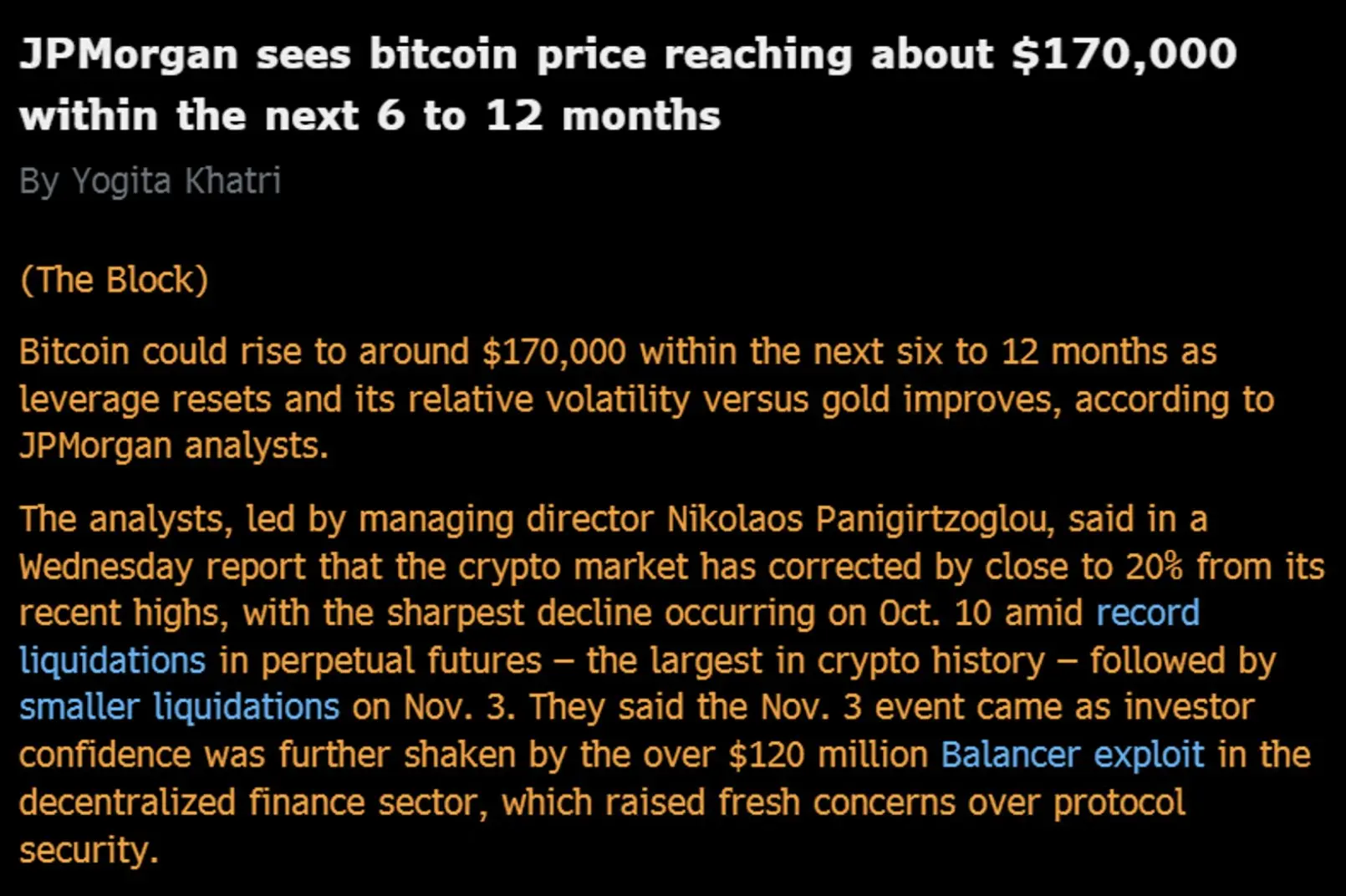
JPMorgan maintains a long-term positive outlook for Bitcoin, with a theoretical price near $170,000, meaning that if market conditions stabilize, Bitcoin could see a substantial increase in value over the next 6 to 12 months. This forecast uses a framework comparing Bitcoin and gold as stores of value.
Gold’s total market value is about $29.31 trillion. Since Bitcoin’s volatility is higher than gold’s, JPMorgan applies a discount when calculating Bitcoin’s theoretical fair value. The analyst team led by Nikolaos Panigirtzoglou notes that Bitcoin continues to behave like gold during periods of market stress.
JPMorgan’s model explains the significant volatility difference between Bitcoin and gold. Over the past three months, gold has risen 17.17%, while Bitcoin has fallen 19%. Year-to-date, gold is up 60.01%, while Bitcoin is down 8.2%. Over a five-year period, gold has risen 125.97%, while Bitcoin has fallen 3.4%.
According to CoinGecko data, as of December 5, Bitcoin was trading at $89,251, down 3.2% from 24 hours earlier. This price leaves about 90% upside to the $170,000 target, and if achieved within 6 to 12 months, would be among the strongest rallies in crypto market history.
JPMorgan strategists note that several factors are impacting Bitcoin’s current trend. Recent risk-off sentiment has pressured the crypto market, and shifts in 2026 interest rate expectations have also affected market dynamics. The bank believes that during periods of macroeconomic volatility, Bitcoin’s trading patterns will continue to resemble those of gold. Crypto-supporting analysts point out that broad institutional adoption, increasingly mature market structure, and Bitcoin’s limited supply are factors supporting its long-term resilience.


