Author: Kev.Ξth, Crypto Researcher
Compiled by: Felix, PANews
The following 10 key points are based on Vitalik’s interpretation of Public Goods Funding (PGF) in 2026 as well as recent surveys using public data and user-reported data.
Potential directions for the PGF sector after reforms:
- Traditional funding still accounts for a significant proportion, but innovative on-chain PGF mechanisms are beginning to take shape.
- Verifiable mechanisms replace unverifiable ideas: on-chain PGF has shifted from a charity model to a verifiable, liquid, and dependency-driven funding model.
- Privacy and open source first: focus on public goods critical to Ethereum’s survival.
- Funding dependencies: Systems like Deep Funding allocate funds based on real upstream impact, not just popularity.
- Sustainable revenue streams: Sequencer fees, open source license models, and yield-based PGFs (like Octant) create ongoing funding support, rather than relying on donors showing up.
- AI + ZK become coordination technologies: AI assesses massive dependency graphs, ZK enables privacy-preserving, manipulation-resistant governance.
- Federated funding: L2s, appchains, and protocols each fund their own ecosystems; if dependencies exist, alliances are formed—a network of many PGF funding sources instead of reliance on a single large pool.
- Diversity as strength: Multiple PGF innovators (e.g., Gitcoin, OP, ARB, CLRFund, Giveth Drips, Octant, Nouns, etc.) enhance antifragility, spur innovation, and reduce monopoly risk.
1. Current Funding Sources
a. Mainly from traditional grants (reliable legacy channels)
Currently, the vast majority of Ethereum public goods funding still comes from L1 and L2 traditional grant programs, such as the Ethereum Foundation, Stellar, Optimism, Arbitrum, etc.
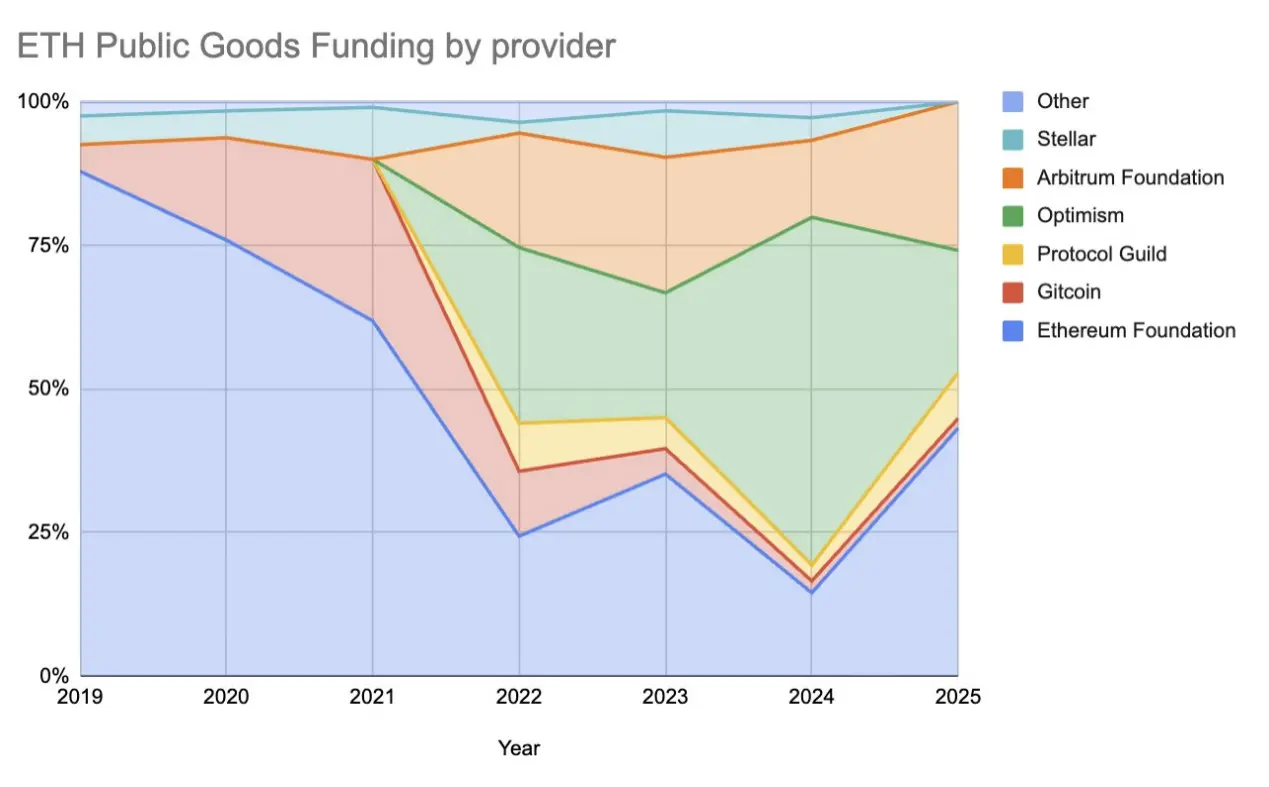
(Treemap of funders by USD allocation—percentage format)
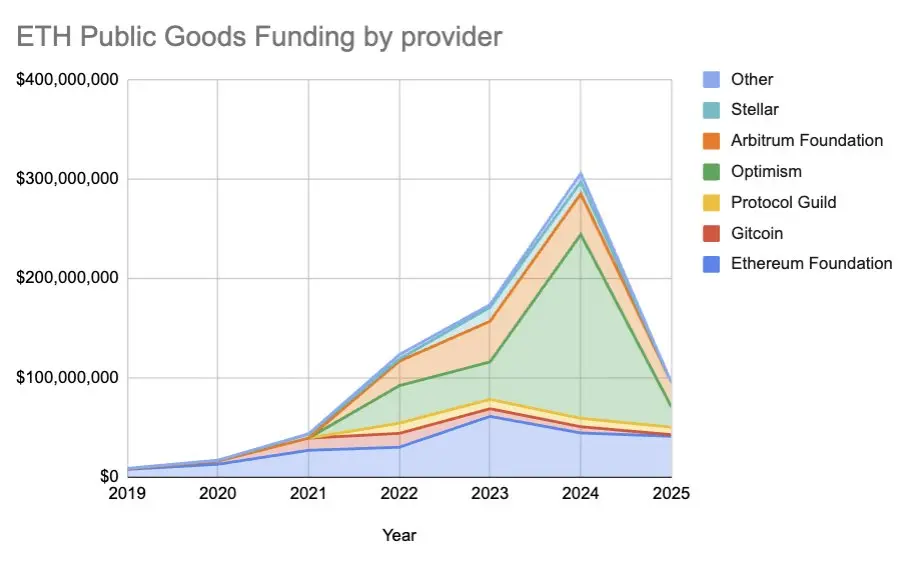
(Treemap of funders by USD allocation—absolute value format)
b. Innovative Long Tail Effect
Gitcoin and MolochDAO were early exceptions to the L1/L2 grant monopoly from 2019 to 2021—their independently raised and distributed funds accounted for only a single-digit percentage of the ecosystem’s total at the time.
In 2022, Protocol Guild emerged, quickly becoming a major funding pillar.
Since then, a series of experiments and innovations have created a rather long cycle.
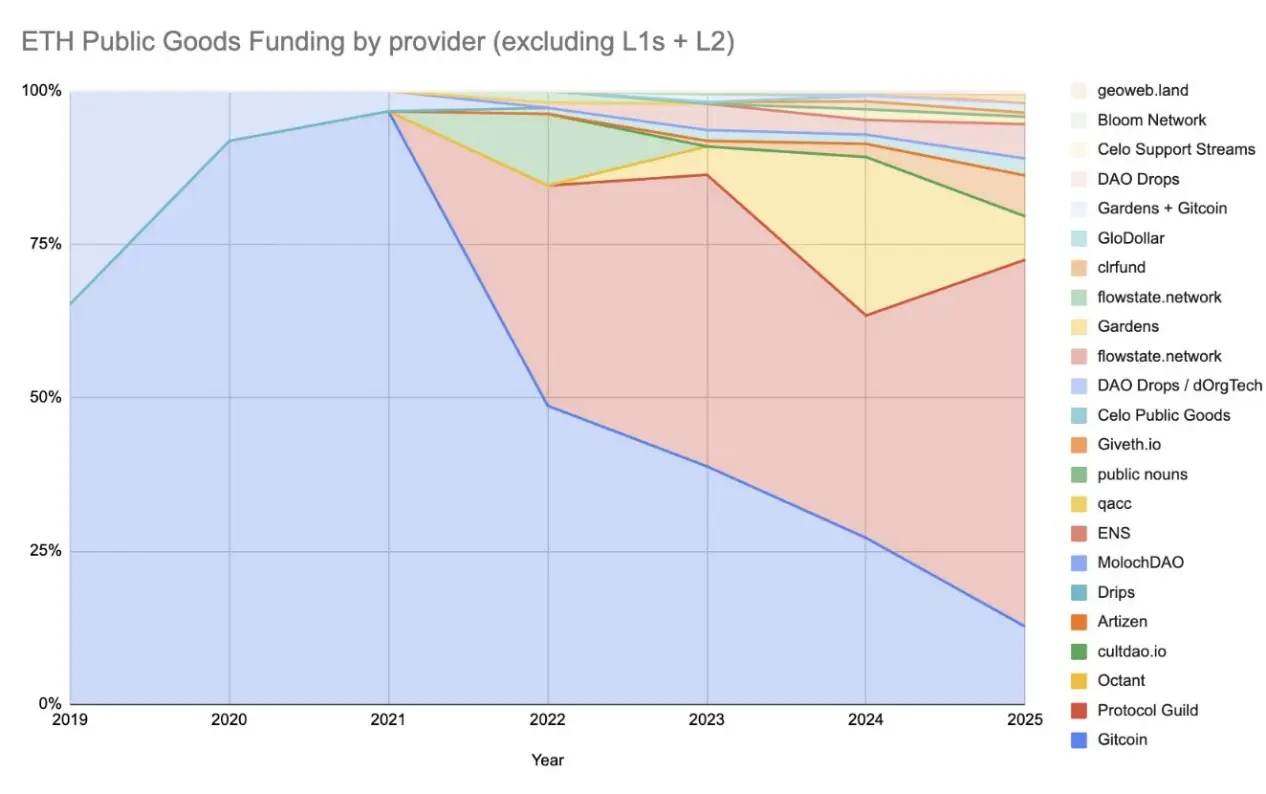
(Non-L1/L2 funders by USD grant allocation treemap—percentage format)
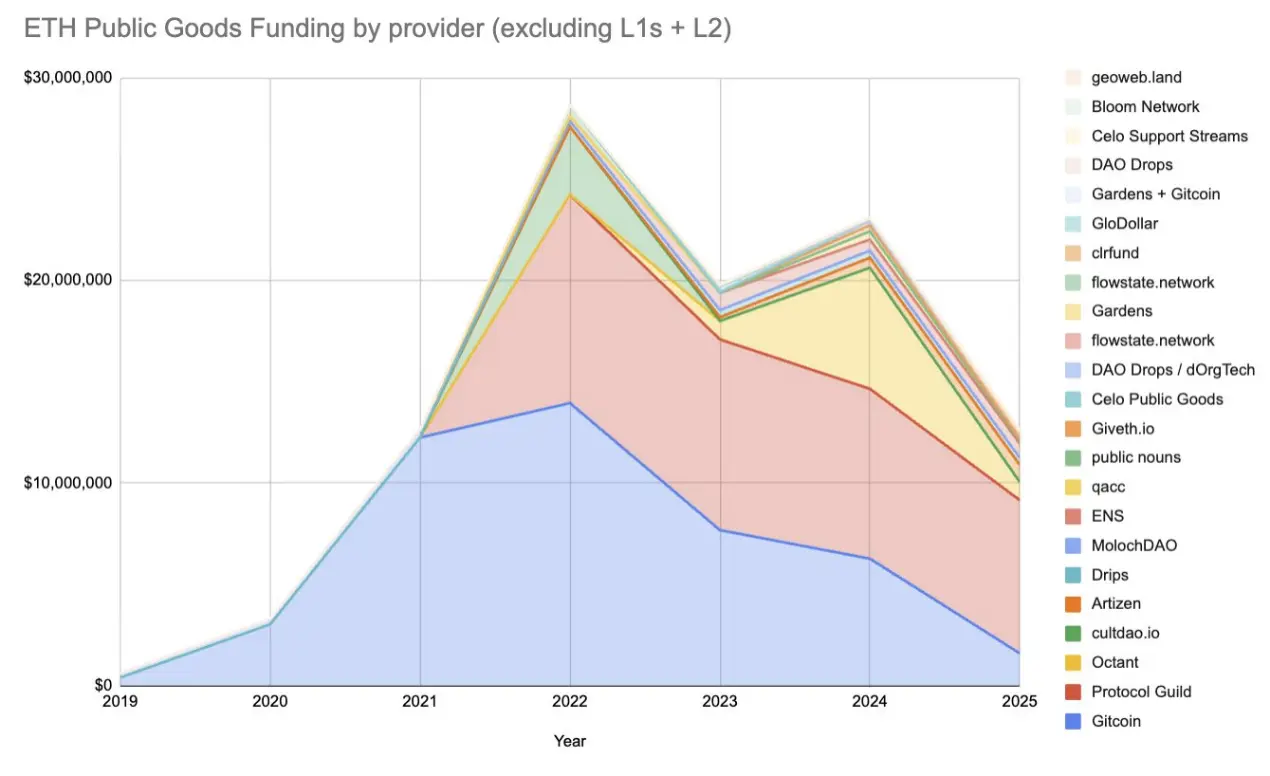
(Non-L1/L2 funders by USD grant allocation treemap—absolute value format)
2. Diversity Is a Feature, Not a Bug
In Ethereum’s early days, the Ethereum Foundation was the main funder of public goods.
In 2019 and 2021, Gitcoin and MolochDAO introduced new on-chain funding mechanisms for Ethereum public goods.
2021 saw an explosion of innovation: Protocol Guild, Optimism, Arbitrum, Drips, Octant, DAO Drops, CLR.Fund, Public Nouns, CultDAO, and more.
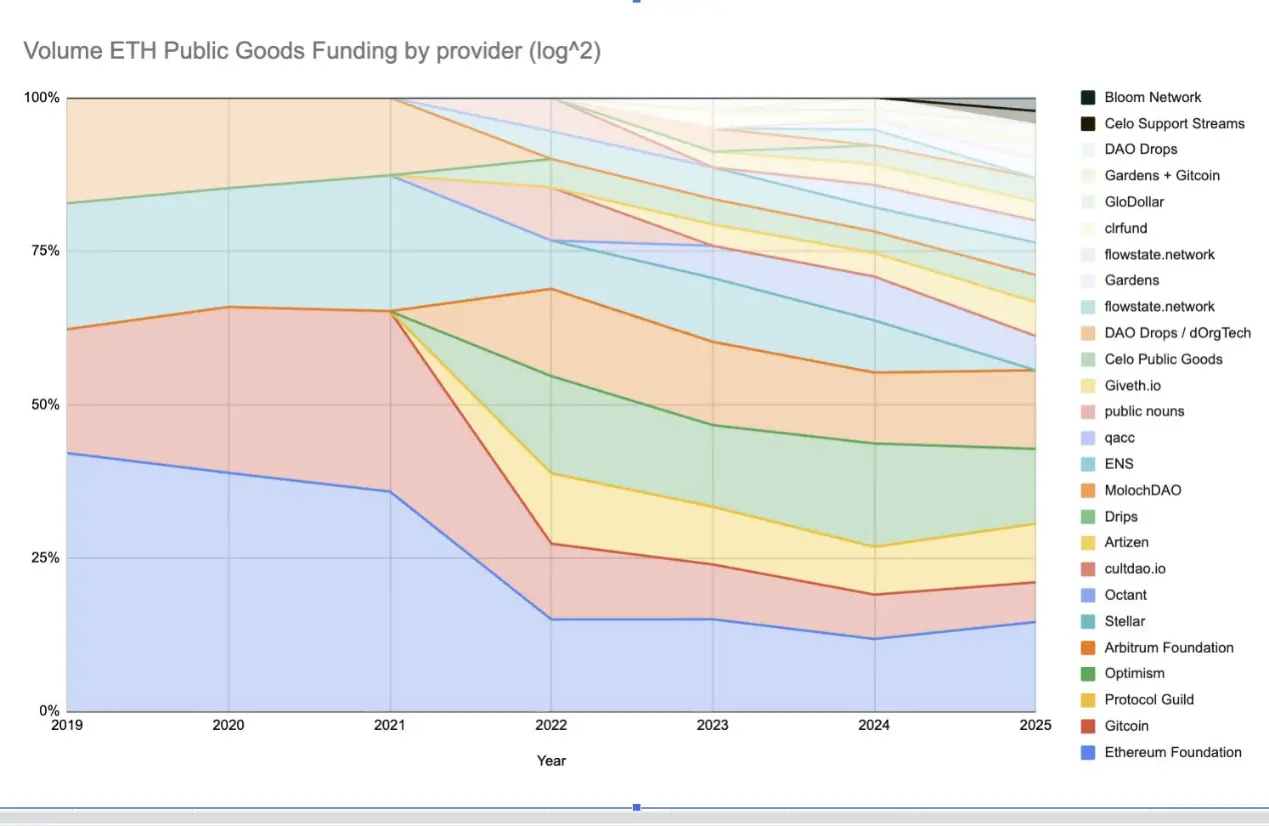
(Logarithmic squared treemap of funder allocations)
By 2025, diversity of public goods funding sources seems to have become the norm. This is a positive development, akin to customer diversity for funding sources.
Benefits include:
- Reducing risk of capture or control
- Expanding the audience for great ideas, accelerating innovation
- Building redundancy
- Preventing any single funder from becoming a “kingmaker”
- Allowing builders to bypass broken systems
- Highly aligned with the ethos of Ethereum
3. The “vibes era” is completely over
PGF in 2021 leaned towards “regen vibes,” with funds circulating rapidly and people donating to each other.
After a period of stagnant ETH prices, industry-wide contraction, and the decline of vibes-based grants, the trend has shifted.
The future belongs to verifiable, precise, income- or yield-driven structural funding.
The reformed PGF sector focuses on:
- Proof of impact, not vibes
- Targeted funding, not “fund everything”
- Mechanisms that can survive in a chaotic and adversarial world
- Core infrastructure essential to Ethereum’s survival
- Sustainable funding sources, like income or yield
The 2021 Quadratic Funding era assumed a more universal and abundant altruism.
PGF in 2026 assumes a chaotic, fragmented world and builds credibility from the ground up at the architectural level.
The biggest unlock of reformed PGF: shifting from “praying for donors” to structural, sustainable funding streams.
Here are some possible directions:
4. Structured, Sustainable Revenue Streams
To scale PGF, revenue centers must be connected to cost centers. Currently, most project revenue comes from L1 block rewards, L2 sequencer fees, and DeFi protocol fees. These flows already fund a provable public good: blocks. Proof-of-Work / Proof-of-Stake mechanisms make block production quantifiable, so rewards can be automatically distributed. This creates a clear loop.
The problem is that most other public goods can’t prove their value, so their funding relies on goodwill, grants, and politics rather than inherent economic mechanisms.
The shift post-2026 is to close this gap: Deep Funding, open source protocol licensing, Protocol Guild, etc., make more public goods as provable as block production. Once impact is visible, revenue from L1, L2, and DeFi can consistently flow to these cost centers.
Long-term vision: expand the scope of provable public goods so PGF becomes structural, not charitable. When revenue centers can see and support their dependencies, the flywheel becomes self-sustaining.
5. Open Source Licensing as a Revenue Engine
This is an entirely new concept:
- Add a Harberger-style “Openness Tax” into open source licenses
- Make “fund your dependencies” a rule
- Only require profit sharing if someone closes the code
This way, the trillions of dollars in business built on open source can be transformed into a small, steady, and sustainable PGF funding stream.
6. Yield-Based PGF
People are more willing to donate yield rather than principal. This matters both psychologically and structurally.
Octant is the flagship and absolute leader in this segment.
Privacy and open source are priorities
These two are critical.
- Open source—Ethereum runs on open protocols. Funding dependencies is good practice. It’s also a great way to connect with the real world.
- Privacy—Privacy prevents PGF and governance from becoming bribery markets. ZK and programmable cryptography are key to this. Both are pillars of the reformed PGF tech stack.
7. Funding Dependencies
Deep Funding is the flagship project here.
- Build a real internet dependency graph
- Use AI to rank millions of edges
- Use reviewers for spot checks
- Allocate funds based on real upstream value
Most importantly: accountability is internalized. For example, if users stop using your service, you stop getting paid. No more “zombie” projects surviving just because of connections.
8. L2 and Appchain Polycentric Tree Structure
From a macro perspective, PGF architecture is becoming polycentric: each L2, appchain, and protocol funds its own dependencies, and these funds spread outward like mycelium.
No longer does a single big donor try to fund everything; instead, federated funding emerges: many smaller ecosystems each support their dependent public goods, together covering the entire stack.
Embedded economic incentives replace “universal charity.” When each layer funds its upstream dependencies and there is overlap between layers, the ecosystem forms a resilient funding coalition.
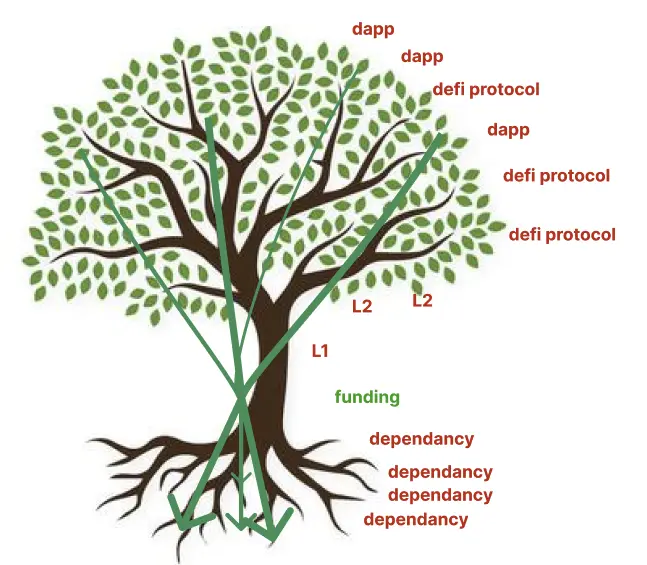
(A child’s-eye view of how funds flow at large scale)
9. New PGF Builders Should Be Compatible with New, Not Old, Systems
New PGF builders should focus on compatibility with new systems, not the old:
- Most legacy treasuries resist change
- New ecosystems want growth, move fast, and embrace new tools
If you’re building new PGF infrastructure in 2026, your energy should focus on the frontier: new ZK ecosystems, new appchains, new open source software licensing standards.
Note: There are exceptions—Filecoin and Gitcoin, for example, are prioritizing support for new PGF mechanism builders, and there are surely others doing the same.
10. New PGF Builders Must Leverage Two Superpowers: AI + Cryptography
Reformed PGF is made possible by the maturity of two technologies:
Artificial Intelligence:
- Assist jurors
- Assess massive dependency trees
- Provide explainable reasoning
- Power always-on on-chain mechanisms
ZK / Programmable Cryptography:
- Guarantee privacy
- Ensure credible neutrality
- Reduce manipulation
AI provides scale, ZK provides integrity.
Conclusion
Overall: Funding for Ethereum public goods isn’t dying, it’s transforming. The “vibes” era is fading, revealing a more persistent, mechanized, scalable PGF ecosystem underneath.
The last cycle exposed the limits of charity, the fragility of vibes, and the danger of relying on a single funding source. The next cycle will be marked by diversity, verifiability, sustainable revenue streams, and new privacy + AI technologies that truly work at internet scale.
If 2017–2021 was about discovering the importance of PGF, and 2021–2024 was about bold experimentation, then 2026 and beyond are about putting lessons into practice: fund your dependencies, build provable systems, embrace federated funding, and use AI and ZK to turn funding from art into engineering.
We’re heading toward a world of continuous funding flows, not round-by-round fundraising, where open source and privacy are viewed as true survival infrastructure.
The road ahead isn’t easy, but it’s exciting. This is the frontier. If done right, we’ll leave behind a PGF system more credible, antifragile, and regenerative than anything before. If you’re building in this space: now is your moment.
Further Reading: Major Overhaul of Ethereum Foundation Grants: Focus on Strategic Tracks, Mentorship Programs Supporting Founders


