Standard Chartered just significantly revised its Bitcoin price forecast, cutting the end-of-2025 target in half to $100,000 from the previous $200,000, while pushing back the $500,000 projection by another two years — to 2030 — after recent price movements forced the bank to reevaluate its model.
In the report dated December 9, Geoffrey Kendrick, Head of Global Digital Asset Research at Standard Chartered, stated that market developments “necessitated an adjustment” to their targets, although the roughly 36% drop from the all-time high in October to around $80,500 at the end of November remains “within normal expectations” compared to previous correction cycles since the US spot ETF launched.
“Our previous short-term targets were incorrect,” Kendrick wrote, but reaffirmed that the bank still believes Bitcoin will eventually reach $500,000.
According to the new roadmap, Standard Chartered forecasts Bitcoin reaching $100,000 by the end of 2025, $150,000 in 2026, $225,000 in 2027, $300,000 in 2028, and $400,000 in 2029, before hitting the $500,000 mark in 2030. Previously, the bank set targets of $200,000 for 2025 and $500,000 for 2028.
Main Drivers of Change: Corporate Buying Power Has “Maxed Out”
Kendrick believes the two main drivers of the recent price rally since the ETF approval are ETF inflows and purchases by “digital asset treasury” companies — publicly listed firms holding large amounts of Bitcoin on their balance sheets such as Strategy (MSTR) and some miners.
However, he notes that this second wave of buying has reached its limit.
According to the bank, Bitcoin purchases by the DAT group “have hit a ceiling,” as valuation metrics like mNAV (market-cap-to-bitcoin-value) no longer support balance sheet expansion.
With total net asset value (mNAV) decreasing and the mNAV of Strategy itself falling below 1.0 for the first time since 2023, Kendrick predicts a consolidation among smaller companies rather than new accumulation waves from large conglomerates.
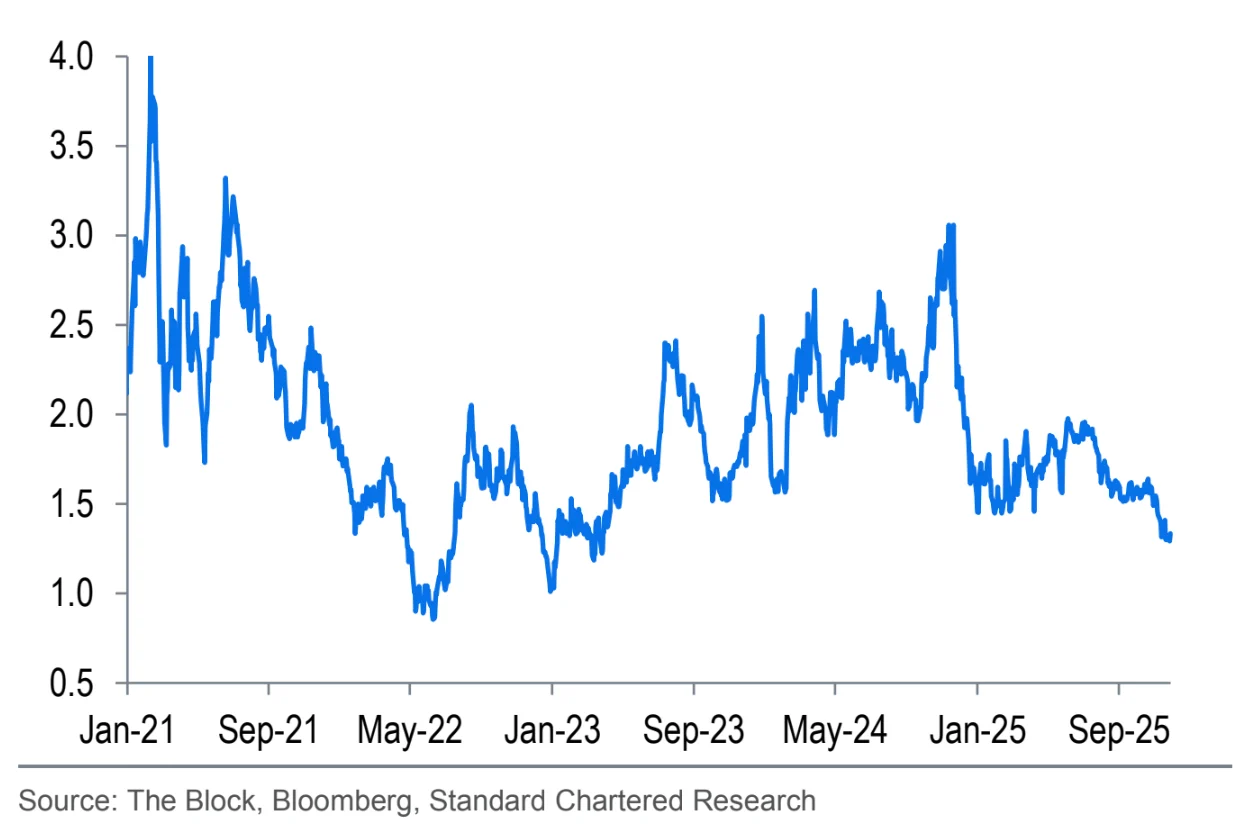
Nonetheless, Standard Chartered does not expect major holders to sell off. Strategy’s average cost basis is around $74,000 — still profitable — and in the previous cycle, the firm did not sell despite prices dipping below this average.
Therefore, the new model assumes “no more DAT buy flows” and ETF capital flows remaining at roughly 200,000 BTC per quarter — enough to create new highs before, but now serving as the sole demand pillar.
ETF Replaces Halving Cycle as a Leading Factor
Kendrick dismisses the view that the current correction signals the start of a new “crypto winter” tied to the halving cycle. Although the recent peak occurred about 18 months after the 2024 halving — similar to previous cycles — he argues that the fundamental drivers have shifted.
“With ETF inflows, the halving cycle is no longer a price driver,” the report states. “Long-term ETF investors are far more important.”
Analysis indicates that large capital injections from ETFs and corporate buyers — approximately 250,000 BTC, 450,000 BTC, and an additional 250,000 BTC in rolling quarters — align with three major rally phases starting from March 2024, early 2025, and July 2025.
In contrast, the all-time high on October 6, 2025, occurred when quarterly purchases dropped to just 160,000 BTC, now down to about 50,000 BTC — the lowest since the spot ETF launched.
In this context, Kendrick views the current decline as more of a “storm before calm” rather than a market structure break, but admits that Bitcoin’s short-term dependence on ETF inflows is increasing.
Slower Pace, but Long-term Outlook Remains Very Optimistic
The report maintains a long-term bullish outlook based on optimal asset allocation rather than cycle timing. The bank’s Bitcoin–gold portfolio model shows the global portfolio is “under-allocated” in Bitcoin.
Based on Bitcoin’s historical volatility, the optimal allocation is 12% Bitcoin and 88% gold, whereas current market cap reflects roughly 5%/95%. Using the current three-month volatility, the optimal share could rise to 20%.
In a scenario using implied volatility for both Bitcoin and gold, the optimal allocation could go as high as 36%, implying a maximum upside potential of around 7 times if the market shifts according to this model.
Kendrick notes that the pace of actual allocation shifts may be slower than previously expected, especially as corporate drivers weaken. Still, he expects allocations to gradually increase as ETF access improves and more institutional investors incorporate digital assets into their strategies.
Standard Chartered reiterates that “the crypto winter is a thing of the past,” asserting that Bitcoin now plays a structural role in risk hedging for banks and amid the instability surrounding US Treasury bonds.
In conclusion, Kendrick admits that “the previous targets were too ambitious, but the destination remains unchanged.”
“We are lowering our Bitcoin price forecast to 2029,” he writes, “and extending the projection window to 2030 — when Bitcoin is expected to reach $500,000.”
JPMorgan: Bitcoin Still Has Room to Grow, No “Crypto Winter” in Sight
JPMorgan analysts stated on Tuesday that Bitcoin and many other digital assets still have room for growth, despite lingering concerns after the sharp correction of the largest cryptocurrency in the market last month.
Although many observers believe the dip to $81,000 last month could trigger a prolonged downturn, JPMorgan does not see signs of an impending “crypto winter.”
“Following last month’s developments, many worry the market may be heading into the next crypto winter,” the report states. “We do not believe the current rally cycle has ended, but the correction in November was notable.”
The bank notes that Bitcoin closed the month 9% below its start-of-year level, marking the first annual decline since May 2023. As of Tuesday, Bitcoin traded around $93,000, down about 1.5%.
Over the past 12 months, Bitcoin’s price has fallen 5% according to CoinGecko data. However, JPMorgan assesses that digital asset prices have been “pushed up significantly following the 2024 US presidential election,” coinciding with Donald Trump’s re-election.
Analysts also observe that market trading volume has declined sharply as the total capitalization of many tokens decreased by over 20% recently. Stablecoins, however, remain resilient, recording a 17th consecutive month of growth.
“We do not view recent corrections as signs of structural weakness in the crypto ecosystem. Our outlook remains positive,” the report concludes.
Notably, JPMorgan suggests that the four-year cycle linked to Bitcoin halving events is gradually losing influence as the market has undergone substantial change.
Based on Myriad’s forecasts, users now assess only a 6% probability of a crypto winter occurring before February 2026, down from 16% just four days ago.


