XRP is transforming from a competitor in the L1 ecosystem to a settlement infrastructure. Ripple has launched a compliant RLUSD stablecoin, forming a “dual asset pipeline” alongside XRP positioned near SWIFT. The US spot XRP ETF has attracted nearly $1 billion in institutional capital, but most retail investors remain focused on price speculation rather than settlement adoption rates, completely ignoring this valuation logic revolution.
The Narrative Revolution from Speculative Token to Financial Pipeline
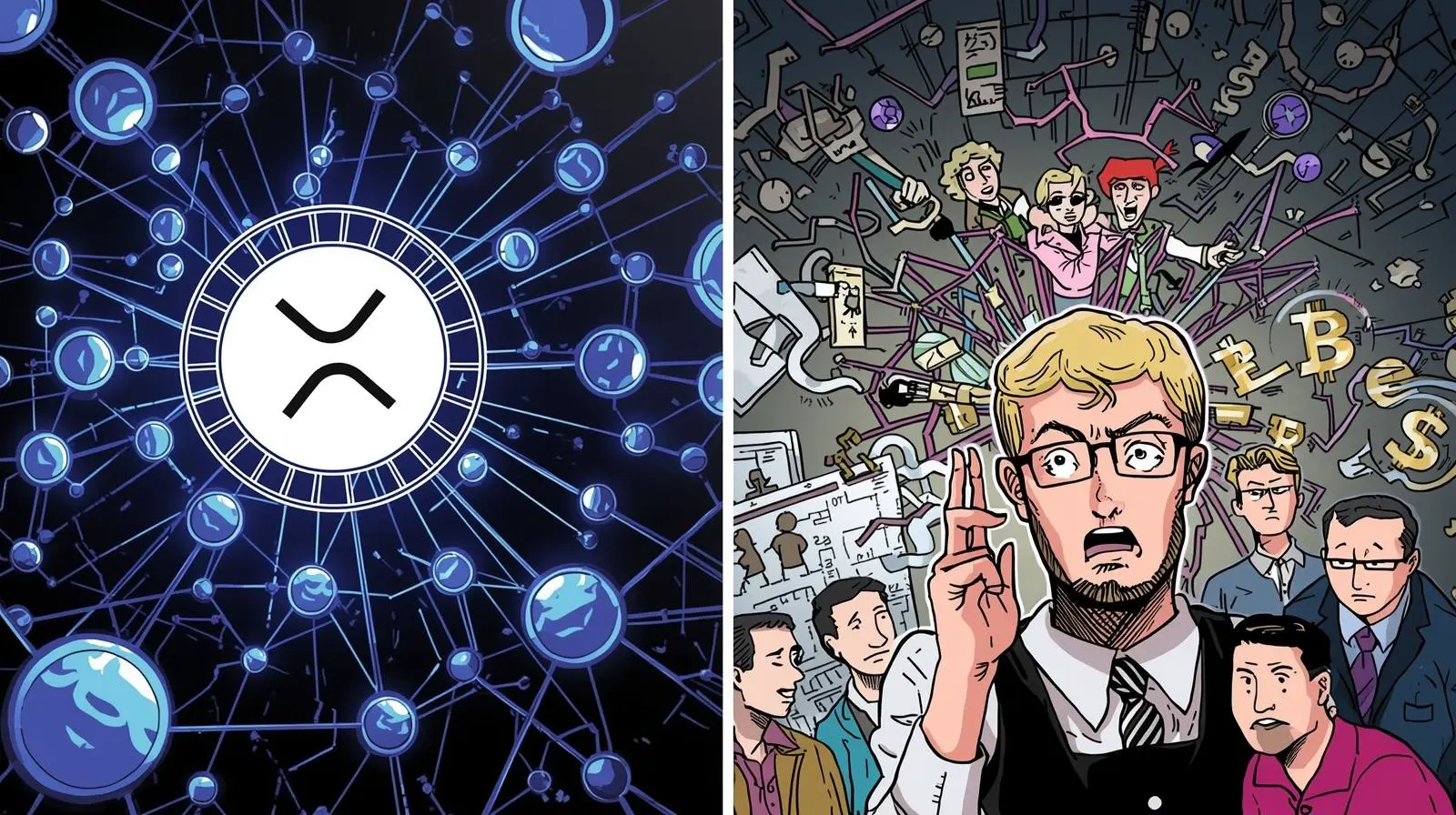
For years, XRP’s market characteristics have been influenced by various dynamics from the early crypto era: retail-driven speculation, regulatory uncertainty, and a deep-seated belief that blockchain technology could disrupt decades-old banking infrastructure. This narrative has been tumultuous, adversarial, and highly cyclical, because XRP’s performance fluctuates with court headlines and sentiment swings rather than measurable adoption.
However, as 2025 nears its end, different perspectives are emerging. XRP is no longer seen as just another participant in the fiercely competitive L1 ecosystem but is increasingly evaluated from the standpoint of settlement infrastructure. This narrative is not rooted in token appreciation or ecosystem expansion but in whether XRP can serve as part of a liquidity and messaging stack, ultimately enabling the circulation of tokenized dollars.
DAS’s report clearly articulates this shift. While the analysis does not claim that XRP has fully made this transition, it suggests the market has begun pricing in this possibility. Therefore, this redefinition, though subtle, is significant, because the question is no longer whether XRP will replace currencies but whether it can become part of the infrastructure that drives currency flow.
This valuation shift is reflected in changes in investor composition. Early XRP holders were mainly retail speculators focused on price swings and short-term trading opportunities. Yet, as the XRP ETF attracted nearly $1 billion from institutional investors, these investors are concerned with whether Ripple can become part of the global payments infrastructure, with investment cycles of 3 to 5 years or longer.
Policy Clarity and the Catalytic Role of RLUSD Stablecoin
The most obvious catalyst for this narrative shift is the alignment of US policy with Ripple’s product architecture. The signed and enacted GENIUS Act in July established the first federal regulatory framework for payment stablecoins. The law requires stablecoins to be backed by sufficient reserves, subjected to strict regulation, and have transparent redemption mechanisms, transforming stablecoins from regulatory gray areas into qualified settlement tools for enterprises and financial institutions.
Ripple’s stablecoin RLUSD fully complies with this framework. Launched at the end of 2024 and custodized by BNY Mellon, its supply has steadily grown to about $1.3 billion. Institutional investors see this as Ripple’s first issuance of a compliant fiat-backed asset. Meanwhile, Ripple’s long-running lawsuit with the SEC was settled in August, removing structural obstacles that previously caused many institutions to blacklist XRP. Today, XRP is one of the few digital assets with a clear classification in secondary market trading.
This is the core of the “dual asset portfolio.” Crypto research firm Stern Drew notes that RLUSD, as a fiat-backed currency, and XRP, as a neutral bridge asset connecting different fiat systems, form a layered approach. XRP’s fast, deterministic settlement mechanism makes this design feasible, while its federated consensus model offers the predictability valued by financial teams.
These policy shifts are reflected in market behavior. According to SoSo Value data, the US spot XRP ETF has accumulated nearly $1 billion in inflows. Compared to Bitcoin or Ether, its scale is smaller. However, its audience is entirely different: funds are coming from investors who cannot access unregistered tokens but can hold fully regulated exchange-traded products.
Three Core Actions in Ripple’s Institutional Strategy
Acquisition of Custodian Palisade: Building bank-grade digital asset custody capabilities
Acquisition of global broker Hidden Road: Rebranded as Ripple Prime, offering institutional-level execution and credit functions
Launch of RLUSD stablecoin: Custodied by BNY Mellon, with a supply now reaching $1.3 billion
Through these acquisitions, Ripple has built a toolkit similar to traditional market stacks. While these developments do not guarantee XRP’s usage, they create a more credible platform for enterprises to test on-chain settlement. Overall, these shifts help explain why market participants are beginning to see XRP as a potentially practical component within broader payment architectures rather than just a speculative asset.
Valuation Model Shift: From L1 Metrics to Corridor Economics
If XRP is to evolve into financial infrastructure, then the assumptions underlying its valuation must also change. Traditional crypto indicators—such as developer activity, NFT trading volume, and L1 competition—do not well reflect a design optimized for assets held for only seconds at a time. Instead, XRP’s value is closely tied to corridor economics, including transaction throughput, liquidity depth, pathfinding efficiency, and its ability to compress foreign exchange spreads.
This shift in valuation logic addresses the core discrepancy between retail and institutional perceptions. Retail investors tend to evaluate tokens based on market cap rankings, 24-hour trading volume, and community activity. But for institutions, XRP’s value lies in its ability to reduce cross-border payment costs, shorten settlement times, and provide predictable liquidity. These metrics are not directly visible on CoinMarketCap and require deeper analysis of Ripple’s enterprise partnerships and actual settlement data.
However, this argument also faces challenges. Theoretically, if global liquidity becomes concentrated among a few well-regulated issuers or bank-backed tokenized deposits, stablecoins might replace the need for intermediaries. In such a scenario, transfers among stablecoins could dominate, diminishing XRP’s intermediary role. Furthermore, asymmetric adoption could exacerbate this risk. Ripple claims over 300 institutional partners, but most use RippleNet’s messaging layer rather than settling value directly on-chain.
Converting these insights into active settlement participation requires redesigning operational workflows. The concentration of XRP tokens is another structural issue—Ripple and related entities still hold large reserves of XRP. Currently, a missing piece is scalable, on-chain, bank-grade settlement. Unless banks begin transmitting value within a decentralized system, the narrative shift for XRP remains largely theoretical.
Disclaimer: The information on this page may come from third parties and does not represent the views or opinions of Gate. The content displayed on this page is for reference only and does not constitute any financial, investment, or legal advice. Gate does not guarantee the accuracy or completeness of the information and shall not be liable for any losses arising from the use of this information. Virtual asset investments carry high risks and are subject to significant price volatility. You may lose all of your invested principal. Please fully understand the relevant risks and make prudent decisions based on your own financial situation and risk tolerance. For details, please refer to
Disclaimer.


