In January 2025, when news broke that the Phemex exchange had lost $69 million due to a vulnerability, few realized that this was just the prelude to a systemic collapse. By December, when Yearn Finance faced a severe blow, the entire Crypto Assets industry had accumulated losses of over $3.4 billion, of which $2.02 billion—almost 60% of the total losses—flowed to the North Korean Hacker group “Lazarus.” This figure not only set a historical record but also exposed the deep vulnerabilities of the Crypto Assets ecosystem.
A systemic security collapse
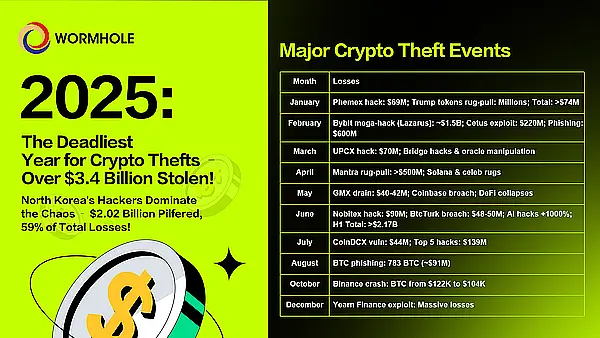
The attacks in 2025 exhibit unprecedented levels of organization and professionalism. Unlike the scattered and opportunistic attacks of the past, the attacks this year are planned, structured, and strategic.
In February, the Lazarus Group launched an attack on Bybit, stealing approximately $1.5 billion in a single incident, a figure that exceeds the total losses for the entire industry in 2024. The attack was not a random occurrence, but was based on months of analysis of the exchange's architecture, risk control systems, and fund flows.
In June, the industry saw a dangerous signal: AI-driven Hacker attacks increased by over 1000% year-on-year. The attack tools are becoming more intelligent, and traditional rule-based security defenses are beginning to fail.
The annual trend shows that attackers have formed a complete attack chain: from intelligence gathering (analyzing on-chain data to identify high-value targets), exploiting vulnerabilities (developing or purchasing 0day vulnerabilities), implementing attacks (multi-path coordinated intrusions), to fund transfers (washing coins through mixers and cross-chain bridges).
More than 75% of major attacks exploit the same vulnerability: the transparency of blockchain. Attackers can precisely identify exchange hot wallet addresses, DeFi protocol treasury locations, large holder position dynamics, and even predict large transfer times by analyzing publicly available on-chain data. This transparency should be an advantage of blockchain, but in the hands of advanced attackers, it has become the best tool for mapping out “attack maps.”
Privacy Technology: A Cognitive Shift from Edge to Core
Before 2025, privacy technology was often associated with negative labels such as “money laundering” and “illegal transactions.” However, the catastrophic losses of this year prompted the industry to rethink the fundamental meaning of privacy.
The technical architecture of the Wormhole protocol provides an important perspective. This protocol does not seek complete anonymity but focuses on increasing the complexity and cost of transaction tracking. Its core mechanisms include:
1 Multi-layer Cross-chain Splitting: Randomly split a transaction into up to 50 sub-transactions, executed in parallel on 2-3 different chains. After completing each layer of splitting, the funds will be randomly split again and transferred across chains, allowing for up to 4 layers of such operations. Actual tests show that for each added layer of splitting, the difficulty of on-chain correlation analysis increases by more than 10 times.
2 Dynamic Address Pool: The protocol maintains an address pool contributed by community nodes and hosted by the platform. Each transaction uses a brand new address, and the same address is never reused. This design fundamentally cuts off the possibility of analyzing user behavior patterns through address association.
3 Confusion of Time and Amount: A random delay of 10 minutes to 3 hours will be added before and after each transaction execution, and the transaction amount will also be randomly split (ranging from 1% to 100%). This dual randomization renders analysis methods based on time series and amount patterns ineffective.
The design philosophy of Wormhole represents a new direction for privacy technology: not just hiding transactions, but also protecting them. Its goal is not only to help users evade regulation but also to prevent users from becoming precise targets of advanced attackers through technical means.
The entry of state actors changes the game rules
The $2.02 billion spoils of the Lazarus Group reveal a harsh reality: the security of Crypto Assets has escalated from technical confrontations to asymmetric warfare between nations. State-backed Hacker organizations have several significant advantages:
Unlimited Resources: It is possible to invest months or even years in preliminary reconnaissance, develop or purchase expensive 0day vulnerabilities, and deploy complex attack infrastructure.
Persistence of Action: Not constrained by the pursuit of short-term returns by commercial companies, capable of executing complex attacks that require long-term stealth and multi-phase implementation.
Money Laundering Specialization: Through state-controlled financial channels and specialized mixing networks, it is able to efficiently clean large-scale stolen funds, making it extremely difficult to trace.
Target Strategy: No longer pursuing small quick profits, but aiming for high-value targets that can cause systemic impact all at once.
Facing such opponents, traditional security thinking has completely failed. Technologies such as firewalls, multi-signatures, and cold storage are still necessary, but they are no longer sufficient. What the industry needs is a systematic, ecosystem-level privacy protection solution.
Rebalancing Transparency and Privacy
The lessons of 2025 force the industry to re-examine the fundamental attributes of blockchain. The design of a fully transparent ledger is elegant in theory, but in practice, it brings unexpected security risks.
The Security Cost of Transparency:
● The exchange's hot wallet address is public, becoming a target for continuous attacks.
● Large holders' positions are transparent, making them easy targets for social engineering and targeted attacks.
● The flow of funds in the protocol is traceable, and attackers can accurately calculate their attack profits.
● The trading model can be analyzed, which is beneficial for hackers to plan the best attack timing.
Privacy as a Complement to Security Rather than Opposition: An important development direction for the new generation of privacy technologies is “verifiable privacy.” Technologies represented by zero-knowledge proofs allow users to prove the compliance of transactions to regulators or auditors while hiding transaction details. This means that privacy and compliance are no longer mutually exclusive propositions but can be concurrent goals.
The “smart custody” feature in the Wormhole protocol actually explores this direction. Through the Rosen Bridge cross-chain protocol, the system can ensure that the flow of funds complies with preset rules and risk control requirements while protecting user transaction privacy.
Technical Insights from 2025 Events
From a technical perspective, the major attack incidents of 2025 revealed several key vulnerabilities:
Cross-chain bridges have become a major target for attacks: Due to the need for cross-chain bridges to centrally manage a large amount of assets and the complexity of their technical implementation, they have become a primary target for attackers. The multi-chain parallel split strategy adopted by Wormhole actually mitigates this risk—if a certain chain or bridge encounters issues, it only affects a portion of the funds rather than all.
Oracle Manipulation Becomes a New Threat: In the March 2025 attack, oracle price manipulation led to a chain liquidation of multiple DeFi protocols. Privacy protocols can mitigate such attacks by severing direct price dependencies or by introducing multi-source, delayed price data.
AI-Driven Attack Paradigms: As AI tools are used to analyze on-chain patterns, identify vulnerabilities, and automate attacks, traditional signature-based defenses are increasingly overwhelmed. Privacy technologies, by introducing randomness and complexity, essentially increase the difficulty and uncertainty of AI analysis.
Inevitable Adjustment of Regulatory Environment
The large-scale theft incident in 2025 will inevitably provoke a response from global regulatory agencies. It is foreseeable that:
1 Reassessment of Privacy Technologies: Regulators may shift from comprehensive prevention to conditional acceptance, especially for privacy solutions that support compliance audits.
2 Strengthening Cross-Border Cooperation: In response to state-sponsored hacker attacks, regulatory agencies in various countries may establish closer intelligence-sharing and joint action mechanisms.
3 Increased Security Standards: Exchanges, DeFi protocols, etc. may need to meet stricter security certification requirements, and privacy protection capabilities may become important evaluation indicators.
4 Evolution of Insurance Mechanism: As the risk landscape changes, Crypto Assets insurance products may require the insured to adopt certain levels of privacy protection measures.
Build the Next Generation of Secure Architecture
Based on the lessons of 2025, the next generation of Crypto Assets security architecture may need to include the following elements:
Foundation of Privacy Layer: Privacy protection should not be an afterthought feature, but rather a core layer considered from the very beginning of protocol design. This requires innovation at the foundational levels of the industry, including consensus algorithms, transaction structures, and account models.
Depth of Defense: A single defense method is no longer sufficient; it is necessary to establish a multi-layered defense system that includes privacy obfuscation, behavior analysis, threat intelligence, and emergency response.
Ecological Synergy: Different protocols need to share attack intelligence, collaboratively upgrade defense strategies, and form ecosystem-level security linkage.
Normalization of User Education: Ordinary users need to understand the correct use of privacy tools and recognize that in today's environment, not using privacy protection is equivalent to “running naked” in front of attackers.
Privacy as a Survival Skill
The year 2025 will be remembered as the “Year of Awakening” for Crypto Assets. The loss of $3.4 billion is not just a number, but a thorough reflection on the security concepts of the entire industry. As attackers have upgraded from individual criminals to state-sponsored teams, the defense must also shift from technological upgrades to systemic reconstruction.
Privacy technology plays a key role in this reconstruction process. It is no longer a moral debate about “what to hide,” but a practical skill about “how to survive.” Protocols like Wormhole demonstrate a possible path: significantly increasing the cost of attacks through technological means, without sacrificing the core values of blockchain, thus protecting ordinary users from professional attackers.
The future Crypto Assets ecosystem is likely to be privacy-enhanced, attack-adaptive, and ecologically synergistic. Projects that can deeply integrate privacy into their architecture are not only providing a function but are also building the foundation for the survival of the entire industry.
The cost of 3.4 billion USD is painful, but if this can truly make the industry value the strategic importance of privacy technology, then these losses may not be entirely in vain. After all, in the world of digital assets, the best defense is sometimes not thicker walls, but making it so that attackers can't find where the walls are at all.


