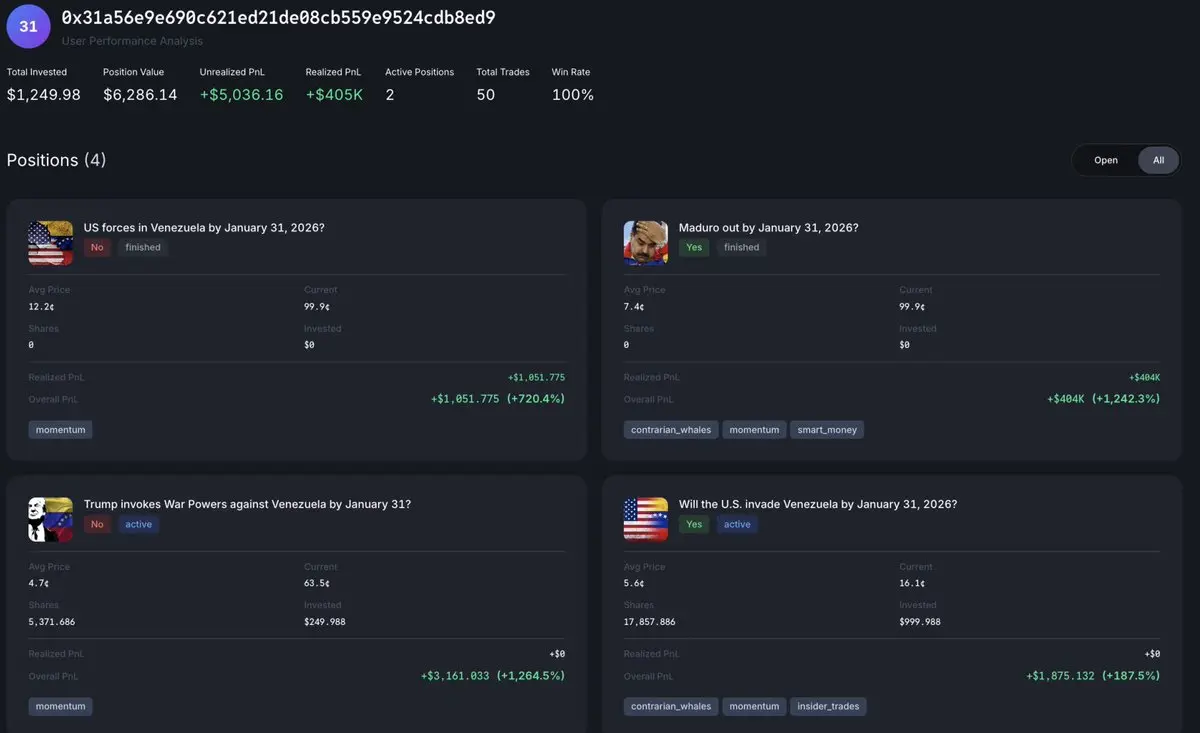
Prediction market platform Polymarket saw explosive trading activity hours before President Donald Trump announced the capture of Venezuelan President Nicolás Maduro in a U.S. military strike on January 3, 2026. Several accounts placed large bets on Maduro’s ouster, earning millions in profits—sparking accusations of insider trading on prediction markets.
(Sources: X)
Mysterious Bets Pay Off Big Before Official Announcement
One newly created Polymarket account wagered over $30,000 on “Maduro out of power” shortly before the operation. Within 24 hours of Trump’s confirmation, the position yielded approximately $400,000—a return exceeding 1,200%.
Another trader reportedly earned $80,000 overnight by monitoring unusual Domino’s pizza orders near the Pentagon—a long-standing informal indicator of late-night government activity. The trader automated alerts and bought heavily into the “U.S. strikes Venezuela?” market on Polymarket.
Trading data showed “Yes” shares surging in implied probability well ahead of public confirmation, fueling speculation of leaked intelligence.
Trump later confirmed on Truth Social: U.S. forces conducted a “large scale strike,” capturing Maduro and his wife, who were flown out of the country.
How Prediction Markets Enable “Insider Trading”
Unlike traditional financial markets, prediction markets like Polymarket openly allow—and even reward—bets based on non-public information, as long as they reflect accurate outcomes.
Participants freely trade event contracts (e.g., political outcomes, military actions) using private analysis or signals. The Maduro-related markets highlight how insider trading—prohibited in stocks—remains a core feature of prediction platforms.
Critics argue this creates an uneven playing field, while proponents claim superior information aggregation improves market accuracy.
The incident has intensified calls for oversight, with some comparing it to past cases where Google search trends or employee leaks preceded major announcements.
Regulatory Spotlight Intensifies on Prediction Markets
The surge in Polymarket volume—nearing $1 billion weekly—has drawn regulatory attention. U.S. state gaming commissions view certain contracts as unlicensed sports betting, issuing cease-and-desist orders.
Polymarket recently resumed U.S. access after a four-year hiatus, while crypto exchange is suing states to affirm CFTC jurisdiction over election-related markets.
Analysts warn that unchecked growth could invite stricter rules, especially as political contracts dominate trading.
Broader Market Reaction
Bitcoin briefly dipped below $90,000 on the news before rebounding above $91,000, liquidating over $60 million in short positions in an hour.
Oil markets remained muted, with analysts noting Venezuela’s diminished production (~1 million barrels/day) limits supply disruption risk.
Trump stated major U.S. oil firms would invest billions to rebuild infrastructure, signaling focus on long-term revival rather than immediate shortages.
Outlook: Prediction Markets at a Crossroads
The Maduro capture bets underscore Polymarket’s power—and controversy—as a real-time information aggregator.
While defenders praise efficiency, critics highlight ethical risks when sensitive events become tradable.
As prediction markets gain mainstream traction, 2026 could bring pivotal regulatory decisions balancing innovation with fairness and national security concerns.
The incident serves as a high-stakes example: in prediction markets, insider trading isn’t just possible—it’s often the winning strategy.
Disclaimer: The information on this page may come from third parties and does not represent the views or opinions of Gate. The content displayed on this page is for reference only and does not constitute any financial, investment, or legal advice. Gate does not guarantee the accuracy or completeness of the information and shall not be liable for any losses arising from the use of this information. Virtual asset investments carry high risks and are subject to significant price volatility. You may lose all of your invested principal. Please fully understand the relevant risks and make prudent decisions based on your own financial situation and risk tolerance. For details, please refer to
Disclaimer.


