Ethereum increases blob limit to 21 per block with the successful activation of the second “Blob Parameters Only” (BPO #2) hard fork, marking another seamless step in the network’s modular scaling roadmap.
(Sources: growthepie)
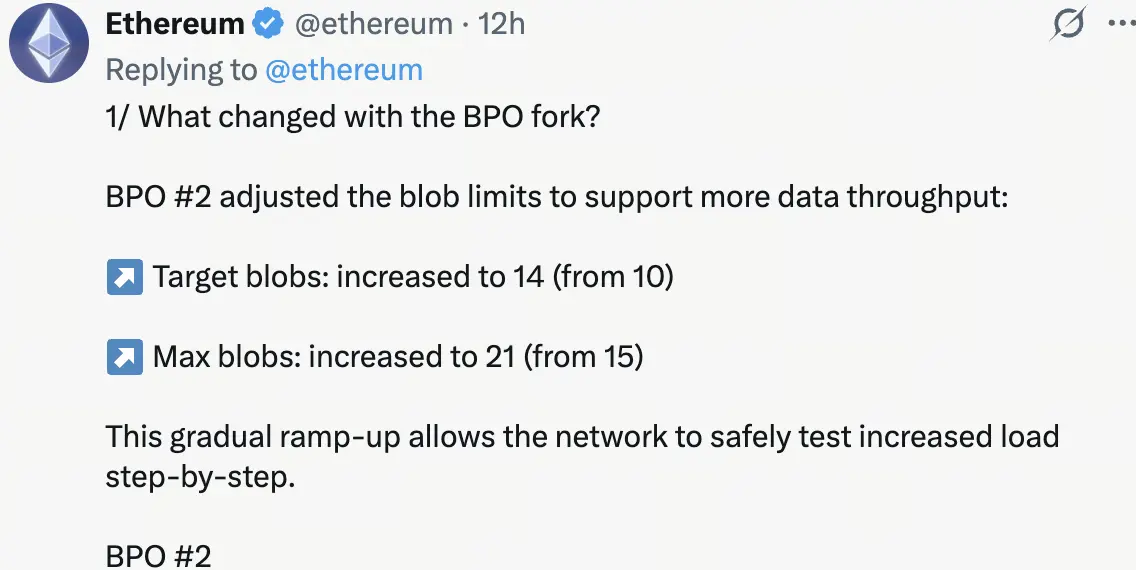
This targeted upgrade raises the target from 10 to 14 blobs and the maximum from 15 to 21—delivering approximately 40% more data availability capacity for Layer 2 rollups. In this analyst insight, we examine how Ethereum increases blob limit enhances ecosystem efficiency, reduces rollup costs, preserves decentralization, and positions the network far ahead of monolithic alternatives as of January 8, 2026.
What the BPO Upgrade Means When Ethereum Increases Blob Limit
The BPO #2 fork, activated smoothly at block 247904, introduces a unique parameter-adjustment mechanism inherited from the December 2025 Fusaka upgrade. Rather than bundling changes into large annual hard forks, Ethereum increases blob limit through focused, low-risk updates that incrementally expand capacity without compromising security or validator requirements.
- New Limits: Target 14 blobs/block; maximum 21 blobs/block.
- Capacity Gain: Up to 2.7 MB of rollup data per block (~40% increase).
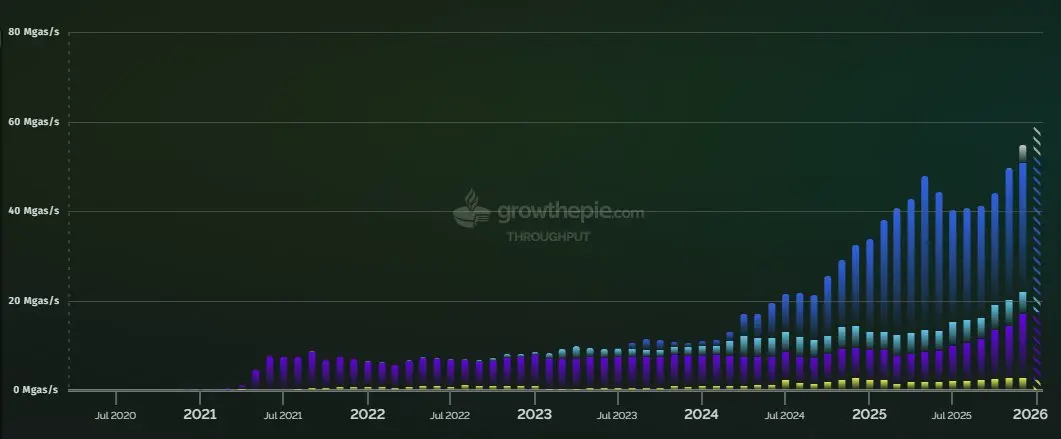
- Throughput Impact: Ecosystem-wide record of 59 million gas per second.
- Utilization: Rapid adoption post-activation, with high blob usage.
This approach allows Ethereum to scale dynamically in response to Layer 2 demand while maintaining Layer 1’s robust decentralization.
(Sources: X)
Impact on Layer 2 Ecosystems as Ethereum Increases Blob Limit
The additional blobs directly lower data posting costs for rollups, enabling higher transaction volumes at reduced fees. Leading L2s quickly capitalized:
- Base: Consuming ~44% of available blobs.
- Worldchain: Accounting for ~17%.
- Broader Effect: Projects like Lighter achieving potential 100k+ TPS.
Community figures like educator Anthony Sassano highlighted the immediate benefits, noting fee compression and record throughput as evidence of the upgrade’s success.
- Cost Reduction: Lower blob fees passed to end-users.
- Scalability Boost: Supports rising L2 activity without congestion.
- Modular Advantage: L1 focuses on security; L2s handle execution.
Why Ethereum Increases Blob Limit Preserves the Trilemma Solution
Unlike monolithic Layer 1 competitors that often sacrifice decentralization for speed (breaking at ~5k TPS), Ethereum increases blob limit while keeping over 1 million validators and no centralization trade-offs. The BPO mechanism exemplifies the modular roadmap’s success: secure settlement on Ethereum mainnet, affordable scaling via rollups.
- Decentralization Maintained: No hardware or stake concentration required.
- Security Intact: Minimal fork risk with single-parameter changes.
- Speed Achieved: Effective 100k+ TPS across L2s—higher than centralized alternatives.
- Community Sentiment: Described as an “engineering marvel” and “light years ahead.”
Technical and Market Outlook Post-Upgrade
Immediate post-fork data showed quick saturation of the new capacity, validating demand strength. Future BPO adjustments could further raise limits as needed, providing a flexible path to multi-megabyte blocks without disruptive overhauls.
- Short-Term: Continued fee relief and L2 growth.
- Medium-Term: Potential for additional BPO forks based on utilization.
- Long-Term: Reinforces Ethereum’s dominance in scalable, decentralized infrastructure.
In summary, Ethereum increases blob limit to 21 via BPO #2 demonstrates the network’s unique ability to evolve efficiently while solving the blockchain trilemma. By empowering Layer 2s with cheaper data availability and record throughput, the upgrade solidifies Ethereum’s modular advantage over monolithic rivals. As adoption accelerates, these incremental enhancements position Ethereum for sustained leadership in 2026 and beyond. Monitor blobspace dashboards and L2 metrics for ongoing impact, using official Ethereum resources and compliant tools for deeper analysis.
Disclaimer: The information on this page may come from third parties and does not represent the views or opinions of Gate. The content displayed on this page is for reference only and does not constitute any financial, investment, or legal advice. Gate does not guarantee the accuracy or completeness of the information and shall not be liable for any losses arising from the use of this information. Virtual asset investments carry high risks and are subject to significant price volatility. You may lose all of your invested principal. Please fully understand the relevant risks and make prudent decisions based on your own financial situation and risk tolerance. For details, please refer to
Disclaimer.
Related Articles
Bitcoin, Ethereum, and Solana ETFs Report Mixed Flow Data on March 26
Gate News bot message, according to the March 26 update, Bitcoin ETFs recorded a 1-day net inflow of +86 BTC (+$5.92M), while showing a 7-day net outflow of -898 BTC (-$61.97M). Ethereum ETFs experienced a 1-day net outflow of -4,439 ETH (-$9.17M) and a 7-day net outflow of -121,318 ETH (-$250.64M).
GateNews9m ago
ETH drops 0.81% in 15 minutes: ETF fund outflows and whale accounts' concentrated selling pressure cause short-term pressure
2026-03-26 15:00 to 15:15 (UTC), ETH's return over 15 minutes was -0.81%, with price fluctuations between 2058.1 and 2076.69 USDT, a volatility of 0.90%. Market volatility intensified, with rapid downward movement in a short period, drawing high attention from mainstream investors to capital outflows and market liquidity changes.
The main driver of this movement is the continuous large net outflows from ETH spot ETFs over several days. On March 26, 2026, the net outflow exceeded $40 million, with total ETF outflows surpassing $234 million, directly contributing to the decline.
GateNews33m ago
In the past 24 hours, the total liquidation across the entire network reached $253 million, with over 80% of the liquidations involving long positions.
In the past 24 hours, the total liquidation amount in the cryptocurrency market reached $253 million, with over 80% from long positions. BTC and ETH were liquidated for $68.88 million and $87.89 million respectively, involving a total of 90,432 traders. The largest single liquidation was $9.315 million.
GateNews34m ago
High-Stakes Volatility – Hyperliquid Whale Suffers $125K Liquidation Amid $5.59M ETH Long Position
Decentralized finance has enabled traders to have significant success with high-leverage trading; therefore, a trader who can handle high-risk volatility can significantly benefit from these high-risk/returns trades that exist today. Liquidation of the trader could have a significant effect on the e
BlockChainReporter45m ago
Next Crypto To Explode: ETH Boosts Security With New Network While SUI Targets $1 Amid Recovery But Traders Push To Join DeepSnitch AI As Launch Announcement Fuels 500x Moonshot Discussions
A new resource hub has been launched by a team of Ethereum developers to protect the Ethereum network against future quantum-computing attacks.
But still, investors are waiting for a project with potential to become the next 100x crypto. So far, only DeepSnitch AI (DSNT) has shown what it
CaptainAltcoin1h ago


