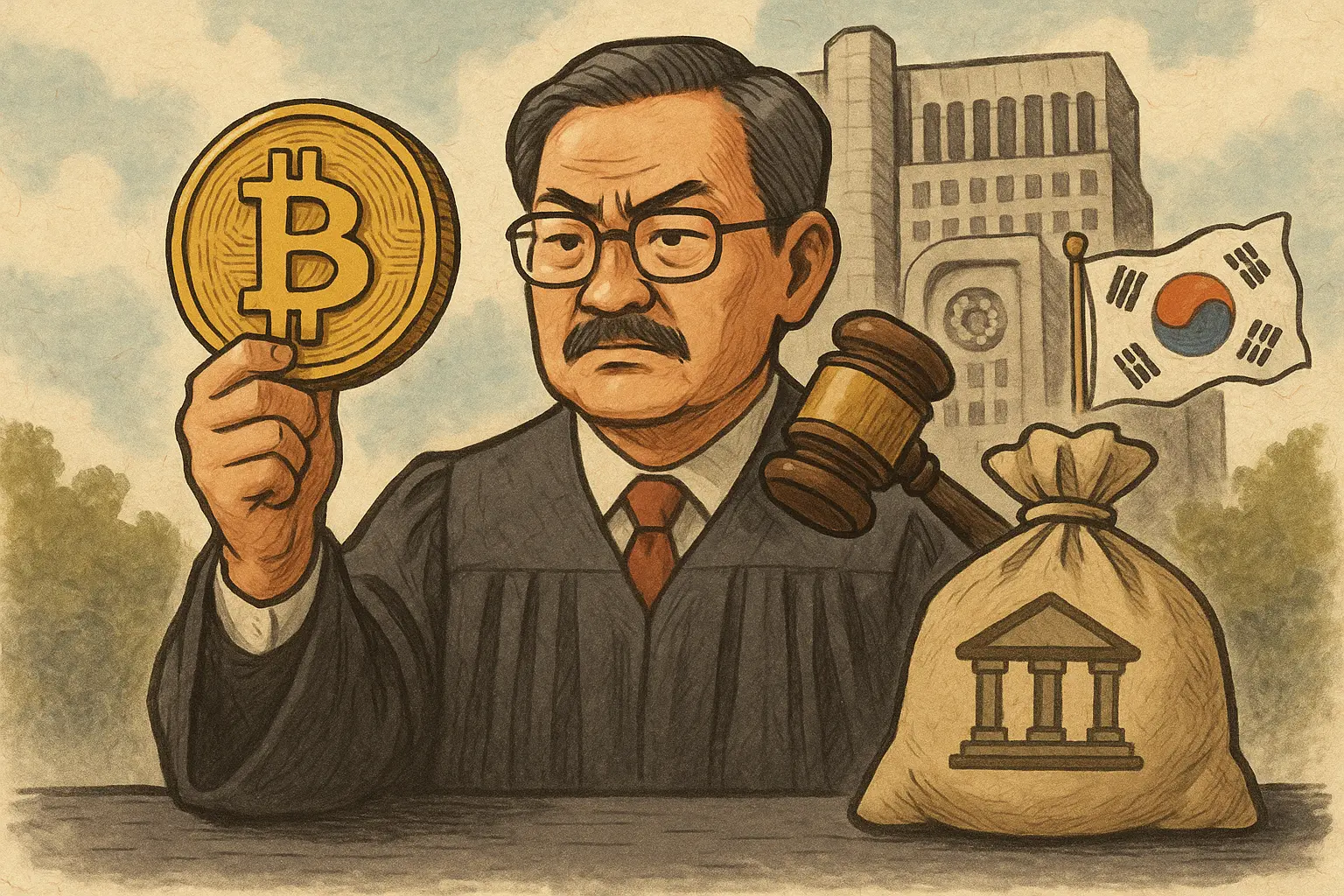
The Supreme Court of Korea has ruled that assets stored on exchanges, such as Bitcoin, can be lawfully seized, ending legal disputes. The case originated from the seizure of 55.6 BTC (worth $413,000), with the suspect claiming digital information is intangible. The court recognized that these assets have economic control, equivalent to bank deposits under the law. Korea had classified intangible property in 2018 and incorporated it into criminal law in 2021; this case completes the seizure process. 16 million people are affected.
Legal Battles Over the Seizure of 55.6 BTC
According to The Chosun Ilbo, the Supreme Court of Korea recently made a pivotal ruling, explicitly stating that Bitcoin stored in cryptocurrency exchange accounts qualifies as assets that can be lawfully seized, officially ending the long-standing legal debate over whether “digital assets are subject to criminal law seizure.”
The case stemmed from a money laundering investigation. During the investigation, police seized 55.6 BTC from an exchange account linked to a suspect identified only as “A.” At the time, the value was approximately 600 million Korean won, about $413,000. A. filed an appeal, arguing that, under Article 106 of the Criminal Procedure Act, seizure targets are limited to “tangible objects,” and since Bitcoin is purely digital information, not a physical item, it should not be considered a lawful seizure target.
After the Seoul District Court dismissed this claim, the case was appealed to the Supreme Court. Ultimately, the Supreme Court supported the prosecution’s position, ruling that seizure targets in criminal procedures include not only physical objects but also electronic information with economic value and controllability. The core logic of this decision is that law should focus on the economic substance of assets rather than their physical form.
The Supreme Court stated in its reasoning that, although Bitcoin is intangible, it qualifies as an “electronically managed, tradable token with substantial economic value,” meeting the core criteria of assets under criminal law. The court emphasized that excluding digital assets from seizure scope solely because of their digital nature would create significant loopholes in tracking and confiscating criminal proceeds, which is clearly against legislative intent.
Evolution of the Legal Status of Crypto Assets in Korea
2018: The Supreme Court recognized Bitcoin as “intangible property with economic value,” eligible for confiscation upon criminal conviction.
2018 (Divorce case): The court viewed crypto assets as divisible property.
2021: Ruling clarified that Bitcoin is virtual property recognized by criminal law.
2026 (This case): Completes the seizure process, allowing exchange assets to be lawfully seized.
Legal Equivalence Between Exchanges and Bank Deposits
This ruling essentially confirms that “cryptocurrency assets on exchanges” and bank deposits have similar legal status under criminal law. Law enforcement agencies can, as long as they establish a connection to criminal activity, lawfully apply for seizure, preventing suspects from transferring or hiding illegal gains via digital assets.
Establishing this legal equivalence is critically important. In the past, law enforcement faced procedural hurdles when investigating crypto crimes, with suspects claiming that digital assets are outside the scope of criminal law seizure, requesting courts to lift freezes. This legal uncertainty allowed criminals to transfer illicit funds abroad or launder them through mixing services. The clear ruling from the Supreme Court now closes this loophole.
It also means that, in future judicial investigations, exchanges will more frequently be asked to cooperate in freezing, transferring, or securing user assets. Exchanges will need to develop more comprehensive legal teams and emergency procedures to respond swiftly to law enforcement seizure orders. For highly compliant Korean exchanges, this cooperation obligation will become part of daily operations.
From a user perspective, this ruling serves as a warning. If your exchange account funds are of unknown origin or involved in illegal activities, law enforcement can directly seize them. Even if you argue “Bitcoin is not money” or “just digital code,” courts will not accept this. While this legal clarity limits criminals’ operational space, it also means that ordinary users involved in cases may have their assets proactively frozen.
The New Era of Compliance for 16 Million Korean Won Holders
In fact, Korea’s courts have not been the first to clearly define the nature of crypto assets. As early as 2018, the Supreme Court recognized Bitcoin as “intangible property with economic value,” subject to confiscation upon criminal conviction; the same year, in divorce cases, crypto assets were considered divisible property. In 2021, further rulings confirmed that Bitcoin is virtual property acknowledged by criminal law.
This recent ruling adds the final piece to the procedural puzzle, enabling the full application of seizure, confiscation, and restitution mechanisms to exchange assets. With high crypto adoption in Korea—over 16 million people holding exchange accounts by 2025—this decision is seen as highly impactful in practice.
It is widely believed that, in future cases involving fraud, money laundering, or other economic crimes, crypto assets will no longer be a legal gray area but fully integrated into criminal responsibility and asset disposition systems. This will have profound effects on market compliance and user risk awareness. While providing legal clarity benefits the Korean crypto industry by enhancing legitimacy and mainstream acceptance, it also strengthens government monitoring capabilities.
For Korea’s 16 million crypto users, the practical impact of this ruling is: your Bitcoin on exchanges is no longer “digital code beyond legal reach,” but assets with the same legal standing as bank deposits. In criminal cases, law enforcement can directly seize them. If your funds are from legitimate sources, this ruling will not affect you. But if your coins are involved in suspicious transactions, be prepared for possible freezing.
From a global perspective, Korea’s Supreme Court ruling may serve as a reference for other countries. When courts elsewhere face similar disputes, Korea’s logic—“focus on economic substance rather than physical form”—provides a valuable legal basis. This could accelerate the worldwide clarification of crypto asset legal status.
Disclaimer: The information on this page may come from third parties and does not represent the views or opinions of Gate. The content displayed on this page is for reference only and does not constitute any financial, investment, or legal advice. Gate does not guarantee the accuracy or completeness of the information and shall not be liable for any losses arising from the use of this information. Virtual asset investments carry high risks and are subject to significant price volatility. You may lose all of your invested principal. Please fully understand the relevant risks and make prudent decisions based on your own financial situation and risk tolerance. For details, please refer to
Disclaimer.


