
UBS plans to offer Bitcoin and Ethereum spot trading services to Swiss private banking clients, symbolizing the traditional bank’s accelerated embrace of digital assets and on-chain finance, while evaluating market expansion into Asia-Pacific and the United States.
UBS Enters the Digital Asset Space, Targeting Switzerland’s Top Private Banking Clients
According to Bloomberg, the world’s largest wealth management firm UBS Group AG is planning to launch cryptocurrency trading services for some of its private banking clients. This Swiss-based banking giant currently manages assets worth approximately $4.7 trillion to $6.6 trillion. Sources familiar with the matter reveal that UBS has conducted internal discussions on this proposal for several months and is in the process of selecting external partners to develop a comprehensive trading and custody process.
In the initial plan, the service will be prioritized for certain private banking clients in Switzerland, allowing them to directly buy and sell the two largest cryptocurrencies by market cap: Bitcoin ($BTC) and Ethereum ($ETH). If the pilot phase runs smoothly, UBS is considering expanding this business into Asia-Pacific and key markets like the US, depending on local regulatory progress and client demand. This move signifies a major step for the traditional financial fortress, shifting from offering indirect investment channels to providing direct spot trading services in digital assets.
Wall Street Giants Shift En masse, Traditional Banks Race to Secure a Piece of the Crypto Sector
UBS’s strategic move is not an isolated case but a concrete example of the increasingly blurred lines in the global traditional financial industry. As wealthy investors’ willingness to allocate crypto assets within compliant banking systems grows, major Wall Street banks are accelerating their布局.
Morgan Stanley plans to launch Bitcoin, Ethereum, and Solana trading services on its E*Trade platform in the first half of 2026, and is expected to introduce a dedicated digital wallet later that year.
Meanwhile, JPMorgan is actively deepening its influence in the crypto market, currently accepting Bitcoin and Ethereum index ETFs as collateral, and tokenizing JPM Coin on its blockchain platform Base.
Even Vanguard, which has long been skeptical of cryptocurrencies, changed its stance at the end of 2025, allowing clients to trade crypto ETFs on its platform. This competitive pressure is forcing UBS to accelerate its pace to prevent its ultra-high-net-worth clients from moving to competitors who have been offering digital asset services earlier.
Further Reading
Once Opposed to Crypto! Vanguard Opens Crypto ETF Trading This Week, 50 Million Clients May Enter the Digital Currency World?
CEO Speaks at Davos, Blockchain Technology Will Reshape Financial Infrastructure
UBS Group CEO Sergio Ermotti stated in an interview with CNBC at the 2026 World Economic Forum in Davos that blockchain technology is not only the future of traditional banking but also a key to reshaping global financial infrastructure.
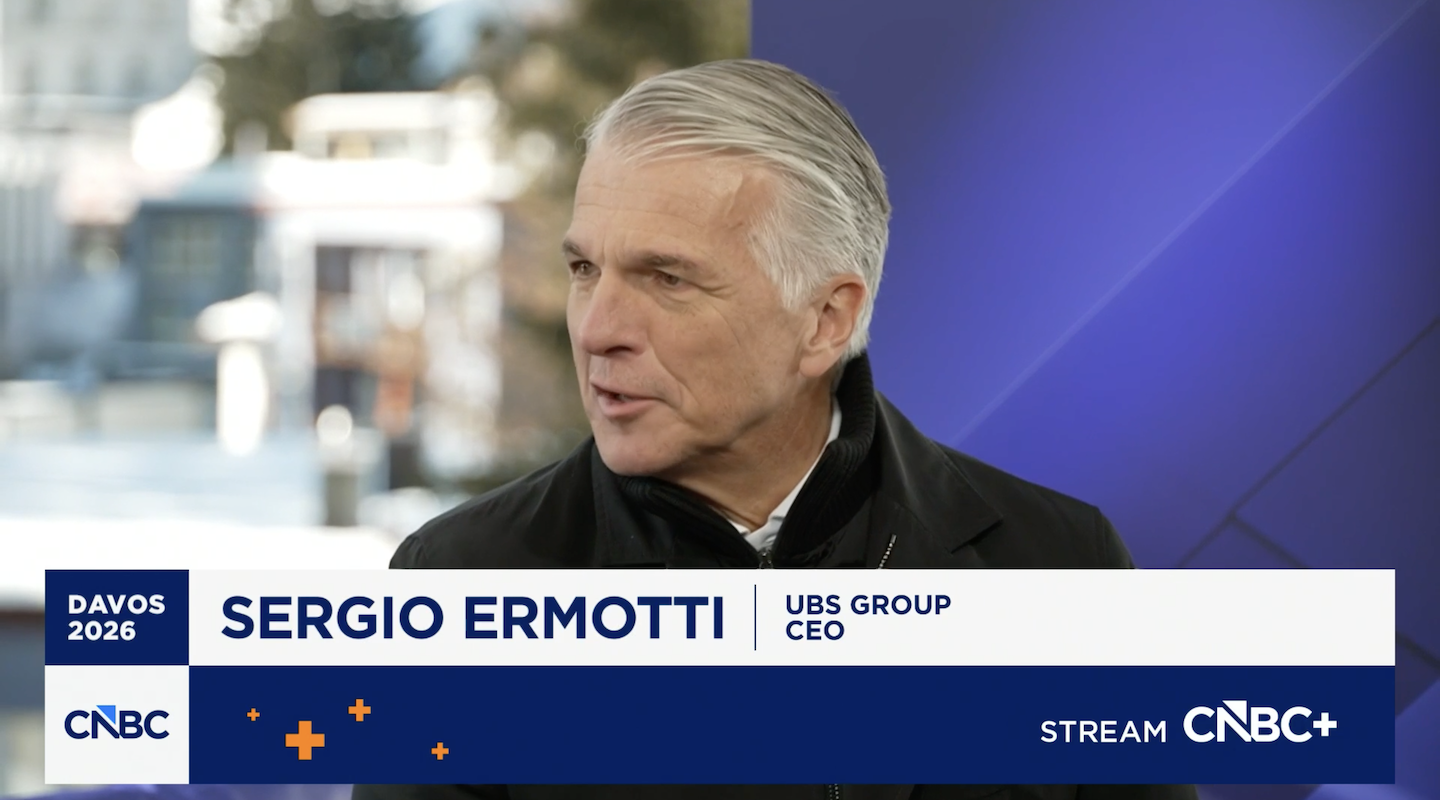
Image source: CNBC UBS Group CEO Sergio Ermotti said in an interview with CNBC that blockchain technology is the future of traditional banking.
He pointed out that a inevitable integration trend will emerge between traditional finance (TradFi) and decentralized finance (DeFi). Ermotti’s view has significantly evolved since 2018, when he saw blockchain merely as a means to improve efficiency. Now, he believes it is an unavoidable structural transformation that could drastically change the cost structure of the industry within 5 to 10 years.
While he remains cautious about the security threats posed by quantum computing, he emphasizes that banks must actively integrate on-chain assets to stay competitive. UBS has invested heavily in recent years in technological R&D, including collaborating with Ant International to test tokenized deposits, utilizing the UBS Digital Cash platform to enable real-time cross-border fund flows, reducing settlement times from days to minutes.
Successful On-Chain Finance Experiments, UBS Deepens Asset Tokenization Applications
Before officially launching trading services, UBS had already accumulated extensive experience in blockchain applications. UBS Asset Management launched a tokenized money market fund built on the Ethereum network in 2024. Additionally, in 2025, the bank successfully executed its first tokenized fund transaction using Chainlink’s digital transfer proxy standard, automating asset issuance and settlement.
Further Reading
A New Era of Cross-Border Payments! UBS Completes Blockchain Payment Pilot, How Will It Change the Financial Landscape?
UBS favors a “partnership model” to promote crypto trading, meaning the bank will collaborate with third-party infrastructure providers to handle trade execution, custody, and compliance, rather than building an internal digital asset tech stack from scratch. This approach effectively disperses balance sheet risk and aligns with the strict risk weight requirements for bank crypto assets under Basel III regulations, fully implemented from January 2026.
Global Regulatory Environment Sees a Turning Point, Policy Reforms and Tech Upgrades Proceed in Parallel
The penetration of cryptocurrencies into the global banking system is largely influenced by regulatory policies. In the US, Donald Trump’s administration pledged to make America the “global crypto capital,” boosting institutional investor confidence. Market attention is focused on the progress of the CLARITY Act, which aims to clarify the market structure and regulatory responsibilities of digital assets. Although the bill faces challenges in the Senate due to competing interests, the trend toward legal regulation is irreversible.
Meanwhile, Switzerland, with its stable legal system and relatively relaxed innovation environment, is attracting many US-based companies seeking banking partnerships. Especially after several crypto-friendly US banks failed in 2022, Swiss banking’s safe-haven attribute has become more prominent. As regulators begin to revisit reserve requirements for banks holding cryptocurrencies, the threshold for traditional financial giants to enter is expected to lower further, paving the way for larger-scale institutional adoption in the future.
Disclaimer: The information on this page may come from third parties and does not represent the views or opinions of Gate. The content displayed on this page is for reference only and does not constitute any financial, investment, or legal advice. Gate does not guarantee the accuracy or completeness of the information and shall not be liable for any losses arising from the use of this information. Virtual asset investments carry high risks and are subject to significant price volatility. You may lose all of your invested principal. Please fully understand the relevant risks and make prudent decisions based on your own financial situation and risk tolerance. For details, please refer to
Disclaimer.
Related Articles
BlackRock deposits 930 BTC and 12,687 ETH into a certain CEX, with a total value exceeding $93 million.
Gate News reports that on March 19, Onchain Lens monitoring showed that BlackRock deposited 930 BTC (valued at $65.48 million) and 12,687 ETH (valued at $27.75 million) to a certain CEX, and may continue to increase deposits.
GateNews29m ago
South Korean Police Plan to Establish Guidelines for Seizing Privacy Coins; Virtual Assets Confiscated Over Past Five Years Valued at 545 Billion Won
The Korean National Police Agency is developing new virtual asset seizure management guidelines, incorporating handling of privacy coins for the first time. The new regulations will clarify software wallet management, address virtual asset custody gaps, and improve law enforcement efficiency. Police plan to designate private custodian institutions, while experts recommend establishing a centralized public custody mechanism to reduce risks. This reform has been prompted by recent Bitcoin theft incidents, driving the management system's transition toward the digital asset era.
区块客34m ago
Yesterday, US Bitcoin spot ETF net outflows were $163.5 million, and Ethereum ETF net outflows were $55.7 million
Gate News reports that on March 19, according to Farside monitoring data, on March 18, US Bitcoin spot ETFs experienced net outflows of $163.5 million, and Ethereum spot ETFs experienced net outflows of $55.7 million.
GateNews1h ago
"Machi Big Brother" Huang Li-cheng Increases ETH Long Position to 11,200 Coins, Currently Down $530,000 in Unrealized Losses
Gate News reported that on March 19, according to HyperInsight monitoring, "Da Ge Ma Ji" Huang Licheng's address just increased his ETH long position to 11,200 ETH (approximately $24.4 million USD), with an average entry price of $2,226.86 USD, currently showing an unrealized loss of $530,000 USD.
GateNews1h ago
Bitcoin Briefly Falls Below $70,000 Mark During Asian Session as Fed Hawkishness and Macro Uncertainty Weigh on Market Volatility
Bitcoin fell below 70,000 on March 19, touching approximately 69,537, reflecting market concerns about the Federal Reserve maintaining high interest rates. Bitcoin subsequently rebounded to around 70,180, demonstrating psychological support at the 70,000 level. Despite improved market fund inflows, cryptocurrencies continue to face challenges amid global macroeconomic pressures, with 70,000 becoming a critical near-term level.
区块客2h ago


