
Tether announces open-source Bitcoin mining system in El Salvador, integrating operational layers and lowering barriers, reshaping the mining industry competition and community sovereignty ecosystem through decentralized architecture.
El Salvador Forum Shock Release, Tether Turns to Decentralized Infrastructure
Leading stablecoin Tether officially ventures into Bitcoin infrastructure industry, announcing at the 2026 Plan ₿ Forum held in El Salvador that its Bitcoin mining operating system (Mining OS) will be fully open-sourced. This move is seen as a strategic shift for the company, which has a market capitalization of over $120 billion, aiming to break the long-standing monopoly of industrial-scale mining operations’ “black box” proprietary software.
Tether CEO Paolo Ardoino announced this news yesterday (2/3), emphasizing that the system has been made available to the global mining community, hoping to reduce entry barriers through transparency and open-source collaboration. This decision continues Tether’s vision proposed last June, when the company advocated that Bitcoin miners should be able to participate in competition without relying on expensive third-party vendors.
Read More
Tether open-sources Bitcoin mining system! Empowering small and medium miners to control their rigs and break the monopoly ecosystem
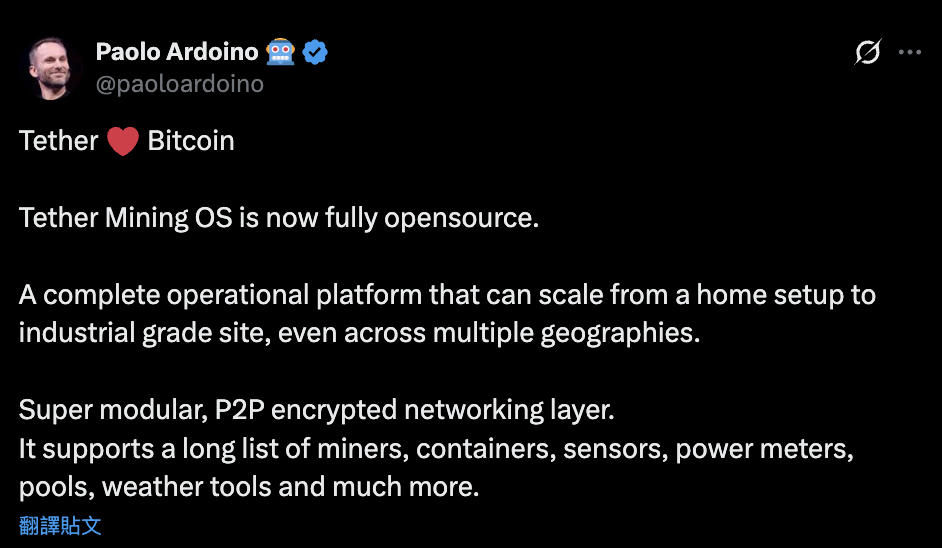
Image source: X/@paoloardoino Tether CEO Paolo Ardoino emphasizes that the system is now open to the global mining community, aiming to lower entry barriers through transparency and open-source collaboration
Unify Mining Nervous System, Integrate Disorganized Hardware Operations
Current mining operations often face software fragmentation issues: hash rate monitoring, power transformer management, and cooling systems usually run on unrelated systems. The emergence of Mining OS provides a single operational layer, described as the “nervous system” for miners, capable of achieving end-to-end complete visualization management. The system covers mining hardware performance, energy efficiency, device health monitoring, and site-level infrastructure management.
Its core technical feature is its self-hosted, peer-to-peer (P2P) architecture built on the Holepunch protocol, ensuring internal communication is encrypted and free from any centralized services, backdoors, or third-party dependencies.
Ardoino points out that Mining OS is highly modular and expandable, allowing both small hobbyists with just a few machines and industrial farms managing multiple regions with gigawatt-scale power to use the same system for efficient management.
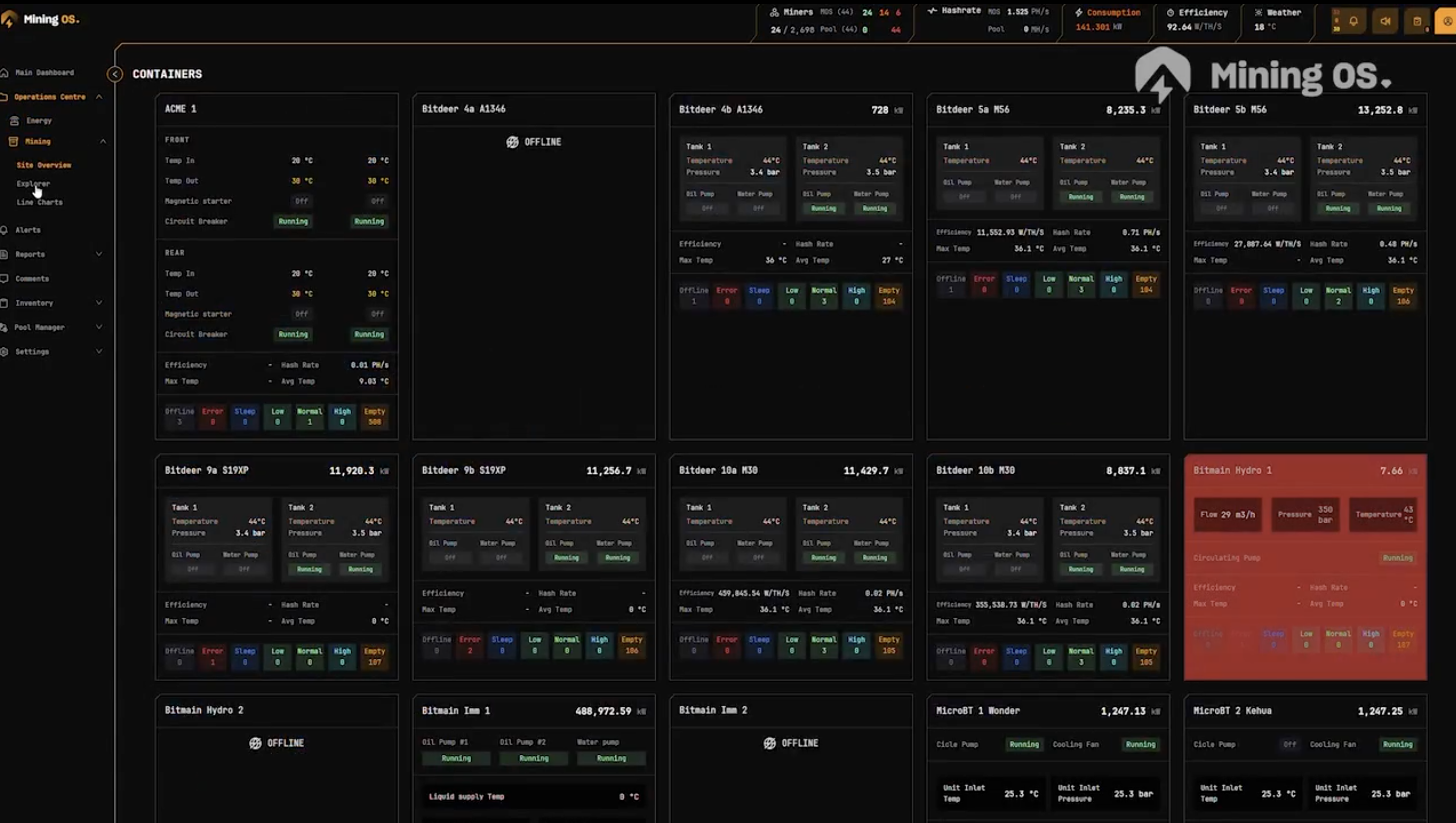
Image source: Mining OS Mining OS interface
Mining SDK Debuts Simultaneously, Lowering Developer Barriers
In addition to the operating system itself, Tether also unveiled the underlying framework supporting Mining OS: Mining SDK. This software development kit offers pre-built modular components (called workers), simple APIs, and UI development tools, enabling developers and mining enterprises to quickly build custom dashboards or internal management tools. The SDK aims to eliminate the need for developers to write infrastructure code from scratch, significantly reducing software development time and costs.
While Mining OS is ready for immediate deployment, the SDK is positioned as a collaborative project, with plans to finalize the version in the coming months in partnership with the open-source community. By open-sourcing the code, Tether hopes to shift the competitive focus of the mining industry from “closed technology access” disputes to a pure pursuit of “operational efficiency,” thereby strengthening the overall resilience of the Bitcoin network.
Rearranged Competition Landscape, Tether Demonstrates Diversification Ambition
Tether’s open-sourcing of Mining OS places it alongside well-known crypto companies like Jack Dorsey’s Block, jointly promoting open-source mining technology.
Notably, Block’s software is mainly optimized for its own hardware, whereas Tether’s Mining OS emphasizes hardware-agnostic compatibility, supporting most infrastructure on the market. This signifies another successful expansion beyond stablecoin $USDT. Looking back at 2025, the company earned over $10 billion in profit and invested heavily in AI, DeFi, tokenized physical assets like gold, and Bitcoin infrastructure development.
With Mining OS licensed under Apache 2.0, miners worldwide can freely use, improve, and optimize this system, further reducing dependence on proprietary software vendors. This is not only a technological advancement but also an important milestone in reclaiming mining sovereignty for the community.
Read more about “Tether” news
Dividing Gold into Smaller Units! Tether Gold Mimics Bitcoin’s “Satoshi,” Introducing Scudo Pricing System
Tether Launches Password Management Tool! PearPass Uses Decentralized Design to Avoid Cloud Data Leaks
Tether to Launch Cryptocurrency Wallet App! Integrates Local AI Assistant, Supports Only Bitcoin and 3 Stablecoins
Disclaimer: The information on this page may come from third parties and does not represent the views or opinions of Gate. The content displayed on this page is for reference only and does not constitute any financial, investment, or legal advice. Gate does not guarantee the accuracy or completeness of the information and shall not be liable for any losses arising from the use of this information. Virtual asset investments carry high risks and are subject to significant price volatility. You may lose all of your invested principal. Please fully understand the relevant risks and make prudent decisions based on your own financial situation and risk tolerance. For details, please refer to
Disclaimer.
Related Articles
Delphi Digital: Sufficient collateral backing for stablecoins does not mean immunity from bank runs; the risk has shifted to the issuer level
Delphi Digital analysis points out that although Tether and Circle's stablecoins are backed by short-term Treasury bills and cash equivalents, they are not completely safe and still face bank run risks. The USDC depegging event in early 2023 demonstrated that stablecoin risks have shifted to issuers, highlighting the dangers posed by their centralization.
GateNews19h ago
Boris Johnson criticizes Bitcoin as a Ponzi scheme, with crypto industry leaders collectively refuting the claim
Former British Prime Minister Boris Johnson characterized Bitcoin as a "Ponzi scheme" and warned investors, particularly elderly individuals, to exercise caution using personal examples. Industry figures such as Michael Saylor quickly refuted the claim, pointing out that Bitcoin lacks a centralized operator, which is a key characteristic of Ponzi schemes. These remarks sparked widespread discussion and reignited controversy over the definition of Bitcoin.
MarketWhisper19h ago
Tether Announces Major AI Breakthrough, QVAC Serverless Intelligence May Usher in Open Source Era
Tether CEO Paolo Ardoino announced that a major breakthrough from the AI division will be released this week, marking progress in decentralized intelligent infrastructure. The QVAC platform aims to enable AI models to run locally on consumer-grade devices with efficient inference and task automation capabilities. Supported by Tether's financial resources, QVAC continues to iterate and involves multiple cutting-edge technologies, though its future breakthroughs still require observation of actual results.
MarketWhisper20h ago
Tether CEO Paolo Ardoino Teases 'True Breakthrough' in Decentralized AI
Tether CEO Paolo Ardoino announced on March 15, 2026, that the company's AI division will release what he described as a "true breakthrough" in the coming week, marking the next phase of the stablecoin issuer's decentralized intelligence strategy.
CryptopulseElite20h ago
Tether hints at a new "AI breakthrough," advancing the decentralized intelligence strategy
Tether's CEO announced a significant AI breakthrough coming soon, following the release of QVAC Workbench 0.4.1. This platform enables on-device AI operation without cloud servers, supported by Tether's substantial profits primarily from U.S. Treasury bonds.
TapChiBitcoin22h ago
Tether Freezes Approximately 11.96 Million USDT on Tron Chain Address
On March 15, Tether froze 11,960,680 USDT on a Tron chain address using the blacklist function of smart contracts. This action typically stems from law enforcement requests related to money laundering and fraud. Over the past several years, Tether has cumulatively frozen more than $4.2 billion in USDT.
GateNews03-15 13:15


