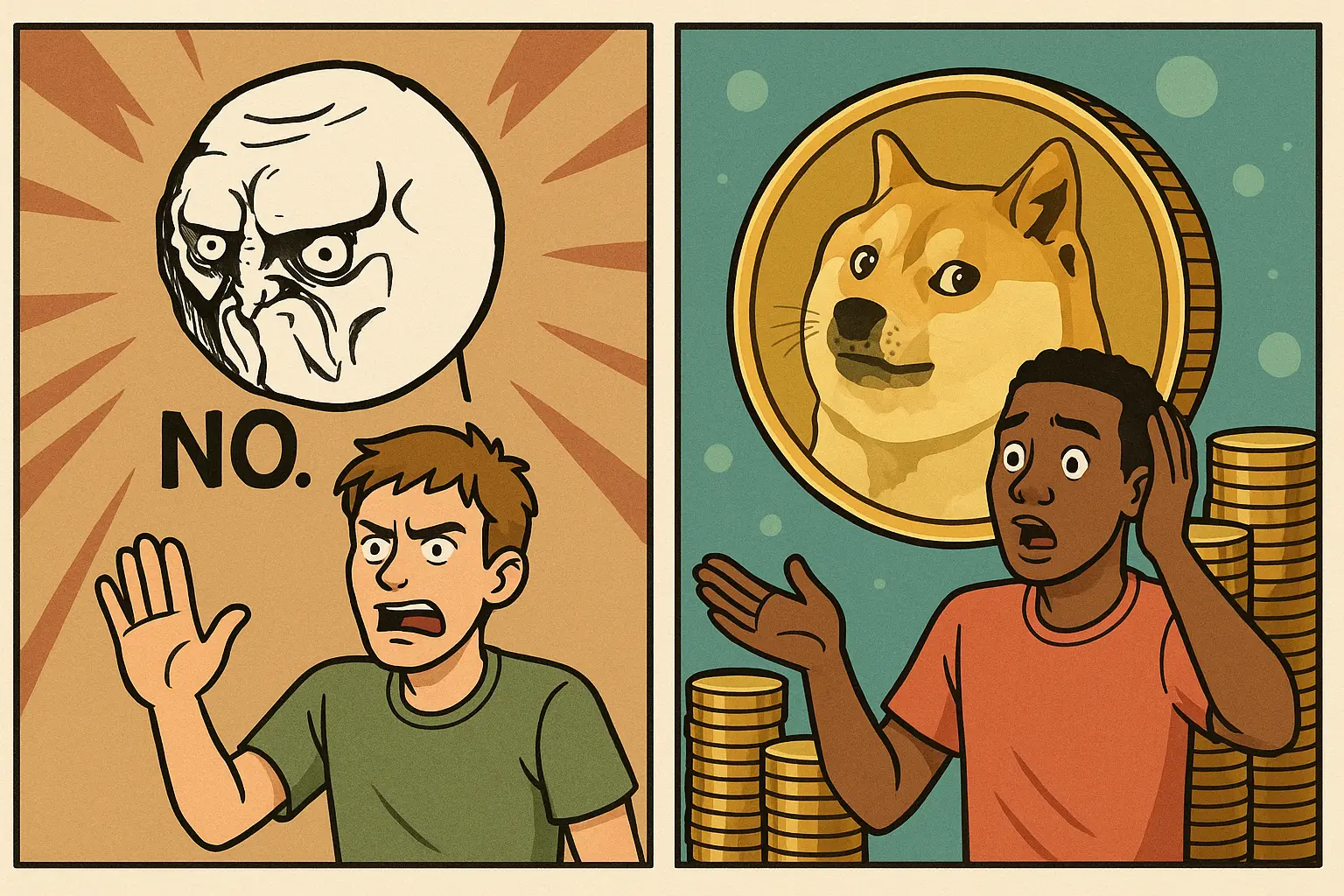
No meme coins are hitting $1—massive token supplies make it mathematically impossible. DOGE at $0.10 has slim chance, while SHIB, PEPE, BONK need 99%+ burns. The “No. rage face” meme created by Chris Farral in 2010 captures investor response to unrealistic targets. Dawgz AI merges memes with AI utility.
The Origin of No Meme: From Rage Face to Market Reality
The No. rage face is image of surly, disgusted face used online to express disapproval or refusal. On August 10, 2010, artist Chris Farral, under username Up2Admin, posted the image that would become known as No. rage face on forum dedicated to Cheat Engine, program used to modify computer games. The drawing depicts face with exaggerated scowl and furrowed brow.
Within year, the image was being incorporated into user-made online comics known as rage comics, where No. face is often used humorously to express irritated disapproval or refusal to do something, often mundane or everyday tasks. Examples include responding to computer prompts to update passwords or mother’s requests for children to take showers. One earliest examples appeared on meme-sharing website Memebase, showing Dora the Explorer saying “say it with me” followed by Farral’s drawing captioned “NO.”
In August 2011, No. rage face was added to site All the Rage Faces, which aimed to catalog faces used in rage comics. A Facebook fan page titled “No! (Rage Face)” appeared. In September 2011, Farral himself posted image on his DeviantArt account with title “Nope.” A comment in December noted user had seen image on videogame subforum of message board site 4chan, underscoring meme’s spread online.
Outside its appearance in online comics, No. rage face is also used in memes and as reaction image, posted to register put-upon displeasure, often in response to basic request or another user’s behavior. Some users write out “No. rage face” for same effect without posting actual image.
The No meme perfectly captures appropriate investor response to unrealistic meme coin $1 predictions: emphatic refusal based on mathematical reality rather than hopeful speculation.
Why Most No Meme Coins Will Hit $1: The Math
Let’s cut the fluff: Most meme coins aren’t touching $1—not today, not tomorrow. Token supplies are massive, the math is brutal, and hype cycles are fleeting. Understanding why requires examining market cap realities that hype-driven communities ignore.
For meme coin to reach $1, its market cap equals its circulating supply multiplied by $1. SHIB has approximately 589 trillion tokens in circulation. At $1 per token, SHIB’s market cap would be $589 trillion—exceeding entire global economy’s GDP of approximately $100 trillion by nearly 6X. This is mathematically impossible without burning 99.9%+ of supply.
PEPE faces similar impossibility. With approximately 420 trillion tokens circulating, $1 PEPE implies $420 trillion market cap. Even if PEPE captured entire crypto market’s current $2 trillion valuation, each token would be worth approximately $0.0000048—still 99.9995% below $1 target.
Why $1 Is Fantasy for Major Meme Coins
SHIB: 589 trillion supply requires $589T market cap (6X global GDP)
PEPE: 420 trillion supply requires $420T market cap (impossible even capturing all crypto value)
BONK: Similar trillion-scale supply creating identical mathematical impossibility
FLOKI: Supply in hundreds of billions making $1 require $100B+ market cap
Without burn mechanisms reducing supplies by 99%+, these tokens cannot approach $1 at any conceivable market cap. The No meme’s disapproving scowl is appropriate response to influencers promoting $1 price targets for these assets.
DOGE: The Only No Meme Coin With $1 Shot
The OG meme coin DOGE hovers at approximately $0.10, still riding waves of nostalgia and Elon-fueled dreams. Remember when it hit $0.73 in 2021? The roadmap to $1 is rocky—but if any meme can do it, it’s DOGE. DOGE has approximately 147 billion tokens circulating. At $1, this implies $147 billion market cap—ambitious but not mathematically impossible.
For context, DOGE’s all-time high of $0.73 represented approximately $107 billion market cap. Reaching $1 would require only 37% additional capital inflow beyond that previous peak. With Elon Musk’s continued endorsements, potential Dogecoin payments integration at X (formerly Twitter), and established brand recognition, DOGE represents the only major meme coin where $1 remains plausible rather than fantasy.
All DOGE needs is market frenzy, mass adoption, and maybe one more tweet from you-know-who. The combination of reasonable supply, established brand, influential supporters, and potential utility creates path to $1 that other meme coins lack. However, even DOGE faces significant hurdles—$147 billion market cap would place it among top 10 cryptocurrencies, requiring sustained buying pressure and fundamental catalysts beyond memes.
SHIB, PEPE, FLOKI, BONK: Big Brands, Impossible Math
Big brands. Loyal armies. But let’s be real—$1 is fantasy for these coins without burn mechanisms or tokenomics reform. Still, don’t sleep on the pumps. These coins can move fast, crash hard, and repeat like clockwork. The No meme’s disapproving face applies to $1 predictions, but short-term trading opportunities exist for those understanding volatility patterns.
SHIB occasionally implements burns through community initiatives and transaction fees, but the scale remains insufficient. Even burning billions of tokens weekly barely dents 589 trillion supply. For meaningful impact, SHIB would need to burn 99.9% of supply—reducing circulation to approximately 589 billion tokens to make $1 mathematically feasible at $589 billion market cap.
PEPE lacks any systematic burn mechanism, relying purely on speculative trading and meme virality. Without supply reduction or revolutionary utility justifying hundred-trillion-dollar valuations, PEPE’s path to $1 is closed. However, PEPE can still deliver significant percentage gains during bull markets—moving from $0.000001 to $0.00001 represents 10X gain without approaching $1.
FLOKI and BONK face identical mathematical constraints. Their loyal communities and aggressive marketing create periodic pumps, but these moves occur within ranges far below $1. Traders can profit from volatility without believing unrealistic price targets. The key is recognizing the difference between trading opportunities and long-term investment thesis.
Dawgz AI: No Meme Evolves Into Utility
Enter the next generation: meme coins with real utility. Dawgz AI is merging meme culture with AI trading tools, staking, and utility. It’s bold, it’s risky—but it’s fresh blood in wild market. This represents evolution beyond pure No meme coins toward hybrid models combining meme marketing with functional products.
The Dawgz AI model acknowledges that meme branding alone is insufficient for sustained value creation. By integrating AI-powered trading signals, automated portfolio management, and staking rewards, the project attempts building revenue-generating utility that justifies valuation beyond speculative meme premium. Whether execution matches ambition remains uncertain, but the approach represents necessary evolution.
Other projects are attempting similar pivots. Meme coins launching in 2025-2026 increasingly include DeFi integration, NFT ecosystems, or gaming utility from day one rather than adding utility as afterthought. This reflects market maturation—investors burned by pure meme plays now demand fundamental value propositions alongside meme marketing.
However, skepticism is warranted. Many “utility meme coins” deliver underwhelming products that fail attracting users beyond token holders. The AI trading tools space is particularly saturated, with hundreds of projects competing for attention. Dawgz AI must execute exceptionally to differentiate, and most projects in this category fail despite good intentions.
The Brutal Investment Reality: Just Say No
Bottom line: Meme coins don’t play by rules. The $1 dream? It’s mostly hopium—but hype, timing, and community can create magic. Just remember the three cardinal rules:
Essential Meme Coin Investment Rules
Don’t FOMO: Resist urge to chase pumps after coins already 10X’d; most late entrants become exit liquidity
Stay Sharp: Monitor social sentiment, whale wallet movements, and exchange listings for early signals
Never Invest What You Can’t Lose: Assume total loss is possible; allocate only risk capital to meme positions
The memes are fun. The moves are real. And next big pop? It’s always just one tweet away. However, building wealth through meme coins requires treating them as short-term trades rather than long-term investments. The No meme’s disapproving face should appear in your mind every time someone promises “$1 SHIB” or “PEPE to the moon.”
Professional traders approach meme coins with strict risk management: 1-5% portfolio allocation maximum, predetermined exit strategies regardless of emotional attachment, and willingness to take profits during pumps rather than holding for unrealistic targets. This discipline separates profitable meme traders from bag holders left after hype cycles fade.
When to Use the No Meme Response
The No. rage face remains relevant 16 years after creation precisely because it captures universal human experience: emphatic refusal to engage with absurdity. In crypto context, the No meme applies to numerous scenarios:
Someone claims SHIB will hit $1 without acknowledging $589 trillion market cap requirement? No meme. Influencer promotes new meme coin as “guaranteed 1000X”? No meme. Project promises revolutionary utility but launches with no working product? No meme.
The face’s exaggerated scowl and furrowed brow perfectly express the irritation serious investors feel toward crypto’s most absurd claims. Rather than engaging in lengthy explanations of why something won’t work, posting No meme communicates dismissal efficiently and humorously.
The Bugs Bunny No Meme Variant
The Bugs Bunny No meme template shows zoomed image of his face with white text “No” falling out of his mouth. He has very emphatic, almost lazy expression on face. This meme is perfect for any situation when you know answer is “No” and you feel like Bugs Bunny in this image.
The Bugs Bunny variant adds layer of exhausted dismissal beyond the original rage face’s anger. Where the No. rage face expresses irritated disapproval, Bugs Bunny’s version conveys weary refusal—the tiredness of explaining obvious truths repeatedly. In crypto context, this captures veteran investors’ exhaustion explaining to newcomers why their favorite meme coin won’t reach $1.
Both variants serve similar functions: providing visual shorthand for “absolutely not” that communicates more effectively than paragraphs of explanation. Just say no, kids. Then share the No meme with friends promoting unrealistic meme coin targets.
The Smart Play: Selective Meme Exposure With Realistic Expectations
The No meme shouldn’t mean avoiding meme coins entirely—it means approaching them with eyes open. DOGE at $0.10 with path to $0.73 previous high represents 7X potential without requiring belief in $1 fantasy. SHIB, PEPE, and others can deliver 2-5X during bull market pumps without approaching their unrealistic community price targets.
The winning strategy treats meme coins as momentum trades with strict risk management rather than long-term holds with delusional price targets. Buy the dip, ride the pump, take profits on way up, and don’t look back when selling. The No meme applies to the “$1 dreams” but not to the legitimate trading opportunities these volatile assets present.
For those seeking meme exposure with better fundamentals, investigate utility-meme hybrids like Dawgz AI that at least attempt building revenue beyond pure speculation. These projects may fail, but they represent evolution beyond pure No meme territory toward potentially sustainable models.
FAQ
What is the No meme?
The No meme originated from the “No. rage face” created by artist Chris Farral in 2010, depicting a surly, disgusted face with exaggerated scowl used online to express emphatic disapproval or refusal. It spread through rage comics and became reaction image for dismissing absurd requests.
Will DOGE hit $1?
DOGE has most realistic path to $1 among major meme coins, requiring $147B market cap versus its $107B previous peak. With Elon Musk support and potential X payments integration, $1 is plausible but not guaranteed. Other meme coins face mathematical impossibility.
Why can’t SHIB reach $1?
SHIB has 589 trillion tokens. At $1, its market cap would be $589 trillion—6X larger than entire global economy’s GDP. Even with aggressive burns, reaching $1 is mathematically impossible without reducing supply by 99.9%+.
What does “No meme” mean in crypto?
In crypto context, “No meme” represents reality check against unrealistic price predictions. It’s the appropriate response when someone claims trillion-supply tokens will hit $1 or promises “guaranteed” returns without mathematical basis.
Are meme coins good investments?
Meme coins are high-risk speculative trades, not investments. They can deliver explosive short-term gains during hype cycles but typically crash 80-90% afterward. Only allocate capital you can afford to lose completely, treat as momentum trades, and take profits during pumps.
What are utility-meme hybrids?
Projects like Dawgz AI merging meme branding with actual products (AI trading tools, staking, DeFi integration). These represent evolution beyond pure memes toward potentially sustainable models, though most still carry extreme risk.


